Showing posts with label movie review. Show all posts

Saturday, February 19, 2011

"Iron Jawed Angels" and seeking shalom

I watched "Iron Jawed Angels" last night, the film about Alice Paul and the Women's Suffrage movement.

It is a poignant film, oddly relevant to the world I normally live in, the world of the Palestinian struggle for freedom from Israeli occupation, and the ambivalence of Arab and Muslim countries to the U.S. wars in Iraq and Afghanistan, and talk about exporting freedom and democracy to the rest of the world.


To me, there were several powerful themes in this story:


How those in power resist change to the status quo, even if such change seems obviously in line with their values.


 How bringing about change takes massive and sustained effort and sacrifice on the part of those seeking it. It would have been much more “comfortable” for the suffragettes to simply accept and work within the status quo. To be willing to push the confrontation to the point of arrest and being sent to the work house, and pursuing a hunger strike, took incredible courage and commitment.


That those seeking to change injustice must act now and not wait. President Wilson kept telling the women to “be patient…”  We see the hypocrisy of those in power knowing that something is right, but maintaining somehow that “this is not yet the time” (made me think of the slave owner founders, who could see that one day slavery would be done away with, but “not yet”). There comes a time when you can’t “be patient,” if you believe in human dignity and rights.

White House protestThat significant change requires a disruption of the social order. It takes making people uncomfortable.

How easy it is for those in power to be duplicitous – the women were quoting President Wilson’s own words, which he was trumpeting to Americans and to the world, but refusing to apply to half of his own population.

How easy it is for the majority (in this case men, and many women), who have their rights or at least basic comforts, to sit back and do nothing on behalf of those who do not have those same rights.

How a government can participate in the hypocrisy of proclaiming values abroad (democracy, freedom, etc.) while denying them to people at home.
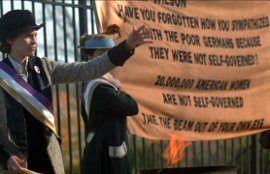
Hilary Swank as Alice PaulHow easy it is to abuse power – arresting the women for no good reason, finding them guilty under sham pretenses, sending them to the work house for 60 days (for “blocking traffic”!), mistreating them in the workhouse, psychiatric exam for undertaking a hunger strike (and the President’s men wanting to have Alice proclaimed crazy because of that), forced feeding, etc. And this was against law abiding, upstanding citizens, whose fault was that those in power hated what they were doing to try to bring about change.

So what does working for social change, for freedom and equality and basic rights, have to do with “peace”? I can imagine some (at least those in support of the status quo) arguing that this kind of movement disturbs the peace, works away from peace. The Hebrew word for peace, shalom, is a comprehensive word meaning completeness, wholeness, health, peace, welfare, safety, soundness, tranquility, prosperity, perfectness, fullness, rest, harmony, the absence of agitation or discord. I would argue, then, that although it might temporarily disturb the “peace” to work for rights and justice, the work (especially if done nonviolently, which the women’s suffrage movement was) is toward a greater peace; because as long as members of society, members of humanity, are deprived of basic rights and dignity, there is no true shalom, not for them, and not for the rest of us.

Monday, January 25, 2010

The Boy in the Striped Pajamas

This is an old post, from November, that I somehow failed to publish:

I watched The Boy in the Striped Pajamas tonight. Overall, not sure what I think of it. Some of the greatest horrors in history, seen from a child's uncomprehending perspective.

The brightness of the leaves, the beauty of the piano, all leading to what? An accidental death? A German child burned to death with his Jewish friend? So that his parents can learn a lesson? Can experience the reality of the horror?

The one part that really got to me was the beginning. The haunting paradox of the idyllic German household and the liquidating Jewish ghetto. Of living a normal life, a simple life, oblivious to the horrors taking place within your country's borders.

Looking back, how would you make sense of it? The decaying monstrosity that had taken place while you had been happy, while life had been normal. How do you recover from such an awakening?

Monday, January 5, 2009

Children Speak about Gaza

Here's a video clip about Gaza BEFORE the recent violence. I still find it rather applicable.

Part of the clip shows interviews with Palestinian children. One boy asks: "Could you live here? Could you? You couldn't because conditions are horrible ["difficult"/"hard"], and you'd be terrified whenever the missiles strike and the walls begin to crack."

Another child recounts the experience of being under fire: "The shelling struck the window, everything broke and got burnt. Why did they break my things? And break my toys? . . . We threw it all in the garbage . . . the food we eat smells like gas. We don't want to get rid of our clothes, even though they smells like gas . . . let the Israelis come and smell our clothes and see our home."

The clip (which can also be found at Behind the Lines: Poetry, War, and Peacemaking) is originally from the documentary Occupation 101: Voices of the Silenced Majority. The film is the winner of multiple awards from various film festivals (including Best Film and Best Documentary), and has a very impressive list of experts interviewed.

"The greatest enemy of knowledge is not ignorance . . . it is the illusion of knowledge."
-Stephen Hawking.

Wednesday, July 16, 2008

Schindler's List

I put my hand over my mouth.
I tremble in silence

for the absence; for the ash
for the scalding, burning,
grief of remembrance

I put my hand over my mouth.

* * *

"The list is an absolute good. The list is life. All around its margins lies the gulf."

I watched it again today: Schindler's List. It's very possibly the most powerful movie -- the most powerful story -- I've ever encountered.

And it's true.

I'm overwhelmed by the weight again. The horror. Who am I to say this is wrong, or this is right? Who am I to say anything at all?

The furnaces. The ghetto. The children. And a man crying for one more life. Just one more.

May God forgive me for my arrogance.

"He who saves a single life, saves the world entire."

Monday, March 17, 2008

a last thought on perfection

And one last thought, before I call it quits for the evening. I went to see Penelope last night, with a few roommates. It was light and fun—a fairytale story about a daughter born cursed, and bearing a pig's snout. Her family (most notably her mother) spend their lives trying to protect her, and living for the day when the spell will be broken (supposedly on the event of her marriage to a "blue-blood"). Penelope, on the other hand, goes on a journey of self-discovery and acceptance. Acceptance of herself for who she is, nose and all (she is continually reminding her mother "but it is my nose").

The disturbing thing about all of this, is that even as the movie is attempting to spread the message that beauty is not about society's standards, it ultimately buys into the system and presents us with a perfect Penelope. Because perfect is the only way to be beautiful, no matter what we may want to believe.

Grrrr . . . .

I'm not sure how well I'm saying this, or how much sense I'm making.

In The Poisonwood Bible, by Barbara Kingsolver (a book I'd definitely recommend for its fascinating look at/critique of culture, missions, gender, and Africa), Adah, a one-time cripple who's been healed by modern medicine, puts it this way:
"If you are whole, you will argue: Why wouldn't they rejoice? Don't the poor miserable buggers all want to be like me?

Not necessarily, no. The arrogance of the able-bodied is staggering. Yes, maybe we'd like to be able to get places quickly, and carry things in both hands, but only because we have to keep up with the rest of you, or [bear the consequences]. We would rather be just like us, and have that be all right.

How can I explain that my two unmatched halves used to add up to more than one whole? In Congo I was one-half benduka the crooked walker, and one-half benduka [two dots on the "e"], the sleek bird that dipped in and out of the banks with a crazy ungrace that took your breath. We both had our good points. Here there is no good name for my gift, so it died without a proper ceremony" (p. 493).
Does anyone understand what I'm driving at?

Tuesday, March 4, 2008

West Bank Story on iTunes

It appears you can also download West Bank Story from the iTunes store for $1.99.

Monday, February 18, 2008

West Bank Story

One film that is VERY much on my "to see" list is West Bank Story. The Academy Award winner for best live-action short of 2006, it's a 21 minute musical comedy based on West Side Story.

Here's a plot summary from one online article:
It’s Shakespeare on the Jordan River when two star-crossed lovers are forced to battle traditional Israeli-Palestinian conflicts with two unusual weapons - music and comedy - in the short film West Bank Story. The plot centers around David, an Israeli soldier, and Fatima, a beautiful Palestinian cashier, who are caught in a running feud between their families’ competing falafel stands in the West Bank. The film’s even-handed humor and insightful gags are specifically designed to break open old prejudices and allow audiences to see the potential for a peaceful outcome in the Middle East, which is often dogged by seemingly endless controversy.

. . .
[Writer/director Ari] Sandel and his creative team believed that the film’s success would hinge on its even-handed portrayal of Jews and Arabs in every aspect of the filmmaking. This balance included the number of jokes made at each groups’ expense, the number of real-life Arabs and Jews in the cast, and the number of shots that featured each of the characters. Even the music features an equalizing blend of Palestinian-style rhythms, Jewish Klezmer sounds, and American Broadway musicals.
To see a trailer for the film, hear some of its music, and buy a copy, visit www.westbankstory.com. A portion of the proceeds will go to these two charities:

Hand in Hand schools seek to spark revolutionary change in Israeli education and society by establishing a new educational paradigm: integrated, bilingual schools where Jewish and Arab children and their families learn and grow together. Hand in Hand's mission is to catalyze the creation of a network of integrated schools around the country, providing Jewish and Arab parents the option to send their children to schools where they can learn and interact with all their neighbors.

The Parents' Circle - Bereaved Families Forum is nearly 500 Israeli and Palestinian families who have lost loved ones in the conflict. Yet they reject violence, traveling and speaking side by side to call on both peoples to reconcile in the spirit of peace. Always Arab and Jew together, they facilitate classroom Dialogue sessions in high schools, promote the "Hello Peace" telephone chat line for communication between Palestinians and Israelis, hold a summer camp for the children, and tour the Middle East and North America creating hope in the hearts of both peoples.

Go here to watch the first 4 minutes of the film.

Friday, November 16, 2007

Munich the Movie: Not the Full Story

I have issues with Steven Spielberg's 2005 film Munich. But I'm not quite sure why. It isn't that the movie is irrationally pro-Israel. On the contrary, the picture it paints of the violence condoned by the Israeli government is appalling. But at the same time, I'm loath to recommend it at as a balanced look at the Palestinian-Israeli conflict.

I think my feelings are due to the lack of Palestinian voice. The perspective on Israel may not be extremely positive in the film, but it still manages to be an Israeli perspective. An Israeli voice.

The movie deals with the affect of violence on the Israelis who partake in it. How it eats away their humanity, and destroys who they are. But the violence itself is rationalized (after all, these are terrorists). It isn't an issue of whether the Palestinians deserve to die; it's an issue of whether the cost of killing them is too high on the Israelis who have to do the dirty work. The full humanity of their struggle is well portrayed. But where is the corresponding humanity of the enemy? Of the Palestinians? I would argue that it's not truly present.

Of course, there are limits to what can be conveyed in a single film. The purpose of this movie was never to tell the Palestinian side of the story. It was to show a different element of the Israeli side. And it does that. Well. I just can't help feeling that it doesn't say enough. That it stops too far short of the mark.

So if you want the full story, don't look to Spielberg to help you. But if you're on a continuing journey of discovery, maybe this is a valid stop along the way.

However, be warned: Munich has issues beyond the plotline. If you plan to see the film, be prepared for extreme violence and very disturbing content.