Showing posts with label the wall. Show all posts

Sunday, February 27, 2011

How ethnocentrism hinders peace (part 1) - denial of difference

One of the most useful intercultural tools that I’ve come across is Milton Bennett’s “Developmental Model of Intercultural Sensitivity” (DMIS), which considers the process of growth that people experience as they encounter cultural difference.*

In Bennett’s model, people grow from an experience centered in ethnocentrism – seeing and experiencing the world only from the perspective of one’s own people and cultural context – to an experience that he calls “ethnorelativism,” which involves developing the ability to know one’s own culture and worldview as one among many, and the ability to enter into the world of others, adapt, and live effectively in that other cultural context.
 
As I consider conflict and the challenge of pursuing peace, I find myself reflecting on insights from the DMIS to the process of seeking peace (whether in the Palestinian-Israeli conflict, Muslim-Christian relations, or any realm).

How Denial hinders peace

The first phase in the DMIS is denial (ignorance, lack of awareness). We begin by not being aware of (cultural) difference, and avoiding it. The world simply is as we see and experience it. We are “the people” (and any others are beyond our clear vision or understanding). If we are aware of others, they are broadly characterized, e.g., we lump all “Asians” or “Africans” or “Europeans” together, with no real knowledge of any specific characteristics.

Denial may be accompanied by isolation, simply being out of contact with different others, or by separation, “intentional erection of physical or social barriers to create distance from cultural difference as a means of maintaining a state of denial” (e.g., racial neighborhoods or ghettos). Denial is often accompanied by extreme nationalism. The “dangerous underside” of denial, Bennett points out, is the implicit relegation of others to subhuman status (e.g., the Nazi treatment of the Jews).

Most of the peace activists I have read, point out that peace is more than the absence of conflict. True peace between peoples involves building something positive, building relationship, developing understanding and coexistence and harmony between peoples. For peace, we need more than different peoples simply staying away from and ignoring each other, and seeking to avoid entering into conflict. We need more than walls keeping us apart.

Thus, this stage of denial hinders peace, because when we live in isolation in our own world, thinking that we are the only real people, and that the world is just as we see it to be, we are not living in relationship or harmony with others. If we want peace, we cannot be content with denial of difference (either isolation or separation).
                 
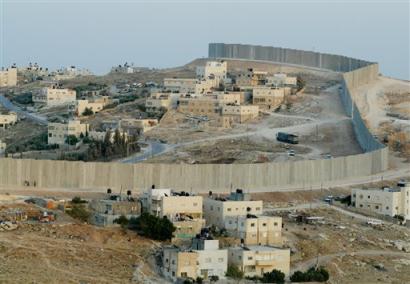
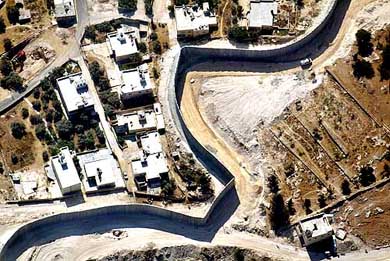
And seen in this light, the actions of the Israeli government since the two intifadas, attempting by all possible means to separate the Palestinian from the Jewish people, with the ultimate step of building a “separation barrier” (or, as Palestinians refer to it, an “apartheid wall”), represent steps away from, not toward, peace. A generation of Palestinian young people is growing up now, whose only contact with Israeli Jews is with soldiers (at checkpoints and in other situations). And the same on the Israeli side (Israelis are prohibited by Israeli law from entering Palestinian controlled “zone A” areas).

 
We cannot stay apart, and find peace. We cannot live as if others do not exist, and find peace. We cannot feed ourselves the myth that we are right, that God is on our side, that we are “the people” and that all others are just vaguely “out there” in the darkness beyond the borders of our world, and find peace.

If we want peace, we must move beyond the ethnocentric stage of denial.

(Coming next: how defense hinders peace) 


*For full treatment of Bennett’s model, see
Bennett, Milton J., “Towards Ethnorelativism: A Developmental Model of Intercultural Sensitivity.” In Paige, R.M. (Ed). (1993) Education for the Intercultural Experience (2nd ed., p. 21-71). Yarmouth, ME: Intercultural Press.

Bennett, Milton J., “Becoming Interculturally Competent.”  In Wurzel, Jaime S., ed., Toward multiculturalism: A reader in multicultural education (2nd ed., pp. 62-77). Newton, MA: Intercultural Resource Corporation, 2004.

Friday, July 2, 2010

Trip Reflections by the President's Wife

I've mentioned (I think) that my most recent trip into Israel and the Occupied Territories was taken with a group from the university where my father teaches (Bethel University in Minnesota).  Here is a concise, but beautiful, reflection on that trip by Barb Barnes, the wife of Bethel's current president (Jay Barnes).  Barb has a heart that is filled with both joy and compassion, and I was incredibly blessed by her presence on the trip

Reflections On Our Trip to Israel
Publication date: Jun 28, 2010 9:34 p.m.
Guest contributor Barb Barnes 
Wall between Israel and Palestine

Five others from Bethel joined Jay and me for seven days in Israel and Palestine. While we were able to see some of the biblical sites, the purpose of the trip was to learn about the current situation there and to explore the possibility of a study abroad program for our students. I am grateful for the safety and good health for everyone while we were there and for an experience of profound learning.

While in Bethlehem (in the West Bank) we stayed with Christian families. It was good to see a faithful Christian presence remaining in spite of the hardships and the exodus of Palestinian Christians to other parts of the world because of the difficult conditions that limit employment and personal freedoms.

Here are a few initial reflections on the week, with more to follow later in a post from Jay.

Incredible conflict exists in the land of Jesus’ birth.

I believe God mourns.

The wall (pictured above) is a constant reminder of many lost freedoms.

I believe God mourns.

For more than 60 years people have lived in poverty in refugee camps.

I believe God mourns.

Apartheid has become a way of life.

I believe God mourns.

Extreme disproportional distribution of resources, such as water, exists.

I believe God mourns.

Hundreds of villages have been demolished to make room for settlements.

I believe God mourns.

Human rights violations occur daily.

I believe God mourns.

The Christian population is declining as many are leaving to avoid persecution.

I believe God mourns.

People on all sides of this conflict have inflicted great harm.

I believe God mourns.

Beth, a recent Bethel grad is working in a Palestinian village, bringing hope and God’s love to the people there.

I believe God rejoices!

I realize there are other perspectives and political realities that go beyond my statements, but our hearts were broken and our minds were stretched by what we saw. We have a different sense of what it means to "pray for the peace of Jerusalem.” We are thankful that Bethel’s reconciliation studies major prepares students like Beth to change the world.

Monday, February 23, 2009

"The Novelist in Wartime"

Japanese author, Haruki Murakami, recently received the Jerusalem prize, Israel's highest literary prize for a foreign author.

In "The Novelist in Wartime," Murakami's reflection on the experience, the author wrestles with his decision to accept an award from a country so mired in controversial military tactics. He states that he does not support any war, and yet, he does not believe that disengaging from communication is the answer: "I chose to come here rather than stay away. I chose to see for myself rather than not to see. I chose to speak to you rather than to say nothing."

However, Murakami goes on to give a passionate plea for the downtrodden and oppressed. For the egg thrown against a wall:
Please do allow me to deliver one very personal message. It is something that I always keep in mind while I am writing fiction. I have never gone so far as to write it on a piece of paper and paste it to the wall: rather, it is carved into the wall of my mind, and it goes something like this:

"Between a high, solid wall and an egg that breaks against it, I will always stand on the side of the egg."

Yes, no matter how right the wall may be and how wrong the egg, I will stand with the egg. Someone else will have to decide what is right and what is wrong; perhaps time or history will decide. If there were a novelist who, for whatever reason, wrote works standing with the wall, of what value would such works be?

What is the meaning of this metaphor? In some cases, it is all too simple and clear. Bombers and tanks and rockets and white phosphorus shells are that high, solid wall. The eggs are the unarmed civilians who are crushed and burned and shot by them.

This is not all, though. It carries a deeper meaning. Think of it this way. Each of us is, more or less, an egg. Each of us is a unique, irreplaceable soul enclosed in a fragile shell. This is true of me, and it is true of each of you. And each of us, to a greater or lesser degree, is confronting a high, solid wall. The wall has a name: it is "the System." The System is supposed to protect us, but sometimes it takes on a life of its own, and then it begins to kill us and cause us to kill others -- coldly, efficiently, systematically.

I have only one reason to write novels, and that is to bring the dignity of the individual soul to the surface and shine a light upon it. The purpose of a story is to sound an alarm, to keep a light trained on the System in order to prevent it from tangling our souls in its web and demeaning them. I fully believe it is the novelist's job to keep trying to clarify the uniqueness of each individual soul by writing stories -- stories of life and death, stories of love, stories that make people cry and quake with fear and shake with laughter. This is why we go on, day after day, concocting fictions with utter seriousness.

I have only one thing I hope to convey to you today. We are all human beings, individuals transcending nationality and race and religion, fragile eggs faced with a solid wall called the System. To all appearances, we have no hope of winning. The wall is too high, too strong -- and too cold. If we have any hope of victory at all, it will have to come from our believing in the utter uniqueness and irreplaceability of our own and others' souls and from the warmth we gain by joining souls together.

I find it hard to believe that the metaphor of a wall, in a country that has surrounded itself with concrete and barbed wire, is just coincidence.

Tuesday, January 20, 2009

MLK and the Separation Barrier


I already posted this in the previous post, but since it's in the middle of Dr. King's letter, I wasn't sure how many would actually find it. So I'm reposting it here. =)

Perhaps more than any other element of his article, this statement brings Israel and Palestine hauntingly to mind:

"Segregation, to use the terminology of the Jewish philosopher Martin Buber, substitutes an I-it" relationship for an "I-though" relationship and ends up relegating persons to the status of things...Paul Tillich said that sin is separation. Is not segregation an existential expression 'of man's tragic separation, his awful estrangement, his terrible sinfulness'?"

"An unjust law is a code that a numerical or power majority group compels a minority group to obey but does not make binding on itself. This is difference made legal."

Monday, July 14, 2008

Bethlehem: the things that made me cry [the Intercontinental]


The hotel sits empty. White stone and glowing candle light.

Survivor of two world wars and a hundred years of human history, it contains an elegance that only age can bring. A grace earned by living. By surviving.

Inside, the night smells of jasmine. Running water. Bright hibiscus. Beauty within walls. In the face of perseverance.

The ceilings are high. Chandeliers and Arab glass. Art and carved stone.

Each table setting is ready. Waiting. Blue goblets, elegant silver, fine china.

But there is only silence.

How does one carry on? Keep waiting, day after day.

Is it through faith? Or hope? Or love?


What grants this kind of courage? To maintain beauty in the midst of nothingness? To prepare each table every night, when no guests come?

For who would want the hassle? Six hours in line to come to the West Bank, when it is so easy, so simple, to stay on the Israeli side. To see only what the soldiers tell you to. Want you to. To know nothing of Palestinian courage. Of beauty that defies violence.

If Christ can be manifest in a building, he was there that night, at the Intercontinental. There in the relentless clinging to hope -- the rejection of despair. There in the waiting and the faith.

Bethlehem: the things that made me cry [the woman and her plums]

A woman selling plums. Sitting in the dirt, with her beautiful Palestinian brocade. The traditional garment of a loving, laughing, people.

Our guide calls her 'haji' -- a term of respect. A recognition of her age. Of her dignity.

He asks her where she's from. She tells him the name of her village. A village cut off by the wall. She shows us her plums. Picked that day from her trees. Her beloved trees, growing on land that was always hers. Now separated by concrete and guards.

She had so many once. Trees growing strong and tall. Now there are only two.

She stood in line for hours. To exit the gate. To pick her fruit. To return and sell them here, in the dirt. She does it every day, she says. It's a long process; a hard fight. But what is she to do? The trees are all she has.

Like children, they are loved for being hers. For existing.

We turn to leave. She presses the dark plums into our palms, like a blessing.

Or a prayer.

Sunday, July 13, 2008

Exclusion and Embrace: the Mechanics of Oppression

This poem is a somewhat-companion to my last post. Though rather flawed, the element that really struck me when I first read it -- and that continues to strike me -- is the theme of distance. And how distance breeds hate and violence. Without human contact, it's easy to stop believing in the humanity of the other. And when the other is not human, or at least not as fully human as you believe yourself to be, oppression ceases to be difficult.

It is for this reason that the separation barrier is so terrifying.

Another note: Shepherdson states "Faceless voices make demands/ Travellers scarce could hear." We found this VERY true, and very odd, on our recent trip to Jerusalem and Bethlehem. At checkpoints, guards sit in glass boxes, far removed from the traveler, and it is almost impossible to hear their instructions. We pondered the reason for this on our trip, but couldn't seem to understand. It's inefficient and extremely frustrating. However, it does serve one purpose: it separates the Israeli from the Palestinian, and keeps contact and communication to a bare minimum.

As one (Arab?) proverb states: what we do not know, we fear; what we fear, we hate.

ERETZ

Concrete-clad confinement cells
Iron rails and turn styles
Sheds and bars and wire and rocks
Line the lonely mile

Faceless voices make demands
Travellers scarce could hear
Distance, planned, enforces space
No human contact near.

Compassion, bred from guarding eyes
Purely duty calls.

Withdraw the contact of the eyes
In airport hanger halls
And men become a processed part.

Without this window on human hearts
It's easier to number us
Than face, the hurt, the pain, the loss of those who
mirror now the past
To those descended from Holocaust

Yet surely some must wonder
As they rend Arab homes asunder
Why they comply in genocide
Of Palestinian hearts and mind.
And surely some who've heard the tales of apartheid
And Robyn Island jails
Must question in their silent hearts
Why scraggy donkeys pull decrepit carts
On dusty roads and potholed 'mac
The poor, who break their ragged backs, and
Cling to Gaza's desert tracks, their homeland?

And surely we must question why
This land turns into nibbled cheese
And check points fear and barricades
And mortar fire and bullet littered streets
Are all their lives entail
In Gaza's cramped and foetid jail.

-Rev. Maria Shepherdson
From Both Sides Now

Saturday, June 28, 2008

Israeli views of the wall

The Israeli side of the wall: clean, sterile, and devoid of "unpleasantness."


"Peace Be With You"


The separation barrier, in Bethlehem.

Pictures from my recent trip.

The wall: six to eight meters (20-26 feet) in height

Hope, amidst violence and pain.

"Injustice anywhere is a threat to justice everywhere." -MLK Jr.

"Say No!"
To what, exactly? Violence? Occupation? The separation barrier? Dehumanization? Fear?

"Here is a wall at which to weep"

Bethlehem, encircled


"Know Hope"

"Freedom for Everyone"

"This is for the broken confessions lost in translation."


"No Walls"

"Blessed are those who mourn, for they will be comforted"

"We are all Palestinians"

Tuesday, June 24, 2008

Both Sides Now: Auschwitz to Palestine

While at Bethlehem Bible College this past week, I picked up a booklet of poetry about the Holocaust and the Gaza strip. It's called From Both Sides Now: Poems for the Journey -- Auschwitz to Palestine, and is written by Rev. Maria Shepherdson.

The inscription on the cover reads: "Unless you see from both sides of the divide you cannot begin to travel a mile in the other person's shoes. Unless you travel that mile your prayers will always be one dimensional when they need to be all encompassing, all embracing."

When I first opened the book at random, I found myself reading the second half of a haunting poem. Haunting because it speaks of a complicated reality. A reality that I can't quite fit my mind around. A reality where there are no monsters -- no convenient orcs to demonize -- but only humans. Humans that can love and hate, kiss and kill.

I wish I could swear I would have been different, had I been there. That I would have been one of the few, risking my life to save another. Not having lived through it, we all believe it to be true: we would have been different. But what are we doing now, today, about Bethlehem? About Gaza? About the ghettos and the walls?

It's not the same. We say it's not the same. No one's dying. At least, not to the same degree. This isn't a holocaust. It's just a protective barrier. A war against terrorism.

How quickly words protect us from the truth.

What scares me, is that the Holocaust was not an act of creation: something out of nothing. It was a process. A slow road of dehumanization. A separation of "us" from "them". Stereotyping and demonizing. And when you build a wall, and allow your young boys to carry guns (as though there were rabid dogs roaming the street -- dangerous and savage), and implement collective punishment, and deny a race of humans their rights to lawyers and courts and laws and justice, where does the road lead? Where has it already led? Sabra, Shatila, Hebron, Bethlehem.

May God have mercy on a generation that has looked, is still looking, the other way . . .

* * *

(the last four stanzas are my favorite)

Where is God?

Christ carries His cross
And five Arimethean Joseph's lift the timbers off his lacerated back
Themselves torn apart by grief, hunger, angry pain and
Resignation

The boots were stolen from one who became smoke
Consumed by flames in the giant bakery of the enemy
It did not lessen the sickening thud of impact
Nor make the bruises less waspish in intensity

The foot belonged to a fellow Jew
A human whose humanity had long ago been traded for an extra crust
A chance to survive
Through serving a whimsical master-overseer of Life and
Death
One more day in a hell marginally less hellish than for others.

The voice that shrills a threat
Has also cooed and chortled to a child
And whispered love nothings to a wife
Spoke out the texts
And prayers
In Church

The eye that witnessed such degradation
Without being moved to pity or protest
Once wept for the death of a wounded bird.

And Which would we have been

Christ crucified
Josephs petrified
The booted dehumanised
The watcher desensitised?

-Rev. Maria Shepherdson

Sunday, February 3, 2008

Bethlehem and the Wall, part 4

Some last reflections from my father's time in Bethlehem. Israel-Palestine, the wall, and identity cards:

Feb. 2, 2008

We had a powerful time this morning with Salim Munayer, starting with him sharing his personal story, and leading into his experience in reconciliation between Palestinians and Israelis (with Musalaha, www.musalaha.org).

A couple of questions from today:

What is a Christian–Christ-centered, true to Jesus, rooted in his life, character, teachings–response to / perspective on the Israeli-Palestinian conflict.

What do you do when your theology puts you with one group of people against another (e.g., plays favorites, exalts one group, and their interests, over another – e.g., Christian support of Israelis, while demonizing the Palestinians)? Can we find a theology that brings people together, brings reconciliation, rather than fosters hatred, strife, division? We need a theology that meets the needs of all people, not just one group (and will pastors dare to speak up?).

Do we believe God is a God of love, for all people? Do we believe in our calling as people of Jesus to love our neighbors, all people (even our “enemies”)? What impact should this make in the Palestinian-Israeli situation?

And then, a thought about the Wall:

For Jews, when confronting those who are different, they usually respond by separating themselves, building a “wall” around themselves and others. The physical Wall is an expression of that – dealing with others by separation (and note that American Christians are tending to do that, too). But this is very harmful, and cannot lead to reconciliation and peace.

On Identity Cards:

Another interesting (and troubling) aspect of the situation for Palestinians / Arabs is that of identity cards. It is very complex, and hard for Americans to understand. I still don’t understand it.

We met:

  • A Palestinian Christian leader who has a West Bank identity card. That allows him to travel in the West Bank, but not to Jerusalem, and not to any part of Israel. He can travel across the West Bank (King Hussein / Allenby Bridge) border crossing into Jordan, and fly out of Amman, but that’s the only way he can travel out of the West Bank. There are many people in this status who are separated from their families in Jerusalem (by identity, and by the Wall and the checkpoints which now keep them from crossing). (There are some West Bank Palestinians who are allowed to travel to Jerusalem, if they have special work permits; but those are hard to come by.)
  • The brother of the above leader, who did have the West Bank identity card, but was out studying Bible and Theology in the U.S., and had his identity revoked by Israel. When he tried to return, they refused him entry even to the West Bank (to his family, his home, his life). He was shut out for 7 years. Eventually he obtained U.S. citizenship, and now has returned to do Christian work in Bethlehem, as a U.S. citizen, a “foreigner” in his own place; and with the realization that at any time the Israeli government might revoke his (temporary) visa and cast him out permanently.
  • A couple of Palestinians who have Jerusalem identity cards. This is the “best” identity card for Palestinians, because it allows them to travel anywhere – Jerusalem, the West Bank, and even Israel. The thing is, they have to keep living in Jerusalem, or they will lose this valuable identity – e.g., if they go out for a number of months or more, to study abroad, they will be considered to have “left,” and will lose their identity and their right to go back to Jerusalem. So in a way they are “trapped,” just as the West Bank Palestinians are trapped in the West Bank.
  • A couple of Palestinians who have Israeli citizenship. They are considered “Israeli Arabs,” and not allowed (publicly, officially) to refer to themselves by their own self-identity as Palestinians, because Israel does not officially recognize the existence of “Palestinians” as a people. They can travel anywhere in Israel, including Jerusalem, and it seems to the West Bank, though we heard that Israelis (perhaps Israeli Jews) are not allowed in the West Bank, because of security issues. As I said, it is complex and hard to follow.

With an American passport (at least, if you’re not Palestinian with an American passport), it is fairly easy to travel anywhere; although, yesterday when we were being driven from Bethlehem to Jerusalem (a short drive of perhaps 10-15 minutes), at the Wall checkpoint they said we would all have to get off the bus and proceed on foot through the walking maze of points where they search your luggage and person, etc. It’s not that you can’t get through, it’s just a hassle; a hassle which any Arab going back and forth is subjected to every time s/he passes. Due to time constraints, we drove a different way to Jerusalem, where they just checked passports but didn’t make us go through a big search process (but the Arabs going that other way all were made to get off their busses and be thoroughly searched, even though their papers were all in order).

Anyone visiting the “Holy Land” needs to be sure to visit areas in the West Bank, meet Palestinians, and see what their lives are like.

Friday, February 1, 2008

The Wall

If you do not know what "the wall" is, you need to.
Here is a discription taken from B'Tselem's website:

In June 2002, the government of Israel decided to erect a physical barrier to separate Israel and the West Bank in order to prevent the uncontrolled entry of Palestinians into Israel . In most areas, the barrier is comprised of an electronic fence with dirt paths, barbed-wire fences, and trenches on both sides, at an average width of 60 meters. In some areas, a wall six to eight meters high has been erected in place of the barrier system.
This wall does not run along the border of Israel, but actually runs through the West Bank, separating families and villages. There are nearly 30,000 Palestinians living on the west side of the barrier, Palestinians who will now require permits to live in their homes which are in the West Bank, and will be completely cut off from the rest of their people. These statistics do not include East Jerusalem, where nearly a quarter of a million Palestinians live.


In July of 2004 the International Court of Justice condemened the wall as being illegal, and a major abuse of human rights:
In its conclusion, the court stated that Israel must cease construction of the barrier, dismantle the parts of the barrier that were built inside the West Bank, revoke the orders issued relating to its construction, and compensate the Palestinians who suffered losses as a result of the barrier. The court also called on the international community to refrain from assisting in maintaining the unlawful situation that has arisen following construction of the barrier, and to take legal measures to cease Israel's violations and to ensure enforcement of the Fourth Geneva Convention.
Israel did not deny the charges. Instead, it simply claimed that human rights were irrelevant when dealing with the Palestinian people. It has ignored the court's ruling.

Bethlehem and the Wall, part 3 (too many thoughts and emotions)

Another reflection written by my father, who is currently in Bethlehem, Palestine. He's there with a D.Min. cohort from Bethel University, looking at issues of global and contextual Christian leadership, especially in the contexts of Islam and the Palestinian-Israeli conflict. They were (are) being hosted by Salim Munayer from Musalaha ("reconciliation") and Bethlehem Bible College:

Feb. 1, 2008
Evening

What to say? What to think? What to feel?

This afternoon we toured Bethlehem. Saw the massive Israeli settlement on an opposite hill, built beginning in the late 90s (when they were not supposed to build any more settlements, after Oslo), encroaching on Palestinian land (built on occupied Palestinian land), part of the building growth to cut off Jerusalem from the rest of Palestinian populations in the West Bank.

We saw, in the shadow of the settlements, a Palestinian (Christian) housing development, built smack in the middle of Palestinian land, started a few years before the (illegal) Israeli settlement, and yet threatened by the Israeli government with demolition, because it is “too close” to the security fence (“protecting” Israelis from the Palestinians), and too close to the (illegal) Israeli settlement. What made it more poignant was, we were being guided by a Palestinian Christian (Elias Gharib), who happens to live in that threatened housing.

We toured a Palestinian refugee camp, which lays in the shadow of the Wall. Heard of the regular nightly Israeli incursions (they come through the big blue gate in their wall, in jeeps and other military vehicles), sometimes looking for Palestinian youth (older teens) they consider dangerous. How they will cordon off an area and go house to house through the walls of houses – they bang holes in walls, and go right in, searching for and sometimes finding and seizing teen boys. How the families sleep in fear that this will happen. If the boys are seized, they are taken off to prison, and held for 3 months (or more) without charge, and not to return home for 6 months (if things go well for the anxious family; it could be longer). We talked with Khulud, a 20 year old Palestinian refugee who is studying English Lit. at Bethlehem U., who when she was younger, went through this fear in regard to her 3 older brothers. She works as a volunteer at a center (Lagee Center) to work with refugee kids, teaching art and English and computer, giving them skills and a chance to process their experience with others. We saw some powerful pictures they took, expressing their dreams and also their nightmares. It was so moving.

We saw maps, too, of the West Bank over time, shrinking, the Israelis carving away more and more territory for their settlements and safe zones, leaving less and less to the Palestinians, and those scattered bits and pieces not continguous (what the Palestinians now have is down to only something like 40% of the West Bank).

Apartheid? An apt description – a wall surrounding people from people, creating cantons, in some cases running right through the middle of Palestinian areas (seemingly with the intent to drive the Palestinians completely out of one of the sides, the side too near to the Israeli population). To tell you the truth, Israeli treatment of the Palestinians seems like a mix of apartheid, the Warsaw ghetto, and American treatment of both Natives and African Americans. It’s shocking, distressing, and getting worse all the time.

And hearing from Palestinian Christians, like Salim Munayer and Alex Awad, brave and hopeful men who are patiently working in the midst of such a tough situation. And how Palestinian Christians feel abandoned or worse, by Christians in the West (who in their Christian Zionism often are or seem to be against all Palestinians, even Christians).

In searching for hope in this situation, I found myself asking, wrestling, what can I (we) do? What must I (we) do? There must be something, some action that can be taken...

Bethlehem and the Wall, part 2

Again, this is written by my father, who is currently visiting Bethlehem:

Feb. 1, 2008

I walked to the Wall this morning. It’s only perhaps 500 meters from Bethlehem Bible College, toward Jerusalem. It’s huge. The only time I’ve seen something like it was when I visited West Berlin in 1977, and saw the Berlin Wall up close. This one has the same sort of feeling, of being blocked out (or in). There are massive guard towers, with little windows in them, and I caught the face of a soldier looking down at me. I wonder what he was thinking?

There’s a big gate, too – I guess so they can drive through into Bethlehem, if they need to.

The wall is covered with graffiti, lots of it about freedom and justice (I'll have to write down some of them). Quotes by Martin Luther King, Jr., and Arabs, and Latinos, and others. Famous people, and local people. Some of them mention America (like, “thanks for helping Israel build this wall,” or mentioning how much American money was spent on the wall).

As I walked up and down, the wall looming over me (50 feet tall? Taller?), and stretching on and on, I couldn’t help but think of the wall of Jericho, and praying, “God, bring this wall down. Bring down this barrier between Israelis and Palestinians. Bring healing, forgiveness, reconciliation. Allow these people to learn to live in peace.”

Bethlehem and the Wall, part 1

My father, a university professor and anthropologist, is currently visiting Bethlehem. The following is a reflection he wrote yesterday:

Jan. 31, 2008
We drove today from Amman to Bethlehem (leaving heavy snow, driving through the balmy Jordan Valley, and then back up on the other side through Jerusalem, where there was also snow).

It was eerie, seeing “the Wall." As we passed through Jerusalem we saw it for the first time, from a distance. It threaded through the countryside, looking something like the Great Wall of China (though obviously not so big at that wall). Then we came to the check point to Bethlehem, and I was shocked – the wall, extending in both directions, large, ominous, imposing, separating. As we sat on the Israeli side, there was a banner on the wall, this wall built to separate peoples (of different ethnicity, different language, different religion), that said something about peace. It seemed ironic, to say the least – cheerful, hopefull, on a concrete barrier holding the “enemy” at bay. Is this what “peace” means – build a wall, keep the enemy, the radical “other,” out?

At Bethlehem Bible College we met (President) Bishara Awad, a kind gentleman. In chatting, I asked where he is from. Jerusalem, he said. But they moved here to Bethlehem in the ‘60s. Which was a mistake, he said, because now (that Jerusalem is annexed by Israel, considered part of Israel rather than the West Bank) he cannot visit Jerusalem, and family members in Jerusalem cannot visit Bethlehem. In fact, to travel out (e.g., to the U.S.), he has to travel to Amman (via the West Bank border crossing into Jordan), because he cannot travel out of the West Bank into Israeli territory.

Visiting Palestine is painful. The truth of how the Palestinian people are treated makes my blood churn, my head feel like its going to explode. Bishara said, it’s time for action; we need action. Writing letters to congressmen hasn’t helped. Educating people hasn’t helped. Still Israel steals land and houses, and builds the wall.

Something must be done. But what? God, I feel helpless… Jesus, what would you do, if you were here in Palestine today?