Showing posts with label women. Show all posts
Showing posts with label women. Show all posts
Tuesday, January 26, 2010
Arab Women Speak for Themselves
Growing
It so happens I am happy to be a daughter
and it happens that I dance into dinner parties and Arab concerts
dressed up, polished, like a pearl in
the tender hands of a diver
sliding on my path in a garden of olive trees and jasmine.
The scent of my mother sends me to a green orchard.
My only wish is to grow like seeds or trees,
my only wish is to see no more death, no poverty,
no more maimed, no drunks, no drugs.
It so happens that I am delighted
by my father's victories and his pride
and his brown eyes and his bald head.
It so happens he is happy to be my father.
And I'd feel lucky
if I attended my parents' 50th wedding anniversary
or conceived a child with dark curly hair.
It would be wonderful to free my country with honest talk
planting orange trees until I died of happiness.
I want to go on following the moon--
bright, silvery, secure with the light
casting jasmine into the bloody streets of Jerusalem,
blossoming every day.
I don't want to fall in a grave,
restless underneath the weight, a martyr for nothing,
dried-up, battling against the lies.
That's why my mother, when she greets me
with her outstretched arms gives me the moon,
and she runs through the arching streets of Gaza,
and stops to stare at the white minarets of the mosques,
planting seeds of green fruit.
And my father leads me to the Golden Dome of the Rock
into debates about survival
into gatherings where friends speak of a good past,
into houses that remind me of home
into a sunny shelter cradled like a baby nursing
from a beloved breast.
There are starving children, and homeless people
hovering in the polluted air that I hate.
There are malignant cysts
that should disappear from bodies and skin.
There are soldiers all over, and machine-guns, and tear gas.
I climb slowly with my moon, my roots, my dome,
remembering my parents,
I hike up, through the sloping hills and green orchards,
and gardens of olive trees smelling of jasmine
in which little white petals are growing.
-Deema Shehabi Khorsheed
from The Space Between Our Footsteps


Saturday, February 7, 2009
the stonecutter's wife: a life in poetry
This is maybe my favorite of Kohleun's poems. The reasons are many. For one, I was with her when she met this family in Bethlehem, and her words call the experience to mind with a clarity that is sacred in its power. There was so much beauty in that home. So much hope. And yet, at the same time, so much pain. The courage of this woman and her family -- to create beauty in the face of violence -- will always awe me. She is the person, the peacemaker, that I want to be.
I posted my reflection on the experience (in prose poetry) a couple of months ago: Bethlehem: the things that made me cry [the stonecutter's family]
I posted my reflection on the experience (in prose poetry) a couple of months ago: Bethlehem: the things that made me cry [the stonecutter's family]
Rebuilding
life
stone
earth
one we carve
to build upon
the other
each boulder
by hand
and lay it
piece by piece
together
my husband
and I
there was a time when this all laid flat against the earth
when bulldozers ripped the house apart, twice
nothing as gentle as piece by piece
no patient sculpture’s mallet and chisel
One by one, they take my boys from me
a soldier their same age will go home
and tell his mother about capturing another
Palestinian threat, and she will thank God he is safe
and I will sit here
in my house of stone
preparing for
lives of my life
who have not returned
five hundred years?
I will wait that long
unto death?
I will rebuild
something beautiful
out of rubble
serve them tea
in clear glass
with sugar
and mint
I will stir it slowly
-Kohleun A. Seo
Monday, January 19, 2009
What She Said
"They don't have snow days in Palestine,
they have military invasion days."
She said, go play outside,
but don't throw balls near the soldiers.
When a jeep goes past
keep your eyes on the ground.
And don't pick up stones,
not even for hopscotch. She said,
don't bother the neighbors;
their son was arrested last night.
Hang the laundry, make the beds,
scrub that graffiti off the walls
before the soldiers see it. She said,
there's no money; if your shoes
are too tight, cut the toes off.
This is what we have to eat;
we won't eat again until tomorrow.
No, we don't have any oranges,
they chopped down the orange trees.
I don't know why. Maybe the trees
were threatening the tanks. She said,
there's no water, we'll take baths next week,
insha'allah. Meanwhile, don't flush the toilet.
And don't go near the olive grove,
there are settlers there with guns.
No, I don't know how we'll harvest
the olives, and I don't know what we'll do
if they bulldoze the trees. God will provide
if He wishes, or UNRWA, but certainly not
the Americans. She said, you can't
go out today, there's a curfew.
Keep away from those windows;
can't you hear the shooting?
No, I don't know why they bulldozed
the neighbor's house. And if God knows,
He's not telling. She said,
there's no school today,
it's a military invasion.
No, I don't know when it will be over,
or if it will be over. She said,
don't think about the tanks
or the planes or the guns
or what happened to the neighbors.
Come into the hallway,
it's safer there. And turn off that news,
you're too young for this. Listen,
I'll tell you a story so you won't be scared.
Kan ya ma kan - there was or there was not -
a land called Falastine
where children played in the streets
and in the fields and in the orchards
and picked apricots and almonds
and wove jasmine garlands for their mothers.
And when planes flew overhead
they shouted happily and waved.
Kan ya ma kan. Keep your head down.
-by Lisa Suhair Majaj (poem available here)
they have military invasion days."
but don't throw balls near the soldiers.
When a jeep goes past
keep your eyes on the ground.
And don't pick up stones,
not even for hopscotch. She said,
don't bother the neighbors;
their son was arrested last night.
Hang the laundry, make the beds,
scrub that graffiti off the walls
before the soldiers see it. She said,
there's no money; if your shoes
are too tight, cut the toes off.
This is what we have to eat;
we won't eat again until tomorrow.
No, we don't have any oranges,
they chopped down the orange trees.
I don't know why. Maybe the trees
were threatening the tanks. She said,
there's no water, we'll take baths next week,
insha'allah. Meanwhile, don't flush the toilet.
And don't go near the olive grove,
there are settlers there with guns.
No, I don't know how we'll harvest
the olives, and I don't know what we'll do
if they bulldoze the trees. God will provide
if He wishes, or UNRWA, but certainly not
the Americans. She said, you can't
go out today, there's a curfew.
Keep away from those windows;
can't you hear the shooting?
No, I don't know why they bulldozed
the neighbor's house. And if God knows,
He's not telling. She said,
there's no school today,
it's a military invasion.
No, I don't know when it will be over,
or if it will be over. She said,
don't think about the tanks
or the planes or the guns
or what happened to the neighbors.
Come into the hallway,
it's safer there. And turn off that news,
you're too young for this. Listen,
I'll tell you a story so you won't be scared.
Kan ya ma kan - there was or there was not -
a land called Falastine
where children played in the streets
and in the fields and in the orchards
and picked apricots and almonds
and wove jasmine garlands for their mothers.
And when planes flew overhead
they shouted happily and waved.
Kan ya ma kan. Keep your head down.
-by Lisa Suhair Majaj (poem available here)
Tuesday, January 6, 2009
A Palestinian Mother's Blog
If you've been watching CNN recently, you might have seen an interview with Laila El-Hadda. A Palestinian from Gaza, she is a journalist and blogger living in North Carolina with her family.
Her parents are still in Gaza.
If you're interested in her side of the story -- a Palestinian raising her children in America, with family still suffering in Gaza -- I'd recommend you check out her blogsite: Raising Yousuf and Noor: diary of a Palestinian mother.
You could also read one of her articles, Bloodied in Gaza, published on the 30th of December.
Her parents are still in Gaza.
If you're interested in her side of the story -- a Palestinian raising her children in America, with family still suffering in Gaza -- I'd recommend you check out her blogsite: Raising Yousuf and Noor: diary of a Palestinian mother.
You could also read one of her articles, Bloodied in Gaza, published on the 30th of December.
Wednesday, August 13, 2008
A Palestinian Woman's Blog and Palestinians at the Olympics
Interested in a Palestinian woman's take on life and politics? I would highly recommend you check out Amal A.'s Improvisations blogsite. Her statement of purpose reads:
The Awesome Palestinians
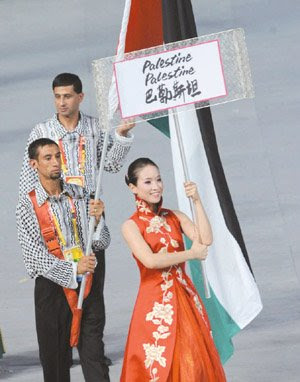
Last night I did something I usually don't do: I planted my eight-year old son in front of the TV and ordered: watch. It was the opening ceremonies of the Olympic games. We watched over two hours of amazing choreography, high-minded symbolism, cute children, huge screens, thousands of performers (basically men doing the heavy lifting and women the pretty dancing). We commented, argued, admired, and shrugged as the spectacle unfolded in front of our comfy sofa.
Then the parade of nations began.
We stopped our snacking and waited.
We blushed when the Bahrain delegation marched holding a picture of the country's leader over the flag. The only people to do so! As my son explained: "they must love their ruler very very much."
We groaned when the commentator described Jordan as a somewhat "progressive country." (define "somewhat")
We snickered when the commentator pointed out that the two women flag bearers for the UAE delegation happened to be the prime minister's daughters (he concluded: "but that maybe a coincident.") (then we fumed for continuing to be the butt of jokes)
We frowned when the Saudi Arabia delegation appeared with no women on it and we had to be reminded that "Saudi women need a male guardian to travel."
We were deeply saddened by the uniforms of the women on the Hungarian delegation.
But we mostly waited.
There were huge nations and small ones (the population of one participating country was 46,000 people). There were bullying and bullied countries. We patiently waited.
Finally, they appeared. The Palestinians.
Now jumping on the sofa, pointing at the screen, and screaming "Palestine, Palestine," my son and I drowned out everything that the commentators said and could hardly focus on the picture. All I remember is this: there were four participants: two runners and two swimmers. The flag bearer was the runner Nader al Masri, who trained in Beit Hanoun, Gaza, during Israeli "incursions." I could see two women dressed in traditional Palestinian dresses. They all walked around the stadium holding hands and raising the victory sign.
They appeared for a few seconds. The Cuban delegation followed and the Palestinians disappeared from the screen.
We know they may not win any medals, but they already won. For despite the occupation, the closed borders, the divisions, the poverty, the misery, the lack of official support, the lack of facilities and the empty promises, they came for Palestine. They had no Olympic-size pools to swim in. They had no shoes or safe roads. They had no budgets. They had to wait for exit permits that may or may not be granted. But they persevered and came.
My son and I cheered for this, not for an abstract nationalism or an "us against them" idea. We cheered for the tenacity of young women and men who insist on dreaming of a better future.
When it was obvious that we will not see more of the Palestinians, we settled down. My son, breathless and flushed with excitement, turned to me and said: "They were awesome!"
Yes, they were: Nader, Ghadeer, Hamse, and Zakiya. We thank you for your awesomeness!
These are improvisations: neither a manifesto nor a treatise because life is too complicated for either. Yet, I'm improvising as an Arab -- Palestinian -- woman with a progressive point of view always under construction. Since I often find myself caught between anti-Arab racism and arab reactionary politics, both of which threaten to gag me, I'm raising my voice against both, hoping in the process to contribute an improvised note to a progressive Arab blogosphere.Here is her moving account of watching the Palestinian delegation march into the Olympic opening ceremony:
The Awesome Palestinians

Last night I did something I usually don't do: I planted my eight-year old son in front of the TV and ordered: watch. It was the opening ceremonies of the Olympic games. We watched over two hours of amazing choreography, high-minded symbolism, cute children, huge screens, thousands of performers (basically men doing the heavy lifting and women the pretty dancing). We commented, argued, admired, and shrugged as the spectacle unfolded in front of our comfy sofa.
Then the parade of nations began.
We stopped our snacking and waited.
We blushed when the Bahrain delegation marched holding a picture of the country's leader over the flag. The only people to do so! As my son explained: "they must love their ruler very very much."
We groaned when the commentator described Jordan as a somewhat "progressive country." (define "somewhat")
We snickered when the commentator pointed out that the two women flag bearers for the UAE delegation happened to be the prime minister's daughters (he concluded: "but that maybe a coincident.") (then we fumed for continuing to be the butt of jokes)
We frowned when the Saudi Arabia delegation appeared with no women on it and we had to be reminded that "Saudi women need a male guardian to travel."
We were deeply saddened by the uniforms of the women on the Hungarian delegation.
But we mostly waited.
There were huge nations and small ones (the population of one participating country was 46,000 people). There were bullying and bullied countries. We patiently waited.
Finally, they appeared. The Palestinians.
Now jumping on the sofa, pointing at the screen, and screaming "Palestine, Palestine," my son and I drowned out everything that the commentators said and could hardly focus on the picture. All I remember is this: there were four participants: two runners and two swimmers. The flag bearer was the runner Nader al Masri, who trained in Beit Hanoun, Gaza, during Israeli "incursions." I could see two women dressed in traditional Palestinian dresses. They all walked around the stadium holding hands and raising the victory sign.
They appeared for a few seconds. The Cuban delegation followed and the Palestinians disappeared from the screen.
We know they may not win any medals, but they already won. For despite the occupation, the closed borders, the divisions, the poverty, the misery, the lack of official support, the lack of facilities and the empty promises, they came for Palestine. They had no Olympic-size pools to swim in. They had no shoes or safe roads. They had no budgets. They had to wait for exit permits that may or may not be granted. But they persevered and came.
My son and I cheered for this, not for an abstract nationalism or an "us against them" idea. We cheered for the tenacity of young women and men who insist on dreaming of a better future.
When it was obvious that we will not see more of the Palestinians, we settled down. My son, breathless and flushed with excitement, turned to me and said: "They were awesome!"
Yes, they were: Nader, Ghadeer, Hamse, and Zakiya. We thank you for your awesomeness!
Monday, March 17, 2008
a last thought on perfection
And one last thought, before I call it quits for the evening. I went to see Penelope last night, with a few roommates. It was light and fun—a fairytale story about a daughter born cursed, and bearing a pig's snout. Her family (most notably her mother) spend their lives trying to protect her, and living for the day when the spell will be broken (supposedly on the event of her marriage to a "blue-blood"). Penelope, on the other hand, goes on a journey of self-discovery and acceptance. Acceptance of herself for who she is, nose and all (she is continually reminding her mother "but it is my nose").
The disturbing thing about all of this, is that even as the movie is attempting to spread the message that beauty is not about society's standards, it ultimately buys into the system and presents us with a perfect Penelope. Because perfect is the only way to be beautiful, no matter what we may want to believe.
Grrrr . . . .
I'm not sure how well I'm saying this, or how much sense I'm making.
In The Poisonwood Bible, by Barbara Kingsolver (a book I'd definitely recommend for its fascinating look at/critique of culture, missions, gender, and Africa), Adah, a one-time cripple who's been healed by modern medicine, puts it this way:
The disturbing thing about all of this, is that even as the movie is attempting to spread the message that beauty is not about society's standards, it ultimately buys into the system and presents us with a perfect Penelope. Because perfect is the only way to be beautiful, no matter what we may want to believe.
Grrrr . . . .
I'm not sure how well I'm saying this, or how much sense I'm making.
In The Poisonwood Bible, by Barbara Kingsolver (a book I'd definitely recommend for its fascinating look at/critique of culture, missions, gender, and Africa), Adah, a one-time cripple who's been healed by modern medicine, puts it this way:
"If you are whole, you will argue: Why wouldn't they rejoice? Don't the poor miserable buggers all want to be like me?Does anyone understand what I'm driving at?
Not necessarily, no. The arrogance of the able-bodied is staggering. Yes, maybe we'd like to be able to get places quickly, and carry things in both hands, but only because we have to keep up with the rest of you, or [bear the consequences]. We would rather be just like us, and have that be all right.
How can I explain that my two unmatched halves used to add up to more than one whole? In Congo I was one-half benduka the crooked walker, and one-half benduka [two dots on the "e"], the sleek bird that dipped in and out of the banks with a crazy ungrace that took your breath. We both had our good points. Here there is no good name for my gift, so it died without a proper ceremony" (p. 493).
Hejab Pt. 2: Another Thought on Hair
Here is a somewhat-companion to Megan's piece. This one I did write—last semester, for a class on writing for publication. Why do I put it here, amidst reflections on peace, the Palestinian-Israeli conflict, and writing? Because, as I've mentioned before, there are many kinds of peace, and many kinds of conflict. Christ came to set us free from it all. "It is for freedom that Christ has set us free" (Galatians 5:1). And I think, through this, I was trying to touch on the issue of pain . . . devastation . . . war . . . and the way our society hides from those things. From the reality of sweat and blood, behind the facade of perfection. I believe in beauty, but it is a very different type of beauty than the ideal my culture is trying to force down my throat. It is a beauty that comes through the ashes—the marks of living—rather than by denying them.
Bare—An Ode to Beauty Bald
I want to shave my head. It’s one of those crazy ideas that terrify my parents. They interpret it, I think, as a sign of my slowly dissolving faculties. The warping of my brain by too much study and feminist theology. After all, why would anyone want to destroy all sign of womanly beauty? The golden ringlets that grew into longer curls. Shear them off in humiliation and shame.
I try to explain. How a boy I liked, once told me that he liked my hair. Liked it down. Said it made me beautiful, those strands of tarnished gold. Strands that are not me.
And I rebel. I will not be my hair. I will reclaim my womanhood from a Bible that proclaims me, and my head, to be man’s glory.
I want to be known for the mind that lies beneath the hair. For the part of me that thinks and yearns and ponders. For the passion and the life, under the meaningless wisps that grow and die, without my consent or say-so. That require nothing of me. Reflect nothing on me.
I want to shave my head in honor of those who never had the choice. In solidarity with the broken. The women at Bergen-Belsen and Dachau. Auschwitz and Buchenwald. Those who survived, and those who didn’t. To honor a humanity that was not taken, cannot be taken, with our hair.
To celebrate survival. From cancer. Leukemia. Radiation and chemo. The women who wear headscarves, and wigs. Afraid to show the scars of battle. The sign of loss, and life. Proof that they’re still here.
I want to join the ranks of men like Yule Brynner and Michael Jordan. Of human beauty unadorned. Skin, and sweat, and age. Unafraid to expose the blue veins that pump life, blood and oxygen, through membrane and golden tissue. The sandpaper texture. The shape of their skulls.
I want to demonstrate a different kind of beauty. Sleek and sexy elegance that denies hairspray and color dyes, styling products and curling irons. Proclaim freedom from magazine images and picturesque perfection. From Barbie dolls and Disney princesses, long silken tendrils, hair to their knees. Coiffured and flowing expectations. Stop hiding beneath the mask of color.
I want to wear henna on my head. Make patterns of tribal beauty. Declare myself at home with earth and sky.
I want to stop running from the feel of my own skin. I want to be myself, free of pins and clips and rubber-bands. And I want to love it.
I want to inhale wind and rain through the pores on my skull. To taste life and pain. To deny the acceptability of pretence, to destroy the masquerade, the papier-mâchéd perfection. To mourn injustice with the women of Beowulf—heads bare, weeping to high heaven. Sackcloth and ashes, and shorn hair.
And most of all, I want to be a nun. Set apart for unreserved worship. To return to child-like innocence, and feel nothing between my head and God, but air and sunlight. To be uncovered before my maker, not in shame, but in the humility of a newborn, and beloved, child. To remember my humanity in the presence of a genderless God. A God who created my soul before she created my hair.
I want to feel my prayers rise out of the top of my skull. Float along air currents. Be breathed in by the Almighty (hairless) God.
Bare—An Ode to Beauty Bald
I want to shave my head. It’s one of those crazy ideas that terrify my parents. They interpret it, I think, as a sign of my slowly dissolving faculties. The warping of my brain by too much study and feminist theology. After all, why would anyone want to destroy all sign of womanly beauty? The golden ringlets that grew into longer curls. Shear them off in humiliation and shame.
I try to explain. How a boy I liked, once told me that he liked my hair. Liked it down. Said it made me beautiful, those strands of tarnished gold. Strands that are not me.
And I rebel. I will not be my hair. I will reclaim my womanhood from a Bible that proclaims me, and my head, to be man’s glory.
I want to be known for the mind that lies beneath the hair. For the part of me that thinks and yearns and ponders. For the passion and the life, under the meaningless wisps that grow and die, without my consent or say-so. That require nothing of me. Reflect nothing on me.
I want to shave my head in honor of those who never had the choice. In solidarity with the broken. The women at Bergen-Belsen and Dachau. Auschwitz and Buchenwald. Those who survived, and those who didn’t. To honor a humanity that was not taken, cannot be taken, with our hair.
To celebrate survival. From cancer. Leukemia. Radiation and chemo. The women who wear headscarves, and wigs. Afraid to show the scars of battle. The sign of loss, and life. Proof that they’re still here.
I want to join the ranks of men like Yule Brynner and Michael Jordan. Of human beauty unadorned. Skin, and sweat, and age. Unafraid to expose the blue veins that pump life, blood and oxygen, through membrane and golden tissue. The sandpaper texture. The shape of their skulls.
I want to demonstrate a different kind of beauty. Sleek and sexy elegance that denies hairspray and color dyes, styling products and curling irons. Proclaim freedom from magazine images and picturesque perfection. From Barbie dolls and Disney princesses, long silken tendrils, hair to their knees. Coiffured and flowing expectations. Stop hiding beneath the mask of color.
I want to wear henna on my head. Make patterns of tribal beauty. Declare myself at home with earth and sky.
I want to stop running from the feel of my own skin. I want to be myself, free of pins and clips and rubber-bands. And I want to love it.
I want to inhale wind and rain through the pores on my skull. To taste life and pain. To deny the acceptability of pretence, to destroy the masquerade, the papier-mâchéd perfection. To mourn injustice with the women of Beowulf—heads bare, weeping to high heaven. Sackcloth and ashes, and shorn hair.
And most of all, I want to be a nun. Set apart for unreserved worship. To return to child-like innocence, and feel nothing between my head and God, but air and sunlight. To be uncovered before my maker, not in shame, but in the humility of a newborn, and beloved, child. To remember my humanity in the presence of a genderless God. A God who created my soul before she created my hair.
I want to feel my prayers rise out of the top of my skull. Float along air currents. Be breathed in by the Almighty (hairless) God.
Jesus and the hejab . . . ?
Hmm . . . it's been a while since I've posted.
Here's something a little different. It was written by a good friend. See what you think, but more importantly, ask yourself why. Whether this resonates with you, or you find yourself hating it, confused by it, offended . . . I don't really care. I just care that you think.
My Jesus Wears a Hejab
by Megan Buff
I am not a Muslim. I am a Christian, though I do sometimes distance myself from mainline and evangelical Christianity. Occasionally, I wear a hejab. This symbol of Muslim femininity sets me apart from the women who run about in immodest clothing, who worry incessantly about what others think about their appearance, who spend twenty minutes in front of the mirror in the mornings. It is a symbol of modesty, in part – but more so, it is a reminder to both myself and others that my appearance is not what defines me.
Hair is crucial to our society. A person’s haircut says much about them. Buzz cuts for the military men, dreadlocks for the anarchist hippie rebels, long flowing hair for the women (unless you’re a butch lesbian, in which case you must cut your hair very short). This is how we are supposed to look. Hairstyles can make or break a “look.” I cover my hair; my hair does not matter to who I am.
When I first wrapped the hejab around my head, I felt an unexpected change. I felt like a real person. Cares, worries, the awkwardness of life slid off my shoulders, ousted by the folds of fabric. I felt peaceful, as I rarely ever do. I saw the beauty of the world when the hejab slipped into my peripheral vision. Somehow, without realizing it, my body acknowledged that covering my hair meant one less un-necessary stressor in my life. It no longer mattered what others thought of me. I could be myself – and when I allowed myself to be myself, I allowed myself to be a person again.
. . .
A large painting of Jesus sits in the prayer chapel. He is pale white, his long black hair matted into his face, his beard covering his chin and some of his neck. Red and blue streaks mark his face – Blood? Tears? He is suffering yet noble. His eyes may bleed, but his face holds loving dignity. He looks off to the side, his face in profile to the viewer, as though looking elsewhere. He wants to show off the blood and tears, the scars of the trials on his face, but he does not want to see. He does not want to accept, to acknowledge, to understand.
This is not my Jesus. My Jesus is loving. My Jesus is kind. My Jesus wears a hejab.
Here's something a little different. It was written by a good friend. See what you think, but more importantly, ask yourself why. Whether this resonates with you, or you find yourself hating it, confused by it, offended . . . I don't really care. I just care that you think.
My Jesus Wears a Hejab
by Megan Buff
I am not a Muslim. I am a Christian, though I do sometimes distance myself from mainline and evangelical Christianity. Occasionally, I wear a hejab. This symbol of Muslim femininity sets me apart from the women who run about in immodest clothing, who worry incessantly about what others think about their appearance, who spend twenty minutes in front of the mirror in the mornings. It is a symbol of modesty, in part – but more so, it is a reminder to both myself and others that my appearance is not what defines me.
Hair is crucial to our society. A person’s haircut says much about them. Buzz cuts for the military men, dreadlocks for the anarchist hippie rebels, long flowing hair for the women (unless you’re a butch lesbian, in which case you must cut your hair very short). This is how we are supposed to look. Hairstyles can make or break a “look.” I cover my hair; my hair does not matter to who I am.
When I first wrapped the hejab around my head, I felt an unexpected change. I felt like a real person. Cares, worries, the awkwardness of life slid off my shoulders, ousted by the folds of fabric. I felt peaceful, as I rarely ever do. I saw the beauty of the world when the hejab slipped into my peripheral vision. Somehow, without realizing it, my body acknowledged that covering my hair meant one less un-necessary stressor in my life. It no longer mattered what others thought of me. I could be myself – and when I allowed myself to be myself, I allowed myself to be a person again.
. . .
A large painting of Jesus sits in the prayer chapel. He is pale white, his long black hair matted into his face, his beard covering his chin and some of his neck. Red and blue streaks mark his face – Blood? Tears? He is suffering yet noble. His eyes may bleed, but his face holds loving dignity. He looks off to the side, his face in profile to the viewer, as though looking elsewhere. He wants to show off the blood and tears, the scars of the trials on his face, but he does not want to see. He does not want to accept, to acknowledge, to understand.
This is not my Jesus. My Jesus is loving. My Jesus is kind. My Jesus wears a hejab.
Tuesday, February 5, 2008
More Gender, Peace, and Poetry
Just to give you a taste, here are two of my favorite poems from Kohleun's site, Poems From a Small Place.
They will try to divide you—body
cleanly from soul—and tell you
where your beauty lies.
No mosaic here,
no puzzle of pieces fit.
One loose shard, a fragment
of your being, will be
lovely and desirable.
They will prize and polish it
‘til it shines from wax and gloss.
Fill in the "h", the "u".
Tack on an "r" here and there.
Of course that's what they meant
to say. Uh huh. I know
how we were all there when
Christ fed the five thousand
(not including women and children).
A star for the wise men,
angels sent to shepherds, pastors
of the fields. Such light
that shown all around
as they proclaimed, "Peace
on earth, good will toward men"
(that explains a lot).
On that night a savior came
for whomsoever believes. The Son
of God, Son of Man.
Humble carpenter of Nazareth,
poor and not handsome--
like a lamb led to the slaughter is silent
(truly a woman's son).
Monday, February 4, 2008
Poetry for Women, Peace for All
My brother often tells me that there can be no peace for any, until there is peace for all.
That is why he is a feminist, but calls himself a humanist. Why he loves Israelis, as well as Palestinians, and why he reaches out to Americans, and not just Arabs. It is why the Palestinian-Israeli conflict is not more important to him than the genocide in Sudan or Uganda. And why he believes that his treatment of the lady in the supermarket is as significant as any anti-war protesting.
We are all connected.
I believe this too. But I find, in practice, it very hard to live.
In honor, however, of peace of all kinds, I would like to recommend that you visit Poems from a Small Place. Much of the author's poetry deals with gender, and the need to reconcile female identity with Christianity, culture, and all of life. The need to restore wholeness to the way we view food, image, and beauty. The need for peace amidst the clash of words like "important" and "insignificant." After all, who is to decide such labels? Who gets to assign such worth?
In the end, doesn't conflict come down to this? To the way we view each other. The way we determine value. The way we deny common humanity. It doesn't have to be overt to be real.
That is why he is a feminist, but calls himself a humanist. Why he loves Israelis, as well as Palestinians, and why he reaches out to Americans, and not just Arabs. It is why the Palestinian-Israeli conflict is not more important to him than the genocide in Sudan or Uganda. And why he believes that his treatment of the lady in the supermarket is as significant as any anti-war protesting.
We are all connected.
I believe this too. But I find, in practice, it very hard to live.
In honor, however, of peace of all kinds, I would like to recommend that you visit Poems from a Small Place. Much of the author's poetry deals with gender, and the need to reconcile female identity with Christianity, culture, and all of life. The need to restore wholeness to the way we view food, image, and beauty. The need for peace amidst the clash of words like "important" and "insignificant." After all, who is to decide such labels? Who gets to assign such worth?
In the end, doesn't conflict come down to this? To the way we view each other. The way we determine value. The way we deny common humanity. It doesn't have to be overt to be real.
Sunday, February 3, 2008
The Economics of Life
Here's another post from Daily Rantings of an increasingly cynical Fish. I really don't know anything about economics, but this is a good prod to keep thinking and wrestling with the issues of the violent world we live in:
Dec. 8, 2007
Donkeys in Gaza, suicide bomber in Iraq, studying in America and Economic theories...
Dec. 8, 2007
Donkeys in Gaza, suicide bomber in Iraq, studying in America and Economic theories...
The past semester I have been taking a class on International Political Economics. Now, everywhere I look instead of seeing bad political policies I see bad economic policies coupled and enhanced with bad political policies. Instead of questioning why Bush contradicts his rhetoric about democracy, I question why he contradicts his rhetoric about economic liberal policies. I am awed by the strength and perseverance of Palestinians making their own work, downsizing from a car to a donkey, and I wonder is the Middle East a backwards underdeveloped society, or are we making it a backwards underdeveloped society?
I then see the article about the tragic suicide bombing in Iraq, and of course the sex of the bomber is emphasized before her act. Again, she did not commit a political act, she committed a vengeful act. Technically her act was not terrorism, for how can a woman commit a politically charged violent act, her act was to get revenge for the killing of her sons.
Then I question what does it matter...she still blew herself up. What type of a world do we live in where the only way people feel that they can have a voice is to blow themselves up?
I think of what my friends would say...of what my society would say being at a Christian school...we are not of this world...only Jesus can solve our problems. I sit quietly as I have been trained to do as a woman (or at least how people have tried to train me to act), and inside I am kicking, shouting and cursing. How can we so easily brush aside these problems as if we are unable to affect them?
Then I recognize if I want the world to change I have to change it. I have to choose a career that will allow me to change it. I've been slowly recognizing this for sometime now...which is why I'm an international studies major...why I study abroad...why I work for the IRC...it's why I'm planning to go to grad school. Still, what will I do? how will I use my skills to change the world...I have no idea. I think I know what I want to do in grad school but I'm not sure. Whatever it is...will it actually help these people? Will I choose a career that will feed my wallet, or keep a person from blowing themselves up? Will I choose a career that will benefit me, or give a man in Palestine an opportunity to start his own buisness?
I guess it all goes back to economics. How do I see the world? Is it really zero-sum, or is positive-sum? Or is it negative -sum? I honestly don't know.
Wednesday, November 21, 2007
Feminism, Terrorism, and the Equality of Violence
I thought this was an interesting question (excerpt from Daily Rantings of an increasingly cynical Fish):
Female terrorists are seen as wild, emotional, uncontrollable forces who commit these [terrorist] acts as acts of revenge. The academics then fail to look at the political reason for the violence (without such it cannot be considered terrorism). In our society, we expect men to be strong, to fight, to be somewhat violent, but women are supposed to be the calm, subdued sex. We must not have a violent bone in our body . . .
Well, what is the difference between a man committing a violent act and a women committing a violent act? Are we not all fallen humans with violent tendencies? Why is a man's violence more legit than a woman's? . . .
I have a prof. who is currently working on a book about female terrorists. She often speaks of how they are overlooked in the study of terrorism, because they are seen as committing emotional acts instead of political acts of violence. This, however, is not the case. In fact another interesting tidbit, is that the female terrorists who commit an act of terrorism in Iraq do not get media coverage. In fact, usually afterwards, we cannot even find any information out about them! Interesting eh? Why are terrorist acts by men more important than acts by women?
Tuesday, November 20, 2007
Christian Women Visit Mosque
Last Thursday (November 13th) two of my friends attended afternoon prayer at a Portland area mosque. Neither of them had previous experiences with Islam or Muslims, but they whole-heartedly embraced the opportunity to step out of their bubble, and see beauty beyond their realms of experience. In our present world of war and terror, it seems like many Americans have lost their ability to respond to this particular religion with anything but fear and hatred. Therefore, I find the openness of people like Megan and Katie, not only extremely rare and refreshing, but the beginning of a way forward into peace. For peace cannot come without a desire to understand, a willingness to respect, and, ultimately, the ability to love.
Here are some excerpts from reflections they wrote for a class:
The Beauty of Religion
Several days ago, I dropped in on a mosque with some friends for a class project. We were welcomed with more open arms and beaming smiles than I’d seen in quite some time. There were four women there who gladly took us aside – all of them separately – to talk to us about Islam. Not with the intent to convert us, not with the intent to educate the infidels, but simply because we were curious and they were only too happy to talk about their religion.Through the Eyes of a Muslim Woman
All of the women wore a hejab, the traditional Muslim headscarf. Here in the States we tend to think that a hejab is somehow restricting of a woman’s personhood . . . Yet one of the women explained the hejab to us with a grin on her face. Women are intelligent, she said, and ought to be respected for their intelligence rather than their body. The hejab, and other modest Islamic dress, reserves a woman’s beauty for those who deserve to see it and not a gawking passer-by. She was liberated and not confined by this perception.
What struck me most was the joy I saw in these women. They were all incredibly knowledgeable, yet without exception they prefaced nearly all of their statements with “but I don’t know very much”; constant smiling humility. They rejoiced in what they knew of life and love and religion. One of the women sat down with us and . . . talked through some of the stories in their holy book, until she got to the revelation to the Prophet Muhammed. The angel Gabriel says to the prophet (and here I’m very much paraphrasing), “The Lord knows you, He who formed you from a drop.” She beamed with pure delight as she explained to us the wonders of this God who knows us so intimately, . . . the Truth she found in His words.
And I thought, how beautiful is that. I feel as though this is the way we should all be. I long for some piece of that true utter beautiful joyful glad Truth revealed to me. I want my face to beam as hers did, to radiate delight in the Most Merciful God . . . Which, I feel, is what all religion should be: pure gladness in the God of peace and the Lord of hosts.
-Megan Buff(photo from here)


We arrived at the Bilal Mosque forty-five before the Call to Prayer . . . An elderly gentleman named Hai Amin came and asked us if we had any questions, and then proceeded to tell us about Islam and its traditions. He explained that there was a women’s room, and a men’s room, and that is where the prayer service was held. Then he brought us to the women’s room . . .
There were three traditionally dressed Muslim women there with their children. When we came in, they all gathered around, and we sat in a circle on the floor while they taught us about Islam. Miriam, an older lady, shared with us . . .
When the call for prayer came, Miriam invited us to join them. We stood in line behind the women so we could watch and imitate what they did. The prayer took perhaps fifteen minutes total. When it was finished, a lady from Bangladesh came and sat with us to tell us more about Islam. I asked her what had been said in the prayer, and she replied that she didn’t entirely know, since her Arabic wasn’t very good. She translated the few sections that she knew, but she explained that you didn’t have to know what was being said. You did the prayer out of devotion; you knew that you were worshiping Allah, and that is good enough . . .
Before the Bangladeshi woman left, another woman came and sat down with us. I don’t know what country she was from, but . . . I was captivated by her. As she told us about Islam, she just glowed. She told us about the beauty of the Koran, and how she was constantly moved by it. There is no way I can believe that Islam is essentially oppressive of women; this Muslim woman found so much joy in it. She didn’t look at all like a woman subjugated by her faith.
Because she was so open, we asked her about the head scarf. She explained to us that especially now, women are looked upon as sex objects. That is the only quality that many men see. She told us that when you wear the head scarf, you aren’t judged by your beauty, but by your intelligence . . . I think that lots of the oppression that we connect with Islam is cultural, rather than religious. We have to remember that Islam was extremely liberating within their very patriarchal society.
I loved that the women had their own room to pray in; their own mosque. It was such a female place. We talked about coming of age, and menstrual cycles without the least bit of discomfort. There was such a warmth in the place. I felt so blessed to be able to hear this untold story of Muslim women of faith. As the last woman was talking with us, I realized how privileged I was to be part of this gathering of women. Sitting next to her I really felt like I was in the presence of a great teacher. It was like I was sitting at the feet of Jesus. Muslim women do have a voice, (and what a powerful voice it is.) They are saying come hear my story, I am a woman, and it is good. Thanks to Allah that I was born a woman.
-Katie
Subscribe to:
Posts (Atom)