"Here are two poems, published by one of my writing and literature professors at George Fox University. You can also find them on Poets Against War.
Epistemology
It’s always about loss,
this kind of epistemology
philosophers regard with dread.
And we can fool ourselves with thinking.
Like the grandfather
I read about recently
who picked up his four-year-old grandson
in two pieces on a Baghdad market street,
after a sudden car bomb there.
And then just yesterday grocery shopping,
concentrating on which broccoli florets to buy,
out of the corner of my eye
a little blond four-year-old girl
is running to the side of my leg
yelling grandpa, grandpa, we saw your car
in the parking lot and knew it was you.
And my son and his beautiful wife
are smiling an aisle away,
near the potatoes and sweet onions,
she holding their year-old daughter
on her hip the way mothers do.
And I’m so happy to see them all there
in one piece that I begin to cry,
like a foolish, foolish old man.
-Ed Higgins
In Baghdad
Silent beneath the women’s wailing
the boxed dead lie like wrapped gifts
to the god grief waiting there
beside open unmarked graves.
Caught in their sorrow sound
these photographed women
sway their silent voices slowly,
like bent minarets of black.
Their eyes sad as charred craters
in the market street. Mothers, wives,
and daughters their naked hands
raised in skeins of grief.
They twist and mourn their war
consumed husbands, sisters,
brothers and children.
So many counted and uncounted
dead they blur a tear-drained land
against a another daylight bomb’s
killing darkness.
In noon’s blood-stained heat
and smoke-lingering light,
graves that keep on filling.
-Ed Higgins
If you're interested in reading more of his poetry, just hit Google. He's everywhere. :)
Tuesday, October 28, 2008


Thursday, October 9, 2008
Belfast Murals
I just got back to Oxford (where I'm currently residing) after spending the weekend with a friend in Belfast. She's in Northern Ireland for the year, working with a local church toward reconciliation and community building. While it was wonderful to see her, and beautiful to see Ireland, I was a bit shocked by the overt support of paramilitary groups still evident in murals throughout the city (particularly on Shankill Road, where I spent over an hour -- just wandering). Though "the Troubles" may be simmering down, it was eerie to see so much hatred and one-sided remembrance of pain. And I had to wonder, how can peace and true healing occur when one side still remembers themselves as heroes, and labels their enemies terrorists?
 "He will wipe every tear from their eyes. Revelation 21:4"
 "IN THE NAME OF LOVE. 1 John 3:16-18, Eph. 5:1-2, Mark 12:30-31"
 "hope. love. forgiveness."
 "He will wipe every tear from their eyes. Revelation 21:4"
 "IN THE NAME OF LOVE. 1 John 3:16-18, Eph. 5:1-2, Mark 12:30-31"
 "hope. love. forgiveness."
The friend I was visiting has an interesting, and succinct, description of the Troubles on her blogsite.
Friday, September 12, 2008
Kohleun's Bethlehem Poem, Published
So, if you're familiar with my site, you've probably run across Kohleun's name a few times. Her blog, Poems from a Small Place, is filled with wonderful poetry about peace and gender and the small details of living. This summer she visited Palestine, Israel, and Jordan, and much of her recent poetry (such as "A Letter to the President of the United States") was inspired by her trip.
And now for the exciting news: she just had one such poem, "For Those Who Talk to Plants," published by Poets Against War. Go check it out. :)
And now for the exciting news: she just had one such poem, "For Those Who Talk to Plants," published by Poets Against War. Go check it out. :)
Sunday, September 7, 2008
The Words of Jenny Holzer: Visual Art and Exhortation to Scream
The following is by American artist Jenny Holzer, and is part of a display of alternating statements found in London's Tate Modern (which I recently had the pleasure of visiting). While I find her medium (that of words) a fascinating choice for a visual artist, I find the actual words just as interesting. Much of her work (in this particular display) focuses on power, violence, strength, weakness, freedom, and hatred, but it was this piece that I found the most gripping (though not, perhaps, the most jolting). I think it goes hand in hand with some interpretations of the Sermon on the Mount (found in Matthew 5-7) -- an exhortation to force tormentors to recognize the humanity of those they tread on, and the significance of their own actions.
SHRIEK WHEN THE PAIN HITS
DURING INTERROGATION. REACH
INTO THE DARK AGES TO FIND A
SOUND THAT IS LIQUID HORROR,
A SOUND OF THE BRINK WHERE
MAN STOPS AND THE BEAST
AND NAMELESS CRUEL FORCES
BEGIN. SCREAM WHEN YOUR
LIFE IS THREATENED. FORM A
NOISE SO TRUE THAT YOUR
TORMENTOR RECOGNIZES IT AS A
VOICE THAT LIVES IN HIS OWN
THROAT. THE TRUE SOUND TELLS
HIM THAT HE CUTS HIS FLESH
WHEN HE CUTS YOURS, THAT
HE CANNOT THRIVE AFTER HE
TORTURES YOU. SCREAM THAT HE
DESTROYS ALL KINDNESS IN YOU
AND BLACKENS EVERY VISION
YOU COULD HAVE SHOWN HIM.
-Jenny Holzer, "Inflammatory Language" (1979-82)
SHRIEK WHEN THE PAIN HITS
DURING INTERROGATION. REACH
INTO THE DARK AGES TO FIND A
SOUND THAT IS LIQUID HORROR,
A SOUND OF THE BRINK WHERE
MAN STOPS AND THE BEAST
AND NAMELESS CRUEL FORCES
BEGIN. SCREAM WHEN YOUR
LIFE IS THREATENED. FORM A
NOISE SO TRUE THAT YOUR
TORMENTOR RECOGNIZES IT AS A
VOICE THAT LIVES IN HIS OWN
THROAT. THE TRUE SOUND TELLS
HIM THAT HE CUTS HIS FLESH
WHEN HE CUTS YOURS, THAT
HE CANNOT THRIVE AFTER HE
TORTURES YOU. SCREAM THAT HE
DESTROYS ALL KINDNESS IN YOU
AND BLACKENS EVERY VISION
YOU COULD HAVE SHOWN HIM.
-Jenny Holzer, "Inflammatory Language" (1979-82)
Friday, August 15, 2008
Quote on Peace: George Bernard Shaw
"Peace is not only better than war, but infinitely more arduous."
Wednesday, August 13, 2008
Inappropriate Behavior: the Art of Shooting Blindfolded Palestinians
Okay, last one, and then I'll try to calm down. This is still from Amal's blog. More fighting words, and yet the world seems to excel at conveniently ignoring the facts:
If You Shoot a Bound and Blindfolded Palestinian in the Foot...
The Israeli soldier who shot a bound and blindfolded Palestinian man with a bullet at close range was found guilty of "inappropriate conduct" and was reassigned.
So if you were holding your breath, you can exhale.
I hope now you understand how the occupation works:
If you shoot a bound and blindfolded Palestinian in the foot, your conduct is "inappropriate."
If you shoot a bound and blindfolded Palestinian in the eye, your conduct is "rather inappropriate."
If you shoot a bound and blindfolded Palestinian in the head, your conduct is "really inappropriate."
If you shoot ten bound and blindfolded Palestinians in the foot, eye, and head, your conduct is "very inappropriate."
If you shoot one hundred bound and blindfolded Palestinians in the foot, eye, head, mouth, and genitals, you are a national hero.
In all the above cases, you will be reassigned. Depending on how many you shoot and where you shoot them, there is a good chance you will be reassigned to be Prime Minister or Chief of Staff.
To put things in perspective:
If a Palestinian throws a stone at an Israeli armored tank, his conduct is labeled "criminal" and he is reassigned to an Israeli jail for a few years.
Inhale that!
If You Shoot a Bound and Blindfolded Palestinian in the Foot...
This update is for those who were holding their breath:
The Israeli soldier who shot a bound and blindfolded Palestinian man with a bullet at close range was found guilty of "inappropriate conduct" and was reassigned.
So if you were holding your breath, you can exhale.
I hope now you understand how the occupation works:
If you shoot a bound and blindfolded Palestinian in the foot, your conduct is "inappropriate."
If you shoot a bound and blindfolded Palestinian in the eye, your conduct is "rather inappropriate."
If you shoot a bound and blindfolded Palestinian in the head, your conduct is "really inappropriate."
If you shoot ten bound and blindfolded Palestinians in the foot, eye, and head, your conduct is "very inappropriate."
If you shoot one hundred bound and blindfolded Palestinians in the foot, eye, head, mouth, and genitals, you are a national hero.
In all the above cases, you will be reassigned. Depending on how many you shoot and where you shoot them, there is a good chance you will be reassigned to be Prime Minister or Chief of Staff.
To put things in perspective:
If a Palestinian throws a stone at an Israeli armored tank, his conduct is labeled "criminal" and he is reassigned to an Israeli jail for a few years.
Inhale that!
Fighting Words: the Illegality of Settlements
Wow, wow, wow. The more I read of Amal's blog, the more I want to repost every entry on mine. Here's something to chew on (as Homer [of Iliad and Odyssey fame] might say, "fighting words"):
Repeat After Me: Settlements are Illegal!!
A BBC article about building new Jewish settlements in the Jordan Valley ends with this question:
We know who is going to win.
Repeat After Me: Settlements are Illegal!!
A BBC article about building new Jewish settlements in the Jordan Valley ends with this question:
The future of the Jordan Valley, its Jewish settlements and Palestinian villages, will be decided in a Palestinian-Israeli peace deal. If and when that happens, might there be a way of accommodating both Jasser [the Palestinian farmer] and Yossi [the Isreaeli colonists] in this stunningly beautiful but often hostile strip of land?Ending the article in this way equates the victim and the thief. Jasser has international law on his side: this land is his land; he owned if for generations and all settlements built under occupation are illegal. Yossi has the power of a colonial state on his side and a god who works in his free time as a real estate agent.
We know who is going to win.
A Palestinian Woman's Blog and Palestinians at the Olympics
Interested in a Palestinian woman's take on life and politics? I would highly recommend you check out Amal A.'s Improvisations blogsite. Her statement of purpose reads:
The Awesome Palestinians
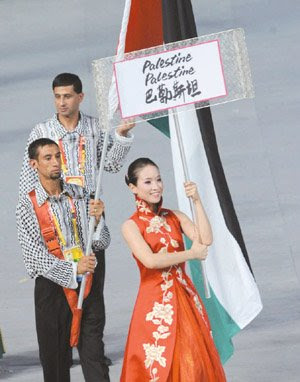
Last night I did something I usually don't do: I planted my eight-year old son in front of the TV and ordered: watch. It was the opening ceremonies of the Olympic games. We watched over two hours of amazing choreography, high-minded symbolism, cute children, huge screens, thousands of performers (basically men doing the heavy lifting and women the pretty dancing). We commented, argued, admired, and shrugged as the spectacle unfolded in front of our comfy sofa.
Then the parade of nations began.
We stopped our snacking and waited.
We blushed when the Bahrain delegation marched holding a picture of the country's leader over the flag. The only people to do so! As my son explained: "they must love their ruler very very much."
We groaned when the commentator described Jordan as a somewhat "progressive country." (define "somewhat")
We snickered when the commentator pointed out that the two women flag bearers for the UAE delegation happened to be the prime minister's daughters (he concluded: "but that maybe a coincident.") (then we fumed for continuing to be the butt of jokes)
We frowned when the Saudi Arabia delegation appeared with no women on it and we had to be reminded that "Saudi women need a male guardian to travel."
We were deeply saddened by the uniforms of the women on the Hungarian delegation.
But we mostly waited.
There were huge nations and small ones (the population of one participating country was 46,000 people). There were bullying and bullied countries. We patiently waited.
Finally, they appeared. The Palestinians.
Now jumping on the sofa, pointing at the screen, and screaming "Palestine, Palestine," my son and I drowned out everything that the commentators said and could hardly focus on the picture. All I remember is this: there were four participants: two runners and two swimmers. The flag bearer was the runner Nader al Masri, who trained in Beit Hanoun, Gaza, during Israeli "incursions." I could see two women dressed in traditional Palestinian dresses. They all walked around the stadium holding hands and raising the victory sign.
They appeared for a few seconds. The Cuban delegation followed and the Palestinians disappeared from the screen.
We know they may not win any medals, but they already won. For despite the occupation, the closed borders, the divisions, the poverty, the misery, the lack of official support, the lack of facilities and the empty promises, they came for Palestine. They had no Olympic-size pools to swim in. They had no shoes or safe roads. They had no budgets. They had to wait for exit permits that may or may not be granted. But they persevered and came.
My son and I cheered for this, not for an abstract nationalism or an "us against them" idea. We cheered for the tenacity of young women and men who insist on dreaming of a better future.
When it was obvious that we will not see more of the Palestinians, we settled down. My son, breathless and flushed with excitement, turned to me and said: "They were awesome!"
Yes, they were: Nader, Ghadeer, Hamse, and Zakiya. We thank you for your awesomeness!
These are improvisations: neither a manifesto nor a treatise because life is too complicated for either. Yet, I'm improvising as an Arab -- Palestinian -- woman with a progressive point of view always under construction. Since I often find myself caught between anti-Arab racism and arab reactionary politics, both of which threaten to gag me, I'm raising my voice against both, hoping in the process to contribute an improvised note to a progressive Arab blogosphere.Here is her moving account of watching the Palestinian delegation march into the Olympic opening ceremony:
The Awesome Palestinians

Last night I did something I usually don't do: I planted my eight-year old son in front of the TV and ordered: watch. It was the opening ceremonies of the Olympic games. We watched over two hours of amazing choreography, high-minded symbolism, cute children, huge screens, thousands of performers (basically men doing the heavy lifting and women the pretty dancing). We commented, argued, admired, and shrugged as the spectacle unfolded in front of our comfy sofa.
Then the parade of nations began.
We stopped our snacking and waited.
We blushed when the Bahrain delegation marched holding a picture of the country's leader over the flag. The only people to do so! As my son explained: "they must love their ruler very very much."
We groaned when the commentator described Jordan as a somewhat "progressive country." (define "somewhat")
We snickered when the commentator pointed out that the two women flag bearers for the UAE delegation happened to be the prime minister's daughters (he concluded: "but that maybe a coincident.") (then we fumed for continuing to be the butt of jokes)
We frowned when the Saudi Arabia delegation appeared with no women on it and we had to be reminded that "Saudi women need a male guardian to travel."
We were deeply saddened by the uniforms of the women on the Hungarian delegation.
But we mostly waited.
There were huge nations and small ones (the population of one participating country was 46,000 people). There were bullying and bullied countries. We patiently waited.
Finally, they appeared. The Palestinians.
Now jumping on the sofa, pointing at the screen, and screaming "Palestine, Palestine," my son and I drowned out everything that the commentators said and could hardly focus on the picture. All I remember is this: there were four participants: two runners and two swimmers. The flag bearer was the runner Nader al Masri, who trained in Beit Hanoun, Gaza, during Israeli "incursions." I could see two women dressed in traditional Palestinian dresses. They all walked around the stadium holding hands and raising the victory sign.
They appeared for a few seconds. The Cuban delegation followed and the Palestinians disappeared from the screen.
We know they may not win any medals, but they already won. For despite the occupation, the closed borders, the divisions, the poverty, the misery, the lack of official support, the lack of facilities and the empty promises, they came for Palestine. They had no Olympic-size pools to swim in. They had no shoes or safe roads. They had no budgets. They had to wait for exit permits that may or may not be granted. But they persevered and came.
My son and I cheered for this, not for an abstract nationalism or an "us against them" idea. We cheered for the tenacity of young women and men who insist on dreaming of a better future.
When it was obvious that we will not see more of the Palestinians, we settled down. My son, breathless and flushed with excitement, turned to me and said: "They were awesome!"
Yes, they were: Nader, Ghadeer, Hamse, and Zakiya. We thank you for your awesomeness!
Tuesday, August 12, 2008
More Darwish
Visit Behind the Lines for a different translation of Mahmoud Darwish's "Under Siege" and an Al Jazeera film clip on Darwish's legacy (also available on YouTube).
A Tribute for Mahmoud Darwish
The following is from the blog Improvisations:
Mahmoud Darwish (1941-2008): Why Did You Leave Us Alone?
The poet is dead. Who will tell the world our story? Who will tell us the stories of the world? He leaves us when we needed him most: when we are no longer heard, when we no longer can see ahead, for our horizons have become prisons.
The poet is dead. No more new poems for us. We have to do with what he left behind. And do we must: for his poems are the oxygen mask that failed him but gets us through our days.
The poet is dead. Words weep. Like us, they know what they have lost. Like us, they have been orphaned, adrift, in a world that has only politicians.
The poet is dead and with him my dream that one day I will hear him live.
The poet is dead. But his poems stay. We will know them better now. We will pour over them and squeeze every word the way we squeeze an olive to get out of it its last drop of goodness.
Goodnight, poet.
Mahmoud Darwish (1941-2008): Why Did You Leave Us Alone?
The poet is dead. Who will tell the world our story? Who will tell us the stories of the world? He leaves us when we needed him most: when we are no longer heard, when we no longer can see ahead, for our horizons have become prisons.
The poet is dead. No more new poems for us. We have to do with what he left behind. And do we must: for his poems are the oxygen mask that failed him but gets us through our days.
The poet is dead. Words weep. Like us, they know what they have lost. Like us, they have been orphaned, adrift, in a world that has only politicians.
The poet is dead and with him my dream that one day I will hear him live.
The poet is dead. But his poems stay. We will know them better now. We will pour over them and squeeze every word the way we squeeze an olive to get out of it its last drop of goodness.
Goodnight, poet.
Subscribe to:
Posts (Atom)