Monday, February 28, 2011

How ethnocentrism hinders peace (part 2) - defensiveness toward difference


How defense hinders peace

The second stage in Bennett’s model of intercultural sensitivity is defense.  As someone moves from a lack of awareness of difference (the denial stage, see http://salemshalom.blogspot.com/2011/02/how-ethnocentrism-hinders-peace-denial.html) into more contact with cultural difference, the initial experience and reaction is often negative.  Differences, at this stage, are perceived as threatening to one’s sense of reality and to one’s identity, and a common reaction is to try to preserve the absoluteness of one’s worldview, in the fact of the growing awareness of difference.

Defense is characterized by polarization (“us” vs. “them”), and by a positive stereotyping of one’s own culture and identity, and a negative stereotyping of the other. Bennett refers to the negative view of the other as denigration – negative stereotyping based on race, religion, age, gender, or any other assumed indicator of difference. He refers to the positive sense of self as superiority – positive evaluation of one’s own status, with the idea that everything has evolved and will evolve in our direction (the sense of ourselves as “civilized,” etc.).

Note that defense is the predominant orientation of nation-building and nationalism. And that it deepens in times of conflict between peoples, e.g., the Palestinian-Israeli conflict, the conflict between Bosnians, Serbs and Croatians in the former Yugoslavia, between Muslims and Christians post-9/11, etc. (I remember my shock, the first time I returned to the U.S. post-9/11, to see Christmas light decorations in the shape and colors of the American flag, and all the “God bless America” bumper stickers everywhere.)

Note also that at the defense stage, the "knowledge" of the other is shallow and superficial. There is an Arab proverb, "he who is ignorant of something, is its enemy." We can most easily negatively stereotype and believe the worst about others, when we do not know them, when we do not have personal relationship with them. Most of the Americans that I know, that are most suspicious of Muslims and of Islam, do not have friendships, or even basic relationships, with Muslims.

Bennett notes a variation on the polarization of the defense stage, which he refers to as reversal – the denigration of one’s own culture, and assumption of the superiority of a different culture. Although this may look more positive toward another culture than defense normally does, it is “only changing the center of ethnocentrism.” Reversal is common for people who go abroad and begin adapting to another culture, like Peace Corps volunteers. It can also occur for anyone who gets involved with another group of people and takes up “their cause.”

It is probably fairly self-evident why and how being at the defense stage, hinders peace. Again, peace requires relationship, building something positive together, coexistence. A sense of one’s own superiority, while denigrating the different other, is a serious roadblock to peace. Whether it is Israeli Jews thinking of Palestinians as “dirty Arabs,” “terrorists,” etc., or Americans wondering “what’s wrong with those Muslims, that they are always so violent,” the negative stereotyping of others – especially in situations of conflict, in which peacemaking is most necessary – makes it hard to move toward peace. And the danger, in conflict situations, is that all parties in the conflict will continue on the “downward” slide of defense, toward villainization and dehumanization of the other. The end of this ugly road is the possibility of doing anything to the other, including ethnic cleansing and extermination, with no twinge of conscience.
     
We cannot live in a state of feeling threatened by those who are different from us, and find peace. We cannot allow ourselves to dwell in “us” / “them” thinking, where we are always criticizing “those people,” and find peace. We cannot take pride in our own superiority, and denigrate those different others, and find peace. And most obviously, we cannot embrace the demonization and dehumanization of others, and find peace.

If we want peace, we must move beyond the ethnocentric stage of defense.

(Coming next: how minimization hinders peace)


*For full treatment of Bennett’s model, see
Bennett, Milton J., “Towards Ethnorelativism: A Developmental Model of Intercultural Sensitivity.” In Paige, R.M. (Ed). (1993) Education for the Intercultural Experience (2nd ed., p. 21-71). YarmouthME: Intercultural Press.

Bennett, Milton J., “Becoming Interculturally Competent.”  In Wurzel, Jaime S., ed., Toward multiculturalism: A reader in multicultural education (2nd ed., pp. 62-77). NewtonMA: Intercultural Resource Corporation, 2004.

Sunday, February 27, 2011

Peace Quote of the Day - seeing & doing

"Once there is seeing, there must also be doing. Otherwise, what is the use of seeing."
(Thich Nhat Hanh, quoted in Johann Christoph Arnold, Seeking Peace)

How ethnocentrism hinders peace (part 1) - denial of difference

One of the most useful intercultural tools that I’ve come across is Milton Bennett’s “Developmental Model of Intercultural Sensitivity” (DMIS), which considers the process of growth that people experience as they encounter cultural difference.*

In Bennett’s model, people grow from an experience centered in ethnocentrism – seeing and experiencing the world only from the perspective of one’s own people and cultural context – to an experience that he calls “ethnorelativism,” which involves developing the ability to know one’s own culture and worldview as one among many, and the ability to enter into the world of others, adapt, and live effectively in that other cultural context.
 
As I consider conflict and the challenge of pursuing peace, I find myself reflecting on insights from the DMIS to the process of seeking peace (whether in the Palestinian-Israeli conflict, Muslim-Christian relations, or any realm).

How Denial hinders peace

The first phase in the DMIS is denial (ignorance, lack of awareness). We begin by not being aware of (cultural) difference, and avoiding it. The world simply is as we see and experience it. We are “the people” (and any others are beyond our clear vision or understanding). If we are aware of others, they are broadly characterized, e.g., we lump all “Asians” or “Africans” or “Europeans” together, with no real knowledge of any specific characteristics.

Denial may be accompanied by isolation, simply being out of contact with different others, or by separation, “intentional erection of physical or social barriers to create distance from cultural difference as a means of maintaining a state of denial” (e.g., racial neighborhoods or ghettos). Denial is often accompanied by extreme nationalism. The “dangerous underside” of denial, Bennett points out, is the implicit relegation of others to subhuman status (e.g., the Nazi treatment of the Jews).

Most of the peace activists I have read, point out that peace is more than the absence of conflict. True peace between peoples involves building something positive, building relationship, developing understanding and coexistence and harmony between peoples. For peace, we need more than different peoples simply staying away from and ignoring each other, and seeking to avoid entering into conflict. We need more than walls keeping us apart.

Thus, this stage of denial hinders peace, because when we live in isolation in our own world, thinking that we are the only real people, and that the world is just as we see it to be, we are not living in relationship or harmony with others. If we want peace, we cannot be content with denial of difference (either isolation or separation).
                 
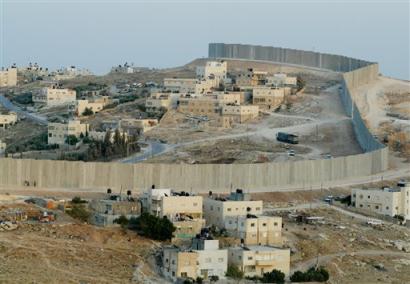
And seen in this light, the actions of the Israeli government since the two intifadas, attempting by all possible means to separate the Palestinian from the Jewish people, with the ultimate step of building a “separation barrier” (or, as Palestinians refer to it, an “apartheid wall”), represent steps away from, not toward, peace. A generation of Palestinian young people is growing up now, whose only contact with Israeli Jews is with soldiers (at checkpoints and in other situations). And the same on the Israeli side (Israelis are prohibited by Israeli law from entering Palestinian controlled “zone A” areas).

 
We cannot stay apart, and find peace. We cannot live as if others do not exist, and find peace. We cannot feed ourselves the myth that we are right, that God is on our side, that we are “the people” and that all others are just vaguely “out there” in the darkness beyond the borders of our world, and find peace.

If we want peace, we must move beyond the ethnocentric stage of denial.

(Coming next: how defense hinders peace) 


*For full treatment of Bennett’s model, see
Bennett, Milton J., “Towards Ethnorelativism: A Developmental Model of Intercultural Sensitivity.” In Paige, R.M. (Ed). (1993) Education for the Intercultural Experience (2nd ed., p. 21-71). Yarmouth, ME: Intercultural Press.

Bennett, Milton J., “Becoming Interculturally Competent.”  In Wurzel, Jaime S., ed., Toward multiculturalism: A reader in multicultural education (2nd ed., pp. 62-77). Newton, MA: Intercultural Resource Corporation, 2004.

Saturday, February 26, 2011

Struggling for peace in interpreting religious texts (the "law of apostasy" in Islam)

There is much public debate and these days about whether Muslims are peaceful people and whether Islam is a “religion of peace.” Many Americans, and many Christians, doubt both of these. Among the issues raised by those who believe that Muslims are extreme and Islam an extreme religion (and, many think, incompatible with the values of Western civilization or Christian teaching), are jihad, views of and relations with outsiders (Christians, Jews and others), treatment of women, and issues like the “law of apostasy,” whereby those who convert from Islam are punishable by death.

Abdullah Saeed (the Sultan of Oman Professor of Arab and Islamic Studies and the Director of National Centre of Excellence for Islamic Studies at the University of Melbourne, Australia), has recently published an article on the latter topic, “The Quranic Case Against Killing Apostates” (http://www.thepublicdiscourse.com/2011/02/2716). (I would highly recommend reading the entire article.)

Saeed discusses the interpretation of the Qur’an and Hadith on the question of killing apostates, and finds no support for this practice.

There is, in fact, no single verse of the Quran that specifies any kind of worldly punishment for converting from Islam, let alone death. The opposite is true. Many verses assert that all human beings are free to believe or not to believe in God or in any particular religion. For example, “Let him who wills believe in it [Islam], and let him who wills, reject it.” Or, “Whoever chooses to follow the right path, follows it for his own good; and if any one wills to go astray, say [O Prophet, to him] ‘I am only a warner.’”

He discusses the classical interpretation, and the fact that many Muslim scholars, teachers and leaders today are arguing for a change in practice and understanding, based on returning again to the texts. And he discusses how this relates to the broader question of whether Islam supports human rights and freedoms (he argues that it does). He argues that, “Today, more and more Muslim thinkers and scholars are adopting the Quranic view of absolute freedom of belief and religion…, “ and sees the debate on apostasy and freedom of belief as “just one dimension of a continuing process of renewal and reform in Islamic thought today. As part of this process Muslims should emphasize the Quran’s values of freedom of belief, compassion for all, and the need not to play God’s role in matters of belief.

For pursuing peace (our topic here), the important point here is that Muslims are debating what the Qur’an and Islam teach about various issues that impact how they relate to others in the world today, and how they view human rights and freedoms. As with any people in any religious tradition, interpretation of the teachings and values of their religion has a huge impact on whether and how they live at peace with others. My hope is that scholars like Saeed will be successful in influencing and guiding the Muslim community worldwide.

Peace Quote of the Day - conflict resolution & spiritual growth

"Conflict provides an avenue for spiritual growth. To resolve conflict, by definition we must become more engaged, not less. Just when we want to 'tell the other person off,' we are forced to be quiet and listen to their complaint. Just when we are most eager to make ourselves understood, we must strive to understand. Just when we seek to air our grievances, we must labor to comprehend another's hurt. Just when we want to point out the fallacies and abusive behavior of someone else, we must ruthlessly evaluate our own offensive attitudes and behaviors."
(Gary Thomas, in Sacred Marriage)

I think that Thomas' view of (some of) what it takes to resolve conflict in marriage (his topic), is at the heart of any peacemaking process (as making peace will always necessitate resolving conflict). And as he sees this process in marriage as an avenue for spiritual growth - which I think he would define as growth as a person of moral character (and spirituality), and in relationship with God - so I think we can also see any conflict resolution in any peacemaking situation (whether Palestinians and Israelis, Muslims and Christians, or whoever) as an avenue for spiritual growth. (Note that Thomas sees practices of listening to others, striving to understand, laboring to comprehend another's hurt, and evaluating of one's own offensive attitudes and behaviors, as practices of spirituality. Call them something else if you like, but at the very least, they entail personal transformation.)

Friday, February 25, 2011

Peace Quote of the Day - overcoming evil

"I have often thought that the most important issue of our time is not racial prejudice or color prejudice or anything else. It is this question of how we overcome evil without becoming another form of evil in the process."
(Laurens van der Post, quoted by Naim Ateek in A Palestinian Christian Cry for Reconciliation)

Can People of Faith Rise Above Tribalism? (Reflections on the occasion of the remembrance of 9/11)

In a post on the site “Not the Religious Type,” the author refers to a recent NY Times editorial by Stanley Fish.  In his editorial, Fish points out the double standard used to discuss violent acts by or against members of a religious community, and concludes the following:

“The formula is simple and foolproof (although those who deploy it so facilely seem to think we are all fools): If the bad act is committed by a member of a group you wish to demonize, attribute it to a community or a religion and not to the individual. But if the bad act is committed by someone whose profile, interests and agendas are uncomfortably close to your own, detach the malefactor from everything that is going on or is in the air (he came from nowhere) and characterize him as a one-off, non-generalizable, sui generis phenomenon.”

What is going on here, I think, is something which we humans easily and naturally slip into, a kind of “tribalism” whereby we assume the best of those who are part of our people, and read their actions in light of our own best values (and with a generous dose of excusing and explaining away bad behavior), but assume the worst of those who are part of a different group, especially during times of conflict and tension between the communities.

(In terms of a model developed by Bennett – his “Developmental Model of Intercultural Sensitivity” – which explains how people progress in their experience of cultural difference, this would fall into the second phase, “Defense,” in which people have a negative experience of difference, and tend to generalize and polarize and talk in “us”/“them” terms, where the “us” is generalized positively and the “them” is generalized negatively.)

The ability to assume the best of our people and the worst of others is rooted, I think, in lack of self-awareness in the first instance (glossing over how bad “we” are and can be) and ignorance of the others in the second instance. When we don’t know people from the “different” group, it is easy to assume the worst of them.

As a Christian, I believe that Jesus would encourage us to be bigger than our tribal allegiances. (As a human being, I would hope that any religious faith would encourage those who follow it, in this same direction.) In illustration of his most important teaching, that the two great commandments are to love God and to love our neighbors as ourselves, he told a parable of a despised Samaritan (who his Jewish listeners would have nothing to do with, and through whose territory they would not even pass) helping a wounded Jew who was abandoned by the road side. And Jesus not only passed through Samaria, he stopped and conversed with a Samaritan woman, someone who would have been looked at by Jewish men as a non-person. By his teachings and by his example, Jesus showed us that God’s perspective on humanity is different than the tribalism we so easily embrace.

My question is, can we – not just Christians, but people of any faith – rise above our tribalism (which is worse when wrapped up with religion – which happens with people of all religions) and learn to relate to other human beings who are not members of our “tribe,” as if they were people also created in the image of God? And can we defuse the generalizing and polarizing, and work toward a more accurate understanding of those of other groups, that can only come as we enter into relationship with those others?

The question, it seems, is whether our faith can be a force for peace, or whether it will be a force in the opposite direction.

Thursday, February 24, 2011

Seeking peace through reclaiming Compassion


I first noticed the "Charter for Compassion" at the Quaker Meeting House in Ramallah (see http://charterforcompassion.org/share/the-charter/):

The principle of compassion lies at the heart of all religious, ethical and spiritual traditions, calling us always to treat all others as we wish to be treated ourselves. Compassion impels us to work tirelessly to alleviate the suffering of our fellow creatures, to dethrone ourselves from the centre of our world and put another there, and to honour the inviolable sanctity of every single human being, treating everybody, without exception, with absolute justice, equity and respect.
It is also necessary in both public and private life to refrain consistently and empathically from inflicting pain. To act or speak violently out of spite, chauvinism, or self-interest, to impoverish, exploit or deny basic rights to anybody, and to incite hatred by denigrating others—even our enemies—is a denial of our common humanity. We acknowledge that we have failed to live compassionately and that some have even increased the sum of human misery in the name of religion.
We therefore call upon all men and women ~ to restore compassion to the centre of morality and religion ~ to return to the ancient principle that any interpretation of scripture that breeds violence, hatred or disdain is illegitimate ~ to ensure that youth are given accurate and respectful information about other traditions, religions and cultures ~ to encourage a positive appreciation of cultural and religious diversity ~ to cultivate an informed empathy with the suffering of all human beings—even those regarded as enemies.
We urgently need to make compassion a clear, luminous and dynamic force in our polarized world. Rooted in a principled determination to transcend selfishness, compassion can break down political, dogmatic, ideological and religious boundaries. Born of our deep interdependence, compassion is essential to human relationships and to a fulfilled humanity. It is the path to enlightenment, and indispensible to the creation of a just economy and a peaceful global community.

I think this is a beautiful document, a necessary and timely project. And I find myself wondering whether conservatives (those who are deeply committed) of the various religions of the world might somehow be against this? Maybe I’m wrong (I hope so). I have the feeling that evangelical Christians, for example, might react against the idea of agreeing and working with those who signed, who represent various Christian and other religious groups (i.e., “how can we work with liberals and people of different religious faiths? What do we have in common?”); and might be suspicious that the language is not their (evangelical) language, and therefore might be a “watering down” or compromising of their convictions.

I find myself wondering, as a follower of Jesus, what he would think of it. Would he embrace these ideas, this document, the principle of joining hands with others (of any religion or none) to work for compassion, for justice, equity and respect? When I put it this way, it seems so obvious. So why would some of us who associate with Jesus by taking the name “Christian,” react negatively to this initiative? 

Why would religious convictions lead some people to initiate and embrace this kind of initiative, and lead others (in the same religions) to be suspicious or reject it?

Tuesday, February 22, 2011

Peace Quote of the Day - being radically "pro life"

“We are not pro-life simply because we are warding off death. We are pro-life to the extent that we are men and women for others, all others; to the extent that no human flesh is a stranger to us; to the extent that we can touch the hand of another in love; to the extent that for us there are no ‘others.’"
 (Brennan Manning, The Ragamuffin Gospel)

Rethinking "pro life"

I was raised in a typical evangelical Christian “pro life” perspective; i.e., “pro life” meant (means) anti-abortion. In recent years, though, I have been challenged to reconsider this view.

One of the themes of the men and women – Jews, Muslims, and Christians –  I have met in Israel and the West Bank is, that a foundation of working for peace is to be radically pro-human, pro-humanity: to see every person as a fellow human being, created in the image of God.

And this leads me to conclude, to be pro-peace is to be pro-life, in a radical, comprehensive sense (seeking shalom, a comprehensive wholeness in all of life). And thus I post the following two quotes for your consideration. Please read them all the way through, and think about the connection between (pro) life and (pro) peace. The first is by Johann Arnold, from Seeking Peace. The second is from Brennan Manning, from his thought provoking work The Ragamuffin Gospel.

“In peacetime, priests and ministers preach on the Ten Commandments, ‘Thou shalt not kill…’ In wartime, they bless bombers. Anti-war people are pro-abortion, and militarists are anti-abortion; anti-abortion activists are prodeath penalty, and so on. Everyone wants to get rid of some particular evil, after which they feel the world is going to be a better place. They forget that you can’t be for the bomb and for children at the same time…”
(Johann Christoph Arnold)


“We are not pro-life simply because we are warding off death. We are pro-life to the extent that we are men and women for others, all others; to the extent that no human flesh is a stranger to us; to the extent that we can touch the hand of another in love; to the extent that for us there are no ‘others.’

“Today the danger of the pro-life position which I vigorously support is that it can be frighteningly selective. The rights of the unborn and the dignity of the age-worn are pieces of the same pro-life fabric. We weep at the unjustified destruction of the unborn. Did we also weep when the evening news reported from Arkansas that a black family had been shot-gunned out of a white neighborhood?

“One morning I experienced a horrifying hour. I tried to remember how often between 1941 and 1988 1 wept for a German or Japanese, a North Korean or North Vietnamese, a Sandinista or Cuban. I could not remember one. Then I wept, not for them, but for myself.

“When we laud life and blast abortionists, our credibility as Christians is questionable. On one hand we proclaim the love and anguish, the pain and joy that goes into fashioning a single child. We proclaim how precious each life is to God and should be to us. On the other hand, when it is the enemy that shrieks to heaven with his flesh in flames, we do not weep, we are not shamed: we call for more.

“The sensitive Jew remembers the Middle Ages: every ghetto structured by Christians; every forced baptism, every Good Friday program, every portrait of Shylock exacting his pound of flesh, every identifying dress or hat or badge, every death for conscience's sake, every back turned or shoulder shrugged, every sneer or slap or curse.

“With their tragic history as background, it is not surprising that many Jews are unimpressed with our anti-abortion stance and our arguments for the sacredness of human life. For they still hear cries of Christkiller; the survivors of Auschwitz and Dachau still feel lashes on their backs; they still see images of human soap, still taste hunger, still smell gas. The history of Judaism is a story of caring: they are not sure we care for them. 

“The pro-life position is a seamless garment of reverence for the unborn and the age-worn, for the enemy, the Jew, and the quality of life of all people. Otherwise it is paste jewelry and sawdust hot dogs.”
(Brennan Manning, emphasis mine)

Takeaways for me, from these authors and my Israel/Palestine “peace heroes,” are that as a “Christian,” I must be open-hearted toward Muslims, Jews, and all others, of any religion or none, treating them with respect, and seeking relationship, working for their rights, etc.  And if I consider myself “pro-life,” I need to rethink the broad implications of that concept, and be ready to follow through on applying it to every area (as these authors advocate).

Values, if they are true, if they are worth holding, if we are to be people worthy of them, must be applied across the board to all people and situations, and not only to our narrowly defined group (or project or cause).