Showing posts with label Bennett's DMIS ("Developmental Model of Intercultural Sensitivity"). Show all posts

Wednesday, May 4, 2011

Beyond Ethnocentrism – Pursuing Peace Through Growth in Intercultural Sensitivity (1): Acceptance

“One of the ways people inevitably increase their awareness when learning about other cultures is to move from thinking ‘My way is the only way’ toward thinking ‘There are many valid ways’ of interpreting and participating in life.”
Brooks Peterson, Cultural Intelligence

In Bennett’s DMIS (Developmental Model of Intercultural Sensitivity), growth toward a richer, fuller, more positive experience of cultural difference, i.e., growth in intercultural sensitivity, is marked by a transition from ethnocentrism (with stages of Denial – Defense – Minimization) to what he calls ethnorelativism (with stages of Acceptance – Adaptation – Integration).


This growth is characterized by a shift from the experience of one’s own beliefs and behaviors (culture, worldview) as “just the way things are,” to the experience of one’s own beliefs and behaviors as one organization of reality among many viable possibilities (i.e., one’s own culture is experienced in the context of other cultures) – as in the Brooks Peterson quote above. From being unknown, alien, absurd, threatening, insignificant, etc., the cultural difference of others becomes (or begins to become) known, real, comprehensible, respected, etc. This change involves a worldview shift – the world is seen and experienced differently, by a person who is becoming interculturally sensitive.

How do we respond to the "different other"?
The movement from ethnocentrism to ethnorelativism is characterized by the development of cultural self-awareness, accompanied by a growing awareness of different others (i.e., of what makes others different, how they are different). (Note that in a different context, Stephen Covey points out that self-awareness is the key human gift, unlocking all other unique human potential, and that without self-awareness we cannot know others, because we treat them as if they were the same as us.)

Part of the growing awareness of others, and of cultural difference, involves beginning to see both the behavior and the values of people from other cultures, within a cultural context (i.e., as understandable within their cultural context).


“people begin to see alien behavior as indicative of profound cultural differences, not just as permutations of universal (and probably ethnocentric) laws”

“Alternative beliefs about both what exists in reality and the value which may be attached to those phenomena are respected as viable, at least as they are expressed in a cultural context.”
Milton Bennett, Towards Ethnorelativism (emphasis mine)

Movement out of ethnocentrism also involves questioning the universality of our experience, our models, our ways of doing things (be it in education, economics, politics, development, leadership, the way we do church life, or whatever realm). One way in which I experienced movement from the “minimization” stage of ethnocentrism, into a more ethnorelative approach, was in realizing that the apparent fact that Egyptians I knew did not seem to live according to Covey’s 7 Habits might not mean that Egyptians are not effective, but that the “7 Habits of Highly Effective Egyptians” are different than Covey’s 7 Habits (i.e., that Covey’s 7 Habits might not be universal). This seems obvious in hindsight, but the idea that a model which works for us is universally applicable, has a powerful force which is hard to escape.  Once we become more aware of the reality of cultural difference, anyone’s claim to have a “universal” model, approach, or solution, should cause us to see red flags and hear alarm bells.

Moving into Ethnorelativism: Acceptance

The first stage in the ethnorelative experience of cultural difference, in Bennett’s model, is Acceptance. Acceptance is characterized by curiosity about cultural difference, and a growing respect for difference. As one moves into Acceptance, s/he does not necessarily have a deep understanding of the difference which exists, but there is at least a realization that there is difference to be discovered, accompanied by a positive attitude toward exploring and discovering the difference.


Acceptance (in my words) involves…
  • letting go of the idea that reality is simply the way we “know” it to be
  • relating to people as they are, rather than as we would like them to be (or according to our image of them)
  • wanting to know people (i.e., in the reality and fullness of who they are)
  • not trying to change others, to be different or to be like us (which is the tendency of an ethnocentric experience of others)
  • accepting others as being as fully human (and as fully complex) as we ourselves are
  • being open to difference, and open to change (for we cannot grow in accepting others, without ourselves changing)
  • being open to the fact that “what works for us” might not work for others, i.e., that “what works for us” might not be “universal”
If conflict in the world can be seen as being caused to some extent by the various manifestations of ethnocentrism (see my previous posts, on how ethnocentrism hinders peace), would growth into what Bennett calls ethnorelativism, have a positive impact for peace? Or to put it another way, would people who are accepting of others who are different, more likely to live in peace with those different others, than those who are denying, defensive toward, or minimizing difference (Bennett's three ethnocentric stages)? If we are serious about pursuing peace, should we be motivated to grow beyond ethnocentrism, into Bennett's stage of Acceptance, and beyond?


I’ll let you answer that one yourself…


Coming soon… Beyond Ethnocentrism (2): Adaptation


*For full treatment of Bennett’s model, see
Bennett, Milton J., “Towards Ethnorelativism: A Developmental Model of Intercultural Sensitivity.” In Paige, R.M. (Ed). (1993) Education for the Intercultural Experience (2nd ed., p. 21-71). Yarmouth, ME: Intercultural Press.

Bennett, Milton J., “Becoming Interculturally Competent.”  In Wurzel, Jaime S., ed., Toward multiculturalism: A reader in multicultural education (2nd ed., pp. 62-77). Newton, MA: Intercultural Resource Corporation, 2004.

Tuesday, March 1, 2011

How ethnocentrism hinders peace (part 3) - minimizing difference


Ethnocentrism, stage three: Minimization

The third stage in Bennett’s model of intercultural sensitivity (the DMIS)* is minimization, about which he comments, “The last attempt to preserve the centrality of one’s own worldview involves an effort to bury difference under the weight of cultural similarities.”

Minimization is the most “tricky” of the stages of ethnocentrism, and perhaps the most difficult, even dangerous, in that it is hard to recognize, it seems on the surface to be positive and nice, and it is possible to function at what seems a good level of interaction with people of other cultures, at this phase.

Will Arabs and Jews really only stop fighting when they face a common enemy? ...Like Iran?!In minimization, people move beyond the polarization of the defense stage (see http://salemshalom.blogspot.com/2011/02/how-ethnocentrism-hinders-peace.html), to a more positive experience of cultural difference. At this stage, cultural difference is overtly acknowledged while not being negatively evaluated. Rather, difference is trivialized by being subsumed under perceived similarity.

“In minimization, human similarity seems more profound than cultural difference, and so we can stand on the common ground of our shared humanity and put aside our differences.”

Minimization is alluring, because of its perceived sensitivity. Bennett is fond of pointing out that people in minimization tend to think of themselves as living by the “Golden Rule,” to “do unto others as you want them to do unto you” – but then he points out the limitations of that approach in relating to different others.

One characteristic of people who are in the minimization stage of dealing with difference is that they have a tendency to think they can just "be themselves" when they travel or enter a different cultural setting, and things will be fine.

Minimization is certainly more pleasant to experience than defense. It is the difference between having a taxi driver ask me to get out of his taxi, in the Middle East, upon hearing that I am an American, versus a taxi driver saying, “that’s okay, it doesn’t matter what your nationality is – we’re all ‘children of Adam’.”

The problem with minimization, though, and why it belongs as a stage of ethnocentrism, is that when I treat people who are culturally different than I am, as if they were not, I am treating them as if they were me, part of my culture. When I “do unto others as I would have them to do unto me,” I fall short of treating them as the unique (and different than me) people that they are.

This is especially problematic with people who are part of a majority or dominant group (in a society or in an organization). Those in the dominant group tend to project their own culture on others, and not see (or experience) significant difference that exists. It has become axiomatic for me that if you want to know how race relations are in a group, you have to ask someone in the minority, not in the dominant group (who will tend to think that “we have no problem with that here”). If you want to know how things are in the area of gender issues, you have to ask women, not men. If you want to know how cultural sensitivity is going in a multicultural group, again, you have to ask those from one of the minority cultures represented.

In the individual realm, we might see minimization in an example of the so-called “love languages.” If I try to love my wife the way that I like her to show love to me, it generally doesn’t work out that well, because she isn’t me. In another realm, if I try to show someone respect by acting in the way that I like others to show me respect, again, it doesn’t tend to hit home for them. Or in yet another area, for me as a strong T (thinker) on the Myers-Briggs (MBTI) to relate well to a friend who is a strong F (feeler), I cannot assume that we are the same (which ends up with me thinking of him as a T, the way that is natural to me).

Bennett talks about two different kinds of minimization, one centered on what he calls physical universalism, and another on what he calls transcendent universalism. The former emphasizes physical needs, e.g., that “all people must eat, procreate, and die.” The latter “suggests that all human beings, whether they know it or not, are products of some single transcendent principle, law, or imperative,” which may be described in religious, economic, political, psychological or other terms. In all cases, cultural differences are ignored, subsumed under dynamics or realities which supposedly trump or neutralize the cultural dimension.

It is easy to find examples of minimization at work, when you know what to look for. They include the confidence with which a group of people leave their own cultural or national context, certain that they have “universal principles” that will work for anyone, anywhere – whether those principles and practices be in leadership, church organization and life, economic development, education, government, politics, or any other area. Americans are obviously adept at this. But the reaction of the rest of the world to those who go abroad with this confidence, is one indication that the values, principles, practices, etc., are not as universal as their proponents assume.

One of the problems with minimization is that people seem sensitive and nice, and can go a long way acting on the assumption of similarity. But the limits of minimization are significant. Think, for example, of the long history of failed aid and development projects. Or consider the reaction of the Arab and Muslim world to the U.S. attempt to export democracy, American style (most Americans still don’t “get” that anyone would have a problem with that). I discovered the limits of minimization when I tried to evaluate Egyptian friends by Covey’s 7 Habits (see http://contextualliving.blogspot.com/2011/02/are-coveys-7-habits-universal.html), or when I attended a Maxwell conference on leadership at an Egyptian church, and tried to imagine what a group of Egyptian leaders were learning from presenters who were parochially American in their language and their examples (had they ever travelled abroad?).

So how does minimization hinder peace?

Minimization is a better place to be than denial or defense, in moving toward peace. In minimization, there can be a kind of peace, a kind of calm coexistence, at least on the surface of things.  But this can be deceptive (which is one of the worse things about minimization). If true peace requires relationship, then minimization represents an obstacle, because when we act as if others are no different than ourselves, when we minimize difference, we cannot really know people as they are, and we cannot therefore attain the depth of genuine relationship that is necessary to build peace. Beyond that, if we interact with different others according to some kind of transcendent universalism, we are probably guilty of trying to fit them into our mold (with the extreme, as Bennett points out, being “aggressive conversion activities”). For people to live together (not apart) in peace, there has to be a level of understanding of and respect for difference, that is not found at the stage of minimization.

And whenever there is “baggage” in the history between groups, or tension, or open conflict, minimization definitely does not work well. Imagine trying to build peace – i.e., positive, constructive relationships built on mutual understanding, etc. – between women and men, whites and blacks, Muslims and Christians, or Palestinians and Israelis – on the assumption that the similarities are greater than the differences, that we’re “all basically the same.”

We cannot minimize cultural differences, and build peace. We cannot project ourselves on others, treat others as if they were us, and build peace. We cannot arrogantly assume that what “works” for us, is right for others around us, and that they should do things “our way,” and live at peace with them (not in the positive sense of a strong positive peace, anyway).

We cannot stay in minimization, and build the depth of peace that we need in our world.

(To be continued...)


*For full treatment of Bennett’s model, see
Bennett, Milton J., “Towards Ethnorelativism: A Developmental Model of Intercultural Sensitivity.” In Paige, R.M. (Ed). (1993) Education for the Intercultural Experience (2nd ed., p. 21-71). Yarmouth, ME: Intercultural Press.

Bennett, Milton J., “Becoming Interculturally Competent.”  In Wurzel, Jaime S., ed., Toward multiculturalism: A reader in multicultural education (2nd ed., pp. 62-77). Newton, MA: Intercultural Resource Corporation, 2004.

Monday, February 28, 2011

How ethnocentrism hinders peace (part 2) - defensiveness toward difference


How defense hinders peace

The second stage in Bennett’s model of intercultural sensitivity is defense.  As someone moves from a lack of awareness of difference (the denial stage, see http://salemshalom.blogspot.com/2011/02/how-ethnocentrism-hinders-peace-denial.html) into more contact with cultural difference, the initial experience and reaction is often negative.  Differences, at this stage, are perceived as threatening to one’s sense of reality and to one’s identity, and a common reaction is to try to preserve the absoluteness of one’s worldview, in the fact of the growing awareness of difference.

Defense is characterized by polarization (“us” vs. “them”), and by a positive stereotyping of one’s own culture and identity, and a negative stereotyping of the other. Bennett refers to the negative view of the other as denigration – negative stereotyping based on race, religion, age, gender, or any other assumed indicator of difference. He refers to the positive sense of self as superiority – positive evaluation of one’s own status, with the idea that everything has evolved and will evolve in our direction (the sense of ourselves as “civilized,” etc.).

Note that defense is the predominant orientation of nation-building and nationalism. And that it deepens in times of conflict between peoples, e.g., the Palestinian-Israeli conflict, the conflict between Bosnians, Serbs and Croatians in the former Yugoslavia, between Muslims and Christians post-9/11, etc. (I remember my shock, the first time I returned to the U.S. post-9/11, to see Christmas light decorations in the shape and colors of the American flag, and all the “God bless America” bumper stickers everywhere.)

Note also that at the defense stage, the "knowledge" of the other is shallow and superficial. There is an Arab proverb, "he who is ignorant of something, is its enemy." We can most easily negatively stereotype and believe the worst about others, when we do not know them, when we do not have personal relationship with them. Most of the Americans that I know, that are most suspicious of Muslims and of Islam, do not have friendships, or even basic relationships, with Muslims.

Bennett notes a variation on the polarization of the defense stage, which he refers to as reversal – the denigration of one’s own culture, and assumption of the superiority of a different culture. Although this may look more positive toward another culture than defense normally does, it is “only changing the center of ethnocentrism.” Reversal is common for people who go abroad and begin adapting to another culture, like Peace Corps volunteers. It can also occur for anyone who gets involved with another group of people and takes up “their cause.”

It is probably fairly self-evident why and how being at the defense stage, hinders peace. Again, peace requires relationship, building something positive together, coexistence. A sense of one’s own superiority, while denigrating the different other, is a serious roadblock to peace. Whether it is Israeli Jews thinking of Palestinians as “dirty Arabs,” “terrorists,” etc., or Americans wondering “what’s wrong with those Muslims, that they are always so violent,” the negative stereotyping of others – especially in situations of conflict, in which peacemaking is most necessary – makes it hard to move toward peace. And the danger, in conflict situations, is that all parties in the conflict will continue on the “downward” slide of defense, toward villainization and dehumanization of the other. The end of this ugly road is the possibility of doing anything to the other, including ethnic cleansing and extermination, with no twinge of conscience.
     
We cannot live in a state of feeling threatened by those who are different from us, and find peace. We cannot allow ourselves to dwell in “us” / “them” thinking, where we are always criticizing “those people,” and find peace. We cannot take pride in our own superiority, and denigrate those different others, and find peace. And most obviously, we cannot embrace the demonization and dehumanization of others, and find peace.

If we want peace, we must move beyond the ethnocentric stage of defense.

(Coming next: how minimization hinders peace)


*For full treatment of Bennett’s model, see
Bennett, Milton J., “Towards Ethnorelativism: A Developmental Model of Intercultural Sensitivity.” In Paige, R.M. (Ed). (1993) Education for the Intercultural Experience (2nd ed., p. 21-71). Yarmouth, ME: Intercultural Press.

Bennett, Milton J., “Becoming Interculturally Competent.”  In Wurzel, Jaime S., ed., Toward multiculturalism: A reader in multicultural education (2nd ed., pp. 62-77). Newton, MA: Intercultural Resource Corporation, 2004.

Sunday, February 27, 2011

How ethnocentrism hinders peace (part 1) - denial of difference

One of the most useful intercultural tools that I’ve come across is Milton Bennett’s “Developmental Model of Intercultural Sensitivity” (DMIS), which considers the process of growth that people experience as they encounter cultural difference.*

In Bennett’s model, people grow from an experience centered in ethnocentrism – seeing and experiencing the world only from the perspective of one’s own people and cultural context – to an experience that he calls “ethnorelativism,” which involves developing the ability to know one’s own culture and worldview as one among many, and the ability to enter into the world of others, adapt, and live effectively in that other cultural context.
 
As I consider conflict and the challenge of pursuing peace, I find myself reflecting on insights from the DMIS to the process of seeking peace (whether in the Palestinian-Israeli conflict, Muslim-Christian relations, or any realm).

How Denial hinders peace

The first phase in the DMIS is denial (ignorance, lack of awareness). We begin by not being aware of (cultural) difference, and avoiding it. The world simply is as we see and experience it. We are “the people” (and any others are beyond our clear vision or understanding). If we are aware of others, they are broadly characterized, e.g., we lump all “Asians” or “Africans” or “Europeans” together, with no real knowledge of any specific characteristics.

Denial may be accompanied by isolation, simply being out of contact with different others, or by separation, “intentional erection of physical or social barriers to create distance from cultural difference as a means of maintaining a state of denial” (e.g., racial neighborhoods or ghettos). Denial is often accompanied by extreme nationalism. The “dangerous underside” of denial, Bennett points out, is the implicit relegation of others to subhuman status (e.g., the Nazi treatment of the Jews).

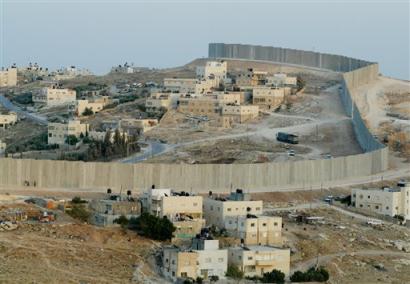
Most of the peace activists I have read, point out that peace is more than the absence of conflict. True peace between peoples involves building something positive, building relationship, developing understanding and coexistence and harmony between peoples. For peace, we need more than different peoples simply staying away from and ignoring each other, and seeking to avoid entering into conflict. We need more than walls keeping us apart.

Thus, this stage of denial hinders peace, because when we live in isolation in our own world, thinking that we are the only real people, and that the world is just as we see it to be, we are not living in relationship or harmony with others. If we want peace, we cannot be content with denial of difference (either isolation or separation).
                 
And seen in this light, the actions of the Israeli government since the two intifadas, attempting by all possible means to separate the Palestinian from the Jewish people, with the ultimate step of building a “separation barrier” (or, as Palestinians refer to it, an “apartheid wall”), represent steps away from, not toward, peace. A generation of Palestinian young people is growing up now, whose only contact with Israeli Jews is with soldiers (at checkpoints and in other situations). And the same on the Israeli side (Israelis are prohibited by Israeli law from entering Palestinian controlled “zone A” areas).

 
We cannot stay apart, and find peace. We cannot live as if others do not exist, and find peace. We cannot feed ourselves the myth that we are right, that God is on our side, that we are “the people” and that all others are just vaguely “out there” in the darkness beyond the borders of our world, and find peace.

If we want peace, we must move beyond the ethnocentric stage of denial.

(Coming next: how defense hinders peace) 


*For full treatment of Bennett’s model, see
Bennett, Milton J., “Towards Ethnorelativism: A Developmental Model of Intercultural Sensitivity.” In Paige, R.M. (Ed). (1993) Education for the Intercultural Experience (2nd ed., p. 21-71). Yarmouth, ME: Intercultural Press.

Bennett, Milton J., “Becoming Interculturally Competent.”  In Wurzel, Jaime S., ed., Toward multiculturalism: A reader in multicultural education (2nd ed., pp. 62-77). Newton, MA: Intercultural Resource Corporation, 2004.

Friday, February 25, 2011

Can People of Faith Rise Above Tribalism? (Reflections on the occasion of the remembrance of 9/11)

In a post on the site “Not the Religious Type,” the author refers to a recent NY Times editorial by Stanley Fish.  In his editorial, Fish points out the double standard used to discuss violent acts by or against members of a religious community, and concludes the following:

“The formula is simple and foolproof (although those who deploy it so facilely seem to think we are all fools): If the bad act is committed by a member of a group you wish to demonize, attribute it to a community or a religion and not to the individual. But if the bad act is committed by someone whose profile, interests and agendas are uncomfortably close to your own, detach the malefactor from everything that is going on or is in the air (he came from nowhere) and characterize him as a one-off, non-generalizable, sui generis phenomenon.”

What is going on here, I think, is something which we humans easily and naturally slip into, a kind of “tribalism” whereby we assume the best of those who are part of our people, and read their actions in light of our own best values (and with a generous dose of excusing and explaining away bad behavior), but assume the worst of those who are part of a different group, especially during times of conflict and tension between the communities.

(In terms of a model developed by Bennett – his “Developmental Model of Intercultural Sensitivity” – which explains how people progress in their experience of cultural difference, this would fall into the second phase, “Defense,” in which people have a negative experience of difference, and tend to generalize and polarize and talk in “us”/“them” terms, where the “us” is generalized positively and the “them” is generalized negatively.)

The ability to assume the best of our people and the worst of others is rooted, I think, in lack of self-awareness in the first instance (glossing over how bad “we” are and can be) and ignorance of the others in the second instance. When we don’t know people from the “different” group, it is easy to assume the worst of them.

As a Christian, I believe that Jesus would encourage us to be bigger than our tribal allegiances. (As a human being, I would hope that any religious faith would encourage those who follow it, in this same direction.) In illustration of his most important teaching, that the two great commandments are to love God and to love our neighbors as ourselves, he told a parable of a despised Samaritan (who his Jewish listeners would have nothing to do with, and through whose territory they would not even pass) helping a wounded Jew who was abandoned by the road side. And Jesus not only passed through Samaria, he stopped and conversed with a Samaritan woman, someone who would have been looked at by Jewish men as a non-person. By his teachings and by his example, Jesus showed us that God’s perspective on humanity is different than the tribalism we so easily embrace.

My question is, can we – not just Christians, but people of any faith – rise above our tribalism (which is worse when wrapped up with religion – which happens with people of all religions) and learn to relate to other human beings who are not members of our “tribe,” as if they were people also created in the image of God? And can we defuse the generalizing and polarizing, and work toward a more accurate understanding of those of other groups, that can only come as we enter into relationship with those others?

The question, it seems, is whether our faith can be a force for peace, or whether it will be a force in the opposite direction.

Thursday, February 10, 2011

Might penitance help with peace?

On a couple of occasions in Minnesota, I’ve had the privilege of hearing Pastor Jin Kim of The Church of All Nations (www.cando.org).  One of his phrases especially caught my attention.

He was decrying denominationalism, and the process of splitting off from other Christian groups because of thinking they are wrong or we are better, thinking and acting as if we have the “best” and sure-to-succeed brand of Christianity. As opposed to this triumphalism, he presented the idea of being what he called “penitently Presbyterian.” Being “penitently Presbyterian,” to him, means recognizing that that is his identity (his people), and that it wouldn’t help the unity of Christians to break off in protest against whatever is wrong in Presbyterianism, to start another “better” or more “pure” church. It means admitting that there are plenty of things wrong with the Presbyterian church (and with Presbyterians), to be repentant, and to seek change for the better. And it means relating well to other Christian denominations.

It strikes me that this attitude can be powerfully applied to just about any group or category that I am part of. Can I, for example, be “penitently Christian” in relation to those of other religions? Recognizing that I am “Christian,” but not relating to others in a way that puts them down, minimizes their humanity, acts as if I (we) have a corner on the truth? (This raises an issue that is a core religious issue, that of truth claims, which I will leave for another time; but in being “penitently Christian,” I mean, for example, that we should not persecute and mistreat others for not being Christian - something which happens far too often when Christians are triumphalist.)

Can I, likewise, be “penitently American” in relation to people of other nationalities? My experience would indicate that people of other nationalities like individual Americans well enough, but very much dislike when we act as if everything American is the best, as if we own the world, as if we can fix (or even understand) everyone’s problems, etc. (i.e., when we are triumphally American). Is it possible to be a different kind of American, aware that I don’t have all the answers (or even know what the problems are), that my country has both good and bad, and that I have a lot to learn from everyone else I encounter?

Those two categories (Christian and American) resonate the most with me, due to my experiences of the past 25-plus years living in the Middle East. But one can easily find other applications (for example, being “penitently male,” in relation to women). And I see a definite connection to the movement from ethnocentrism (seeing my people, my group, as the center and pinnacle, and everyone else as a lesser kind of human being) to ethnorelativism (or ethnosensitivity), experiencing myself / ourselves as one among many, and others as every bit as real and significant as myself / ourselves, and in fact, people (those others) that I can learn and benefit from, if only I will be open.

Nationalism, by the way, is clearly rooted in triumphalism. And if one considers the Palestinian-Israeli conflict (or any other intransigent conflict between different peoples), one always finds a stronghold of national, ethnic, and/or religious triumphalism (again, this reflects the “defense” or “polarization” stage of Bennett’s DMIS). For peacemaking (which requires healthy coexistence and interconnection based on mutual respect as human beings), being “penitent” is essential for all parties.