Here's a well-articulated reflection on the challenges of personal peace-seeking from my good friend and fellow George Fox graduate, Kohleun:
I think deep down I’ve always been a pacifist. Violence in its many forms has unsettled me since I can remember hearing my older brother report a playground fight at his elementary school, or learning that spouse rape was incontestable in court in one last hold out state until I was six years-old, or seeing footage of the NYC World Trade Center falling to rubble when I was planning to go to the cinema to see The Princess Diaries, or watching George W. Bush blink hard as he reported a declaration of war on terror.
Until I began studying at George Fox University (named after one of the founders of the Society of Friends), pacifism as an identification wasn’t something I understood in a contemporary context. I pictured the “old days” when photos were in black and white and you had to take a side or none at all. Pacifism was something I respected and wanted to embrace, but I imagined one had to be an isolationist or at least a social/political puriya as a consequence. And I did NOT want to wear simple dresses and grow my hair out like in The Angel and the Bad Man.
Then I don’t know when it happened, because there was no aha! moment, just the slow coming to terms, but I began to identify myself with pacifism–with non-violent resistors.
read more . . .
Showing posts with label blog/weblink. Show all posts
Showing posts with label blog/weblink. Show all posts
Tuesday, March 15, 2011


Monday, August 2, 2010
Ethnic Cleaning: the fate of Arab Israelis in Israel
The Israeli Declaration of Independence declares that "[The State of Israel] will uphold the full social and political equality of all its citizens, without distinction of race, creed or sex; will guarantee full freedom of conscience, worship, education and culture; will safeguard the sanctity and inviolability of the shrines and Holy Places of all religions; and will dedicate itself to the principles of the Charter of the United Nations."
Unfortunately, it lied.
Nearly 20% of Israel's citizens are not Jews. They are Arab. And yet, despite claims that "Arab Israelis are citizens of Israel with equal rights,"every human rights group we spoke to in Israel (most of which were Jewish) declared that the Arab citizens of Israel are consistently discriminated against, and many live in a constant state of fear.
Just to be clear, I am not talking about the Palestinian residents of the Occupied Territories. I am talking about the Arabs living within the borders of Israel itself, who are supposedly recognized as full citizens by the Israeli government.
One example of this disparity is the difference between the law of return (which makes it illegal for an Arab Israeli to return to their pre-1948 land) and the right of return (which gives every Jew, regardless of citizenship, the right to settle in Israel).
They also receive significantly less public services (i.e. money for schools, health care, road cleanup, etc.) than their Jewish counterparts, despite paying the same amount of taxes.
One of the Jews we talked to at B'Tselem (the Israeli Information Center for Human Rights in the Occupied Territories) cited this as one of the main reasons he got involved with the organization: I have eyes, he said. I grew up seeing the way we lived, and seeing the way our Arab neighbors lived, just across the street. I knew they paid the same taxes, and I couldn't understand why they were treated so differently.
But this is all just an introduction, for what I actually wanted to share, which is Max Blumenthal's article, "The 'Summer Camp Of Destruction:' Israeli High Schoolers Assist The Razing Of A Bedouin Town."
The thing that really struck me in this account of the demolition of a Bedouin village in the Negev (which took place on July 26th) is the fact that the Arabs involved were Israeli citizens.
But instead of being protected by their government and neighbors, they were surrounded by gloating volunteers, celebrating the destruction of an Arab community in their midst.
Unfortunately, it lied.
Nearly 20% of Israel's citizens are not Jews. They are Arab. And yet, despite claims that "Arab Israelis are citizens of Israel with equal rights,"every human rights group we spoke to in Israel (most of which were Jewish) declared that the Arab citizens of Israel are consistently discriminated against, and many live in a constant state of fear.
Just to be clear, I am not talking about the Palestinian residents of the Occupied Territories. I am talking about the Arabs living within the borders of Israel itself, who are supposedly recognized as full citizens by the Israeli government.
One example of this disparity is the difference between the law of return (which makes it illegal for an Arab Israeli to return to their pre-1948 land) and the right of return (which gives every Jew, regardless of citizenship, the right to settle in Israel).
They also receive significantly less public services (i.e. money for schools, health care, road cleanup, etc.) than their Jewish counterparts, despite paying the same amount of taxes.
One of the Jews we talked to at B'Tselem (the Israeli Information Center for Human Rights in the Occupied Territories) cited this as one of the main reasons he got involved with the organization: I have eyes, he said. I grew up seeing the way we lived, and seeing the way our Arab neighbors lived, just across the street. I knew they paid the same taxes, and I couldn't understand why they were treated so differently.
But this is all just an introduction, for what I actually wanted to share, which is Max Blumenthal's article, "The 'Summer Camp Of Destruction:' Israeli High Schoolers Assist The Razing Of A Bedouin Town."
The thing that really struck me in this account of the demolition of a Bedouin village in the Negev (which took place on July 26th) is the fact that the Arabs involved were Israeli citizens.
But instead of being protected by their government and neighbors, they were surrounded by gloating volunteers, celebrating the destruction of an Arab community in their midst.
A number of villagers including Abu Madyam told me the volunteers smashed windows and mirrors in their homes and defaced family photographs with crude drawings. Then they lounged around on the furniture of al-Arakib residents in plain site of the owners. Finally, according to Abu Matyam, the volunteers celebrated while bulldozers destroyed the homes.
“What we learned from the summer camp of destruction,” Abu Madyam remarked, “is that Israeli youth are not being educated on democracy, they are being raised on racism.”
Blumenthal highlights the disturbing reality that many of these volunteers are teenagers, officially working for the Israeli police.
Not only are they being indoctrinated to swear blind allegiance to the military, they are learning to treat the Arab outclass as less than human. The volunteers’ behavior toward Bedouins, who are citizens of Israel and serve loyally in Israeli army combat units despite widespread racism, was strikingly reminiscent of the behavior of settler youth in Hebron who pelt Palestinian shopkeepers in the old city with eggs, rocks and human waste. If there is a distinction between the two cases, it is that the Hebron settlers act as vigilantes while the teenagers of Israeli civilian guard vandalize Arab property as agents of the state.
Blumenthal's concern echoes that of the Arab Association for Human Rights, who we met with in Nazareth. Unlike other organizations (B'Tselem, Al Haq, etc.) working for Arab rights in the Occupied Territories, these were Israeli citizens working for human rights for Arabs in Israel. The director informed us that his great fear is that, while the situation in the Occupied Territories will eventually be resolved, one way or another, the situation for Arabs in Israel will just continue to deteriorate, because they are invisible.
Most do not even know they exist. The terms Israeli and Arab are thought to be mutually exclusive.
While the individual suffering is heartbreaking, it is the trend (and legal precedence) that is truly terrifying. As Blumenthal states, "The spectacle of Israeli youth helping destroy al-Arakib helps explain why 56% of Jewish Israeli high school students do not believe Arabs should be allowed to serve in the Knesset."
Take a moment. Read that again. More than half of Jewish youth (the next generation of leaders and law makers) do not believe that Arab citizens should have a voice in the law-making of their country.
They want the minority silenced.
As for the present condition of Israeli democracy, it is essential to consider the way in which the state pits its own citizens against one another, enlisting the Jewish majority as conquerers while targeting the Arab others as, in the words of Zionist founding father Chaim Weizmann,“obstacles that had to be cleared on a difficult path.” Historically, only failing states have encouraged such corrosive dynamics to take hold. That is why the scenes from al-Arakib, from the demolished homes to the uprooted gardens to the grinning teens who joined the mayhem, can be viewed as much more than the destruction of a village. They are snapshots of the phenomenon that is laying Israeli society as a whole to waste.This is America's democratic ally in the Middle East.
Tuesday, October 27, 2009
Palestinians Denied Water
The shortage of water in the West Bank and Gaza is a very old story, but it is still disturbingly true.
Israelis have swimming pools and gardens; Palestinians have barely enough for subsistence survival.
For an update on the situation (and information from Amnesty International's new report on the issue), see BBC's October 27th article, Report: Palestinians denied water.
While sad, Israel's attempts to keep "their" water for themselves is unsurprising. What I find truly sickening is the wanton destruction of Palestinian water reserves by the Israeli military. One soldier reports that Palestinian water tanks make good target practice.
This needless, pointless waste -- the loss of water in a desert country, the theft of life from a people who love to grow green things -- strikes me as evil. To take something away from someone, not to use it, but simply to prove that one has the power to destroy . . . every bully, from Hitler to Stalin, has done the same.
Israelis have swimming pools and gardens; Palestinians have barely enough for subsistence survival.
For an update on the situation (and information from Amnesty International's new report on the issue), see BBC's October 27th article, Report: Palestinians denied water.
While sad, Israel's attempts to keep "their" water for themselves is unsurprising. What I find truly sickening is the wanton destruction of Palestinian water reserves by the Israeli military. One soldier reports that Palestinian water tanks make good target practice.
This needless, pointless waste -- the loss of water in a desert country, the theft of life from a people who love to grow green things -- strikes me as evil. To take something away from someone, not to use it, but simply to prove that one has the power to destroy . . . every bully, from Hitler to Stalin, has done the same.
Wednesday, March 4, 2009
tabula gaza back up
Philip Rizk's blog is back up.
Gaza, he reminds us, is still dying.
tabula gaza: the veil of normalization
Gaza, he reminds us, is still dying.
During those raids Raed lost his house for the second time. The Israeli soldiers ordered him and his family out of the house, blew it up with dynamite and then bulldozed his and his father’s taxis- their only source of income.We must not forget.
His 15-year old daughter- the top of her class- refuses to return to school.
tabula gaza: the veil of normalization
Thursday, February 12, 2009
Interview with Philip Rizk
Today is Philip Rizk's 27th birthday. Before celebrating with family and friends, he met with journalists to describe his four days in Egyptian detainment.
The full transcription of the interview can be found here.
He was threatened with torture, and informed that if he “continue[d] on this track” (his activism in regards to Gaza, assumedly) he would be “visiting [his interrogators] quite often.”
However, Rizk maintains that this is an insufficient reason to cease acting on behalf of Gaza: “I always knew there was the risk living in Egypt . . . to be involved in these kind of activities,” he said. “So you know there's a risk if you speak out too much; you know there's a risk.”
C.S. Lewis once claimed that those who would make peace in non-violent ways (the so-called "pacifists" of the world) were ultimately cowards at heart. I must humbly (but passionately) disagree. If it's courage that we need, I want the courage, not to point a gun at my enemy (or my friend's enemy), but to suffer at thier hands, and still speak on behalf of justice. To risk recrimination, to risk violence and suffering, and to never be silenced. I want the courage of Jesus, and Gandhi, and Martin Luther King, Jr.
And yes, I want the courage of Philip Rizk.
The full transcription of the interview can be found here.
He was threatened with torture, and informed that if he “continue[d] on this track” (his activism in regards to Gaza, assumedly) he would be “visiting [his interrogators] quite often.”
However, Rizk maintains that this is an insufficient reason to cease acting on behalf of Gaza: “I always knew there was the risk living in Egypt . . . to be involved in these kind of activities,” he said. “So you know there's a risk if you speak out too much; you know there's a risk.”
C.S. Lewis once claimed that those who would make peace in non-violent ways (the so-called "pacifists" of the world) were ultimately cowards at heart. I must humbly (but passionately) disagree. If it's courage that we need, I want the courage, not to point a gun at my enemy (or my friend's enemy), but to suffer at thier hands, and still speak on behalf of justice. To risk recrimination, to risk violence and suffering, and to never be silenced. I want the courage of Jesus, and Gandhi, and Martin Luther King, Jr.
And yes, I want the courage of Philip Rizk.
Sunday, February 8, 2009
Philip Rizk, Journalist and Activist, Abducted
At 8:00pm on Friday, February 6th, Philip Rizk, a German-Egyptian graduate student, activist, and blogger (Tabula Gaza), was abducted by Egyptian national security. Fourteen others were detained; all but Philip have been released.
Philip was taken while participating in a solidarity march for Gaza. His blog reads:
Security originally denied having arrested Philip. They have now confirmed that he is being held, but refuse to comment on his whereabouts or status.
His family has started a facebook group to raise awareness and gather support: Support and Prayer for the Safe Release of Philip Rizk. Join your voice to theirs.
Philip was taken while participating in a solidarity march for Gaza. His blog reads:
In commemoration of the breaching of the Rafah border between Gaza and Egypt one year ago on January 23rd, 2008 the Egyptian Popular Committee in Solidarity with The Palestinian People is calling for a MARCH TO GAZA.
On December 27th, 2008 Israel started a horrific bloodbath in Gaza eventually killing almost 1500 Palestinians, including 410 children and injuring thousands. Israel’s ensuing military onslaught destroyed homes, schools, places of worship, and essential infrastructure leading to a humanitarian catastrophe. These attacks are exacerbated by Israel’s ongoing siege, which leaves the Palestinian people in Gaza prisoners within Israeli created borders and dependent on the trickle of supplies that its occupier allows in.
The Call:
End the Siege on Gaza.
The Vision:
We hope for the call to spread organically, to look different in different places around the world. Whether a defined distance is walked, a specific number of people participate or the march is carried out individually, whether calling for boycott or trying Israel for war crimes we are hoping that such efforts will pick up momentum and increase.
Though the immediate Israeli military onslaught on Gaza- for the time being- has come to a standstill this is not a solution. Let us seize this time of urgency to act and call for an end to siege on Gaza. Though our respective governments reject expressing our resistance to the status quo we- the multitude- must move to the streets, as a collective global expression in condemnation of Israel’s actions.
The Egypt group will march on Gaza from multiple locations starting February 6th.
Follow all events at: www.togaza.net.
His family has started a facebook group to raise awareness and gather support: Support and Prayer for the Safe Release of Philip Rizk. Join your voice to theirs.
Tuesday, January 6, 2009
A Palestinian Mother's Blog
If you've been watching CNN recently, you might have seen an interview with Laila El-Hadda. A Palestinian from Gaza, she is a journalist and blogger living in North Carolina with her family.
Her parents are still in Gaza.
If you're interested in her side of the story -- a Palestinian raising her children in America, with family still suffering in Gaza -- I'd recommend you check out her blogsite: Raising Yousuf and Noor: diary of a Palestinian mother.
You could also read one of her articles, Bloodied in Gaza, published on the 30th of December.
Her parents are still in Gaza.
If you're interested in her side of the story -- a Palestinian raising her children in America, with family still suffering in Gaza -- I'd recommend you check out her blogsite: Raising Yousuf and Noor: diary of a Palestinian mother.
You could also read one of her articles, Bloodied in Gaza, published on the 30th of December.
Saturday, January 3, 2009
Pictures and Stories of Gaza
If you want eyewitness accounts of what's going on in Gaza, on the ground, check out this blog: In Gaza. The pictures alone tell a horrifying story.
Wednesday, November 26, 2008
B'Tselem Joins Facebook (and you can too =)
I just discovered that B'Tselem, the Israeli Information Center for Human Rights in the Occupied Palestinian Territories, has a facebook group. I'm not sure if this is a new development, or if I've just been oblivious. Either way, I encourage you to join. If you happen to be a facebook hater, I exert no pressure (and respect your position), but if you're already a member, this is a good way to dialogue and make connections.
They have a recent news column, and lots of links to related topics (most not posted by B'Tselem, just those interested). They also give an email address (mail@btselem.org) and offer to respond to any questions.
If you're not already familiar with B'Tselem's work, I strongly suggest you become so. Their website (www.btselem.org) is an excellent source of information, whether you want general information, or specific statistics related to home demolition, the separation barrier, Israeli settlements, casualty counts, or related topics.
Here's the blurb from their facebook group, which gives an idea of who they are, and what they do:
They have a recent news column, and lots of links to related topics (most not posted by B'Tselem, just those interested). They also give an email address (mail@btselem.org) and offer to respond to any questions.
If you're not already familiar with B'Tselem's work, I strongly suggest you become so. Their website (www.btselem.org) is an excellent source of information, whether you want general information, or specific statistics related to home demolition, the separation barrier, Israeli settlements, casualty counts, or related topics.
Here's the blurb from their facebook group, which gives an idea of who they are, and what they do:
B'Tselem is the Israeli Information Center for Human Rights in the Occupied Palestinian Territories. The name means "in the image of God" in Hebrew, conveying that we are all born equal.One interesting element of the facebook group (which I haven't found on their website) is a link to videos. Among others, there's the July film clip of a soldier firing a rubber bullet at a bound and blindfolded Palestinian (the event that inspired Amal's "Inappropriate Behavior: the Art of Shooting Blindfolded Palestinians," which I posted back in August). Here's the blurb B'Tselem posted:
_________________Our Intentions_______________
We endeavor to educate the Israeli public and policymakers about human rights violations in the OPT, combat the phenomenon of denial prevalent among the Israeli public, and help create a human rights culture in Israel.
As an Israeli organization, B'Tselem acts primarily to change Israeli policy in the OPT and to ensure that its government, which rules these territories, protects the human rights of its residents and complies with its obligations under international law.
________________Shooting Back_________________
In this video project that has been running for the last two years, we distribute video cameras among Palestinians that live in areas of especially high conflict in the OPT, so they can film violations on human rights. The films are used as court evidence. Also, they have become a non-violent weapon that we use to advocate justice, to protect the rights of Palestinians in the OPT, and to show how life under the occupation really is.
_______________Getting Involved__________________
Sign up at our website to get RSS feeds or bi-weekly updates by email (Hebrew or English) on new publications and recent incidents B'Tselem has dealt with.
We'll be happy to answer any questions - by email or here on the wall.
On 20 July 2008, B'Tselem was given a video cassette a Palestinian youngster filmed through the window of her home, in Ni’lin. The footage, filmed on 7 July, shows a soldier firing a rubber-coated bullet at a handcuffed, blindfolded Palestinian from almost point-blank range. Several security forces were present, among them a lieutenant-colonel who was holding the Palestinian’s arm when the shot was fired. B'Tselem immediately published the footage and sent a copy to the Military Police Investigation Unit. The media reported that following the airing of the video, the army opened an investigation, and that the Judea and Samaria Division Commander had known about the incident but had taken no action in the matter.The family is still struggling to pay legal costs.
The video was shot by Salam ‘Amira, a Palestinian high school student, from her family home window, in the village of Ni’lin. The ‘Amira family did not earn any material reward for the video, but paid a high price for its brave act. Three days later, the family’s head, Jamal ‘Amira, was arrested at a protest in his olive grove, and was detained for over three weeks.
Following an appeal by Adv. Gabi Laski, Jamal ‘Amira was released on bail. The military appeal judge strongly criticized the handling of the case by the military prosecution, and wrote that: "It is doubtful that the evidence in the case will lead to a conviction". The judge treated seriously the family’s allegation that the arrest was official revenge for the video’s release.
Sunday, November 2, 2008
Remembering War: the Imperial War Museum
Here's a different perspective on the trip to the Imperial War Museum: Remembering War. Kohleun (the blog's writer) raises questions about why, and what, we remember about war:
In the main room fighter planes hung from the ceiling with huge propellers. Tanks of many shapes parked in various places shone with green paint. And the largest bullet stood straight up, looking to the sky. But this was dwarfed by the massive bomb in the middle of the atrium, visible from all balconies.The above extract is short, but it gives you a sense of her perspective. I was reading through the comments she'd received, and especially liked the following from Michelle:
And I can't help but think, that is not the stuff of life. Manipulated metal and explosives are not the stuff to base our memories upon.
"Let the sight of rubble be forever present before the leaders' eyes so that the flame of peace will light constructive solutions in their minds."I certainly hope so.
So can we forget (or forgive) war to the extent that we let go of victim/perpetrator status but remember it to the extent that we are motivated to make peace?
Thursday, October 9, 2008
Belfast Murals
I just got back to Oxford (where I'm currently residing) after spending the weekend with a friend in Belfast. She's in Northern Ireland for the year, working with a local church toward reconciliation and community building. While it was wonderful to see her, and beautiful to see Ireland, I was a bit shocked by the overt support of paramilitary groups still evident in murals throughout the city (particularly on Shankill Road, where I spent over an hour -- just wandering). Though "the Troubles" may be simmering down, it was eerie to see so much hatred and one-sided remembrance of pain. And I had to wonder, how can peace and true healing occur when one side still remembers themselves as heroes, and labels their enemies terrorists?
 "He will wipe every tear from their eyes. Revelation 21:4"
 "IN THE NAME OF LOVE. 1 John 3:16-18, Eph. 5:1-2, Mark 12:30-31"
 "hope. love. forgiveness."
 "He will wipe every tear from their eyes. Revelation 21:4"
 "IN THE NAME OF LOVE. 1 John 3:16-18, Eph. 5:1-2, Mark 12:30-31"
 "hope. love. forgiveness."
The friend I was visiting has an interesting, and succinct, description of the Troubles on her blogsite.
Wednesday, August 13, 2008
Inappropriate Behavior: the Art of Shooting Blindfolded Palestinians
Okay, last one, and then I'll try to calm down. This is still from Amal's blog. More fighting words, and yet the world seems to excel at conveniently ignoring the facts:
If You Shoot a Bound and Blindfolded Palestinian in the Foot...
The Israeli soldier who shot a bound and blindfolded Palestinian man with a bullet at close range was found guilty of "inappropriate conduct" and was reassigned.
So if you were holding your breath, you can exhale.
I hope now you understand how the occupation works:
If you shoot a bound and blindfolded Palestinian in the foot, your conduct is "inappropriate."
If you shoot a bound and blindfolded Palestinian in the eye, your conduct is "rather inappropriate."
If you shoot a bound and blindfolded Palestinian in the head, your conduct is "really inappropriate."
If you shoot ten bound and blindfolded Palestinians in the foot, eye, and head, your conduct is "very inappropriate."
If you shoot one hundred bound and blindfolded Palestinians in the foot, eye, head, mouth, and genitals, you are a national hero.
In all the above cases, you will be reassigned. Depending on how many you shoot and where you shoot them, there is a good chance you will be reassigned to be Prime Minister or Chief of Staff.
To put things in perspective:
If a Palestinian throws a stone at an Israeli armored tank, his conduct is labeled "criminal" and he is reassigned to an Israeli jail for a few years.
Inhale that!
If You Shoot a Bound and Blindfolded Palestinian in the Foot...
This update is for those who were holding their breath:
The Israeli soldier who shot a bound and blindfolded Palestinian man with a bullet at close range was found guilty of "inappropriate conduct" and was reassigned.
So if you were holding your breath, you can exhale.
I hope now you understand how the occupation works:
If you shoot a bound and blindfolded Palestinian in the foot, your conduct is "inappropriate."
If you shoot a bound and blindfolded Palestinian in the eye, your conduct is "rather inappropriate."
If you shoot a bound and blindfolded Palestinian in the head, your conduct is "really inappropriate."
If you shoot ten bound and blindfolded Palestinians in the foot, eye, and head, your conduct is "very inappropriate."
If you shoot one hundred bound and blindfolded Palestinians in the foot, eye, head, mouth, and genitals, you are a national hero.
In all the above cases, you will be reassigned. Depending on how many you shoot and where you shoot them, there is a good chance you will be reassigned to be Prime Minister or Chief of Staff.
To put things in perspective:
If a Palestinian throws a stone at an Israeli armored tank, his conduct is labeled "criminal" and he is reassigned to an Israeli jail for a few years.
Inhale that!
Fighting Words: the Illegality of Settlements
Wow, wow, wow. The more I read of Amal's blog, the more I want to repost every entry on mine. Here's something to chew on (as Homer [of Iliad and Odyssey fame] might say, "fighting words"):
Repeat After Me: Settlements are Illegal!!
A BBC article about building new Jewish settlements in the Jordan Valley ends with this question:
We know who is going to win.
Repeat After Me: Settlements are Illegal!!
A BBC article about building new Jewish settlements in the Jordan Valley ends with this question:
The future of the Jordan Valley, its Jewish settlements and Palestinian villages, will be decided in a Palestinian-Israeli peace deal. If and when that happens, might there be a way of accommodating both Jasser [the Palestinian farmer] and Yossi [the Isreaeli colonists] in this stunningly beautiful but often hostile strip of land?Ending the article in this way equates the victim and the thief. Jasser has international law on his side: this land is his land; he owned if for generations and all settlements built under occupation are illegal. Yossi has the power of a colonial state on his side and a god who works in his free time as a real estate agent.
We know who is going to win.
A Palestinian Woman's Blog and Palestinians at the Olympics
Interested in a Palestinian woman's take on life and politics? I would highly recommend you check out Amal A.'s Improvisations blogsite. Her statement of purpose reads:
The Awesome Palestinians
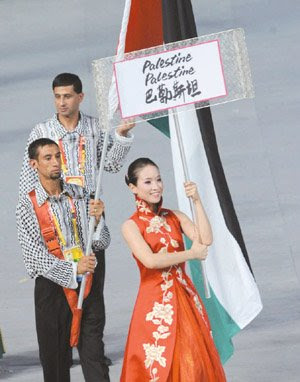
Last night I did something I usually don't do: I planted my eight-year old son in front of the TV and ordered: watch. It was the opening ceremonies of the Olympic games. We watched over two hours of amazing choreography, high-minded symbolism, cute children, huge screens, thousands of performers (basically men doing the heavy lifting and women the pretty dancing). We commented, argued, admired, and shrugged as the spectacle unfolded in front of our comfy sofa.
Then the parade of nations began.
We stopped our snacking and waited.
We blushed when the Bahrain delegation marched holding a picture of the country's leader over the flag. The only people to do so! As my son explained: "they must love their ruler very very much."
We groaned when the commentator described Jordan as a somewhat "progressive country." (define "somewhat")
We snickered when the commentator pointed out that the two women flag bearers for the UAE delegation happened to be the prime minister's daughters (he concluded: "but that maybe a coincident.") (then we fumed for continuing to be the butt of jokes)
We frowned when the Saudi Arabia delegation appeared with no women on it and we had to be reminded that "Saudi women need a male guardian to travel."
We were deeply saddened by the uniforms of the women on the Hungarian delegation.
But we mostly waited.
There were huge nations and small ones (the population of one participating country was 46,000 people). There were bullying and bullied countries. We patiently waited.
Finally, they appeared. The Palestinians.
Now jumping on the sofa, pointing at the screen, and screaming "Palestine, Palestine," my son and I drowned out everything that the commentators said and could hardly focus on the picture. All I remember is this: there were four participants: two runners and two swimmers. The flag bearer was the runner Nader al Masri, who trained in Beit Hanoun, Gaza, during Israeli "incursions." I could see two women dressed in traditional Palestinian dresses. They all walked around the stadium holding hands and raising the victory sign.
They appeared for a few seconds. The Cuban delegation followed and the Palestinians disappeared from the screen.
We know they may not win any medals, but they already won. For despite the occupation, the closed borders, the divisions, the poverty, the misery, the lack of official support, the lack of facilities and the empty promises, they came for Palestine. They had no Olympic-size pools to swim in. They had no shoes or safe roads. They had no budgets. They had to wait for exit permits that may or may not be granted. But they persevered and came.
My son and I cheered for this, not for an abstract nationalism or an "us against them" idea. We cheered for the tenacity of young women and men who insist on dreaming of a better future.
When it was obvious that we will not see more of the Palestinians, we settled down. My son, breathless and flushed with excitement, turned to me and said: "They were awesome!"
Yes, they were: Nader, Ghadeer, Hamse, and Zakiya. We thank you for your awesomeness!
These are improvisations: neither a manifesto nor a treatise because life is too complicated for either. Yet, I'm improvising as an Arab -- Palestinian -- woman with a progressive point of view always under construction. Since I often find myself caught between anti-Arab racism and arab reactionary politics, both of which threaten to gag me, I'm raising my voice against both, hoping in the process to contribute an improvised note to a progressive Arab blogosphere.Here is her moving account of watching the Palestinian delegation march into the Olympic opening ceremony:
The Awesome Palestinians

Last night I did something I usually don't do: I planted my eight-year old son in front of the TV and ordered: watch. It was the opening ceremonies of the Olympic games. We watched over two hours of amazing choreography, high-minded symbolism, cute children, huge screens, thousands of performers (basically men doing the heavy lifting and women the pretty dancing). We commented, argued, admired, and shrugged as the spectacle unfolded in front of our comfy sofa.
Then the parade of nations began.
We stopped our snacking and waited.
We blushed when the Bahrain delegation marched holding a picture of the country's leader over the flag. The only people to do so! As my son explained: "they must love their ruler very very much."
We groaned when the commentator described Jordan as a somewhat "progressive country." (define "somewhat")
We snickered when the commentator pointed out that the two women flag bearers for the UAE delegation happened to be the prime minister's daughters (he concluded: "but that maybe a coincident.") (then we fumed for continuing to be the butt of jokes)
We frowned when the Saudi Arabia delegation appeared with no women on it and we had to be reminded that "Saudi women need a male guardian to travel."
We were deeply saddened by the uniforms of the women on the Hungarian delegation.
But we mostly waited.
There were huge nations and small ones (the population of one participating country was 46,000 people). There were bullying and bullied countries. We patiently waited.
Finally, they appeared. The Palestinians.
Now jumping on the sofa, pointing at the screen, and screaming "Palestine, Palestine," my son and I drowned out everything that the commentators said and could hardly focus on the picture. All I remember is this: there were four participants: two runners and two swimmers. The flag bearer was the runner Nader al Masri, who trained in Beit Hanoun, Gaza, during Israeli "incursions." I could see two women dressed in traditional Palestinian dresses. They all walked around the stadium holding hands and raising the victory sign.
They appeared for a few seconds. The Cuban delegation followed and the Palestinians disappeared from the screen.
We know they may not win any medals, but they already won. For despite the occupation, the closed borders, the divisions, the poverty, the misery, the lack of official support, the lack of facilities and the empty promises, they came for Palestine. They had no Olympic-size pools to swim in. They had no shoes or safe roads. They had no budgets. They had to wait for exit permits that may or may not be granted. But they persevered and came.
My son and I cheered for this, not for an abstract nationalism or an "us against them" idea. We cheered for the tenacity of young women and men who insist on dreaming of a better future.
When it was obvious that we will not see more of the Palestinians, we settled down. My son, breathless and flushed with excitement, turned to me and said: "They were awesome!"
Yes, they were: Nader, Ghadeer, Hamse, and Zakiya. We thank you for your awesomeness!
Tuesday, August 12, 2008
More Darwish
Visit Behind the Lines for a different translation of Mahmoud Darwish's "Under Siege" and an Al Jazeera film clip on Darwish's legacy (also available on YouTube).
A Tribute for Mahmoud Darwish
The following is from the blog Improvisations:
Mahmoud Darwish (1941-2008): Why Did You Leave Us Alone?
The poet is dead. Who will tell the world our story? Who will tell us the stories of the world? He leaves us when we needed him most: when we are no longer heard, when we no longer can see ahead, for our horizons have become prisons.
The poet is dead. No more new poems for us. We have to do with what he left behind. And do we must: for his poems are the oxygen mask that failed him but gets us through our days.
The poet is dead. Words weep. Like us, they know what they have lost. Like us, they have been orphaned, adrift, in a world that has only politicians.
The poet is dead and with him my dream that one day I will hear him live.
The poet is dead. But his poems stay. We will know them better now. We will pour over them and squeeze every word the way we squeeze an olive to get out of it its last drop of goodness.
Goodnight, poet.
Mahmoud Darwish (1941-2008): Why Did You Leave Us Alone?
The poet is dead. Who will tell the world our story? Who will tell us the stories of the world? He leaves us when we needed him most: when we are no longer heard, when we no longer can see ahead, for our horizons have become prisons.
The poet is dead. No more new poems for us. We have to do with what he left behind. And do we must: for his poems are the oxygen mask that failed him but gets us through our days.
The poet is dead. Words weep. Like us, they know what they have lost. Like us, they have been orphaned, adrift, in a world that has only politicians.
The poet is dead and with him my dream that one day I will hear him live.
The poet is dead. But his poems stay. We will know them better now. We will pour over them and squeeze every word the way we squeeze an olive to get out of it its last drop of goodness.
Goodnight, poet.
Sunday, July 20, 2008
Memo to Obama, McCain: No one wins in a war
Here's an interesting article about the futile nature of war -- and the destruction it causes: Jewish Peace News: Howard Zinn: Memo to Obama, McCain: No one wins in a war.
Thursday, March 27, 2008
Jews for Justice and Peace
Here are some websites to visit. Voices for peace from the other side -- Israel, and Jews living abroad. Gush Shalom has a whole page of links to similar sites, so if you're interested, check it out.
Bat Shalom: an organization of Israeli women working for peace. Here's their declaration of principles.
Jews for Justice for Palestinians: this site is based out of Britain, and has some good information on the conflict (the causes and abuses) in their fact sheets.
Jewish Voice for Peace: a group that seeks to affect U.S. foreign policy as it relates to Israel and Palestine.
These next two are run by Israeli soldiers, or ex-soldiers, who are speaking out against the violence and abuse leveled against Palestinians by the Israeli army.
Breaking the Silence: offers testimonies from soldiers about their experiences in the Occupied Territories during the Second Intifadah.
Courage to Refuse: a site created by officers and soldiers in the Israeli army who are refusing to engage in the oppression of Palestinians in the Occupied Territories. Over 280 soldiers have been court martialed and jailed for their stance.
The Combatants Letter, which began this movement, is as follows:
Bat Shalom: an organization of Israeli women working for peace. Here's their declaration of principles.
Jews for Justice for Palestinians: this site is based out of Britain, and has some good information on the conflict (the causes and abuses) in their fact sheets.
Jewish Voice for Peace: a group that seeks to affect U.S. foreign policy as it relates to Israel and Palestine.
These next two are run by Israeli soldiers, or ex-soldiers, who are speaking out against the violence and abuse leveled against Palestinians by the Israeli army.
Breaking the Silence: offers testimonies from soldiers about their experiences in the Occupied Territories during the Second Intifadah.
Courage to Refuse: a site created by officers and soldiers in the Israeli army who are refusing to engage in the oppression of Palestinians in the Occupied Territories. Over 280 soldiers have been court martialed and jailed for their stance.
The Combatants Letter, which began this movement, is as follows:
- We, reserve combat officers and soldiers of the Israel Defense Forces, who were raised upon the principles of Zionism, self-sacrifice and giving to the people of Israel and to the State of Israel, who have always served in the front lines, and who were the first to carry out any mission in order to protect the State of Israel and strengthen it.
- We, combat officers and soldiers who have served the State of Israel for long weeks every year, in spite of the dear cost to our personal lives, have been on reserve duty in the Occupied Territories, and were issued commands and directives that had nothing to do with the security of our country, and that had the sole purpose of perpetuating our control over the Palestinian people.
- We, whose eyes have seen the bloody toll this Occupation exacts from both sides,
- We, who sensed how the commands issued to us in the Occupied Territories destroy all the values that we were raised upon,
- We, who understand now that the price of Occupation is the loss of IDF’s human character and the corruption of the entire Israeli society,
- We, who know that the Territories are not a part of Israel, and that all settlements are bound to be evacuated,
- We hereby declare that we shall not continue to fight this War of the Settlements.
- We shall not continue to fight beyond the 1967 borders in order to dominate, expel, starve and humiliate an entire people.
- We hereby declare that we shall continue serving the Israel Defense Force in any mission that serves Israel’s defense.
The missions of occupation and oppression do not serve this purpose – and we shall take no part in them.
Tuesday, March 18, 2008
Megan's Writing
If you've enjoyed the reflections, poems, and fiction written by Megan Buff that I've posted, I'd encourage you to check out her new blogsite (Reflections of an Odd Duck).
If you don't know what I'm talking about, check out this selection of her work:
The Other One
Standard of Measure
My Jesus Wears a Hejab
Adhan
Settlement
The Beauty of Religion
If you don't know what I'm talking about, check out this selection of her work:
The Other One
Standard of Measure
My Jesus Wears a Hejab
Adhan
Settlement
The Beauty of Religion
Sunday, February 3, 2008
The Economics of Life
Here's another post from Daily Rantings of an increasingly cynical Fish. I really don't know anything about economics, but this is a good prod to keep thinking and wrestling with the issues of the violent world we live in:
Dec. 8, 2007
Donkeys in Gaza, suicide bomber in Iraq, studying in America and Economic theories...
Dec. 8, 2007
Donkeys in Gaza, suicide bomber in Iraq, studying in America and Economic theories...
The past semester I have been taking a class on International Political Economics. Now, everywhere I look instead of seeing bad political policies I see bad economic policies coupled and enhanced with bad political policies. Instead of questioning why Bush contradicts his rhetoric about democracy, I question why he contradicts his rhetoric about economic liberal policies. I am awed by the strength and perseverance of Palestinians making their own work, downsizing from a car to a donkey, and I wonder is the Middle East a backwards underdeveloped society, or are we making it a backwards underdeveloped society?
I then see the article about the tragic suicide bombing in Iraq, and of course the sex of the bomber is emphasized before her act. Again, she did not commit a political act, she committed a vengeful act. Technically her act was not terrorism, for how can a woman commit a politically charged violent act, her act was to get revenge for the killing of her sons.
Then I question what does it matter...she still blew herself up. What type of a world do we live in where the only way people feel that they can have a voice is to blow themselves up?
I think of what my friends would say...of what my society would say being at a Christian school...we are not of this world...only Jesus can solve our problems. I sit quietly as I have been trained to do as a woman (or at least how people have tried to train me to act), and inside I am kicking, shouting and cursing. How can we so easily brush aside these problems as if we are unable to affect them?
Then I recognize if I want the world to change I have to change it. I have to choose a career that will allow me to change it. I've been slowly recognizing this for sometime now...which is why I'm an international studies major...why I study abroad...why I work for the IRC...it's why I'm planning to go to grad school. Still, what will I do? how will I use my skills to change the world...I have no idea. I think I know what I want to do in grad school but I'm not sure. Whatever it is...will it actually help these people? Will I choose a career that will feed my wallet, or keep a person from blowing themselves up? Will I choose a career that will benefit me, or give a man in Palestine an opportunity to start his own buisness?
I guess it all goes back to economics. How do I see the world? Is it really zero-sum, or is positive-sum? Or is it negative -sum? I honestly don't know.
Subscribe to:
Posts (Atom)