Showing posts with label Gaza. Show all posts

Thursday, July 16, 2009

Literature, Conflict, and Peace: Israeli and Palestinian Writing

Those who have known me long, since I first began to speak of Palestine, and my ache for the abandoned children of Lebanese refugee camps, are slightly baffled by my recent interest in graduate school, not in peace studies or development, but in literature.

Perhaps, if my passion was post-colonialism, rather than the obscure work of an amateur British theologian and novelist, it would be easier to justify my interest.

As it is, I find myself attempting to describe the strange, powerful, and ambiguous connection I feel, like a trembling thread, holding life and art together.

Of course, some writing is more easily identified as applicable. I found this article (by Heather McRobie, on guardian.co.uk) to be an excellent introduction of Palestinian and Israeli poets and novelists. It's a bit dated (from January of this year), but still relevant.

Amichai to Darwish: Palestinian and Israeli Writers on Conflict
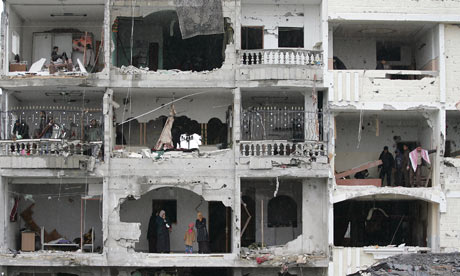
A bombed-out house in Gaza

(After an Israeli air strike in Rafah, southern Gaza)

"I learnt all the words and broke them up
To make a single word: Homeland"

I Come From There by Mahmoud Darwish

Our newspapers and televisions are filled with two different versions of the same story; two conflicting narratives of the current conflict in Gaza. In the first days of the offensive, like many others, I spent the evenings switching between Al Jazeera's and CNN's coverage; between unrelenting war footage with threadbare analysis, to the American networks, with little footage and a permanent drone of commentary and theorising noise. Between the two, there seemed to be no way to get to the core of the reality, with Gaza so hermetically sealed that even its current tragedy loses some of its power in transmission, if only because it feels so locked, untouchable, even from less than 100 miles away here in Amman. It was with this sense of failure already established that I began re-reading Israeli and Palestinian novelists and poets, hoping these writers could begin to give voices to the current statistics, particularly since access to one side of the conflict has been almost completely cut off.

As with all writing on the topic, it's hard to know where to start. There are so many caveats to place at the beginning of any discussion of Palestinian literature that it can become another eternal preface that prevents us ever reaching the heart of the matter, the core of the writing. In the 1960s Ghassan Khalifani coined the term "resistance poetry" in reference to the work of Palestinian writers such as himself and Tawfiq Ziad , but it is a term that Palestinian writers have at times resisted, or at least sought to rewrite on their own terms. The Palestinian poet Mourid Barghouti also spoke eloquently of the pitfalls of being reduced to a totem of a lost people, and refused to sacrifice "aesthetics for your readership", pointing out "we're not one-theme poets. A moment of joy or misery is juxtaposed by its opposite."

There's the danger that the concept of "resistance poetry" becomes another way that Palestinian culture is colonised, in placing Palestinians again in terms of their relationship to Israel. Conversely, attempts to make a post-resistance literature seem to ignore the reality of the situation, as though there could be an "after-occupation" literature while the political occupation remained present. Another layer of loss is losing the ability or right to trace the subtle stylistic dialogues between Israeli and Palestinian writers – as long as noting the influence of Israeli poet Yehuda Amichai on Mahmoud Darwish's work runs the risk of seeming to place Palestinian culture as subordinate to Israeli culture, some critics prefer to leave the line undrawn.

But still, at the core of it, after all the caveats, there is the writing. Most striking is the breadth of Darwish's humanity, intellect and voice: even amid his frequent allegorical references to the lost Edens and biblical exiles, the poetry remains at the same time personal and exploratory. In poems like Psalm 9 and Homing Pigeons, he uses the language of the Song Of Songs without losing the specificity of the very real figures involved. Just as startling are the novels and short stories of Sahar Khalifeh with their sudden bursts of defiant humour and Nabokovian skill for drawing out characters within the space of a few sentences.

Emile Habibi, an Arab-Israeli writer who died in 1996 and was commemorated on Israeli postage stamps in 2003, also mixed humour with pathos and fantasy, as if the reality had to be approached from many angles at once. But his famous novel The Secret Life Of Saeed: The Pessoptimist is not fractured by his approach, so much as it broadens itself to let in many voices and experiences simultaneously: the pessimism and optimism that sit together in the title. Contemporary Jordanian-Palestinian writer Ibrahim Nasrallah writes a different kind of "comedy": his reworking of Balzac's Comedie Humaine into his Palestinian Comedy novels reflects how the varied experiences of occupation and exile in Jordan, Syria, Lebanon and the diaspora have made "Palestinian peoples, and not a single Palestinian people."

It goes without saying that Israel's premier contemporary writers such as David Grossman have also produced some of the greatest feats of sustaining the multiple narratives and voices of Israel and Palestine. As well as works such as Sleeping On A Wire, which focus on the Palestinian experience, Grossman's 1986 novel See Under: Love threads stories of both memory of the holocaust and 1950s Israel alongside the alienation that comes from a lack of memory, as one character dreams of finding an ever-elusive "White Room" in the Yad Vashem Holocaust Museum that would lead to an entrance into understanding.

But it is the late Israeli poet Yehuda Amichai who still seems most able to stretch enough to encompass the suffering on both sides. As much as they dreamed of peace, both Darwish and Amichai rejected the sterile language of the peace treaty, playing with the paper-white terms of conventions and constitutions, converting them into something touchable and everyday. In Wildpeace, Amichai's vision of peace is not the technical "peace of a cease-fire", but a living thing:

"Let it come
like wildflowers
suddenly, because the field
must have it: wildpeace."

Wednesday, March 4, 2009

tabula gaza back up

Philip Rizk's blog is back up.
Gaza, he reminds us, is still dying.
During those raids Raed lost his house for the second time. The Israeli soldiers ordered him and his family out of the house, blew it up with dynamite and then bulldozed his and his father’s taxis- their only source of income.

His 15-year old daughter- the top of her class- refuses to return to school.
We must not forget.

tabula gaza: the veil of normalization

Thursday, February 12, 2009

Interview with Philip Rizk

Today is Philip Rizk's 27th birthday. Before celebrating with family and friends, he met with journalists to describe his four days in Egyptian detainment.

The full transcription of the interview can be found here.

He was threatened with torture, and informed that if he “continue[d] on this track” (his activism in regards to Gaza, assumedly) he would be “visiting [his interrogators] quite often.”

However, Rizk maintains that this is an insufficient reason to cease acting on behalf of Gaza: “I always knew there was the risk living in Egypt . . . to be involved in these kind of activities,” he said. “So you know there's a risk if you speak out too much; you know there's a risk.”

C.S. Lewis once claimed that those who would make peace in non-violent ways (the so-called "pacifists" of the world) were ultimately cowards at heart. I must humbly (but passionately) disagree. If it's courage that we need, I want the courage, not to point a gun at my enemy (or my friend's enemy), but to suffer at thier hands, and still speak on behalf of justice. To risk recrimination, to risk violence and suffering, and to never be silenced. I want the courage of Jesus, and Gandhi, and Martin Luther King, Jr.

And yes, I want the courage of Philip Rizk.

Sunday, February 8, 2009

Philip Rizk, Journalist and Activist, Abducted

At 8:00pm on Friday, February 6th, Philip Rizk, a German-Egyptian graduate student, activist, and blogger (Tabula Gaza), was abducted by Egyptian national security. Fourteen others were detained; all but Philip have been released.

Philip was taken while participating in a solidarity march for Gaza. His blog reads:

In commemoration of the breaching of the Rafah border between Gaza and Egypt one year ago on January 23rd, 2008 the Egyptian Popular Committee in Solidarity with The Palestinian People is calling for a MARCH TO GAZA.

On December 27th, 2008 Israel started a horrific bloodbath in Gaza eventually killing almost 1500 Palestinians, including 410 children and injuring thousands. Israel’s ensuing military onslaught destroyed homes, schools, places of worship, and essential infrastructure leading to a humanitarian catastrophe. These attacks are exacerbated by Israel’s ongoing siege, which leaves the Palestinian people in Gaza prisoners within Israeli created borders and dependent on the trickle of supplies that its occupier allows in.

The Call:
End the Siege on Gaza.

The Vision:
We hope for the call to spread organically, to look different in different places around the world. Whether a defined distance is walked, a specific number of people participate or the march is carried out individually, whether calling for boycott or trying Israel for war crimes we are hoping that such efforts will pick up momentum and increase.

Though the immediate Israeli military onslaught on Gaza- for the time being- has come to a standstill this is not a solution. Let us seize this time of urgency to act and call for an end to siege on Gaza. Though our respective governments reject expressing our resistance to the status quo we- the multitude- must move to the streets, as a collective global expression in condemnation of Israel’s actions.

The Egypt group will march on Gaza from multiple locations starting February 6th.

Follow all events at: www.togaza.net.
Security originally denied having arrested Philip. They have now confirmed that he is being held, but refuse to comment on his whereabouts or status.

His family has started a facebook group to raise awareness and gather support: Support and Prayer for the Safe Release of Philip Rizk. Join your voice to theirs.

Sunday, January 25, 2009

Song for Gaza

Michael Heart's "We Will Not Go Down."
I'm a bit ambivalent about this video. Let me know what you think.


Tuesday, January 6, 2009

Concerning Gaza: A Letter to Obama

This is long. But it's thought provoking. And worth reading.
So read it. Please.

An Open Letter from Laila Halaby to the President Elect Obama

Dear President Elect Obama,

Belatedly, I congratulate you on winning the election.
Belatedly, I offer my condolences for the death of your beloved grandmother.
Hopefully not belatedly, I implore you to consider your role in Palestine.

Though I try to avoid watching the news, last night I forced myself to look at coverage of Gaza. I started with CNN or Reuters, and though at that point over 200 Palestinians had been killed, the footage I saw was of the funeral for the one Israeli who died. I watched several men carry a coffin. I saw attractive women crying. It was both public and private and one felt their grief. The message was clear: one Israeli death is one too many whereas more than 200 Palestinian deaths are in a different category.

So I decided to watch al-Jazeera. Do you ever watch it? Shirin Abu Aqle, who has been reporting from the Occupied Territories for the last eight or so years, is looking very, very tired. I forced myself to watch the scenes of destruction, the ambulances, the men and women slumped over the bodies of their family members. I forced myself to listen to the screams, the wailing.

I forced myself to watch these images because I feel that as long as my country is supporting the country that has caused this, I am guilty.

I got to thinking about your campaign and my reasons for supporting you:

You were by far the smartest and wisest candidate.
Your plans were clear and intelligent.
Your ego did not get in the way.
There was another more personal reason.

I also supported you because you are familiar.

Like you, my mother is white and my father was brown and foreign.
Like you, I had a funny name.
Like you, I did not grow up with my father, but his absence shaped the person I became. Like you, I had connections abroad, an entire other world that seemed as though it should in some way belong to me. Or I to it.
Like you, I was, at times, an Other.
Like you, I became very good at gauging situations and people.

This is why I trust you.

Why I knew you were the only candidate who would truly treat other world leaders as equals, thereby earning their respect.
Why I sang your praises over Senator Clinton to anyone who would listen.
Why I wrote letters, wore t-shirts, bought my kids t-shirts, and bought a second bumper sticker for my car after the first one was stolen. (My younger son, who was eight at the time, wrote you a letter and you wrote him back. He has that letter pinned to his door and he was your spokesperson in the third and fourth grade.)

You see, President Elect Obama, the familiarity that I see in you is one of fairness and justice: you can see both sides of a situation because you are both sides and it's why you ultimately choose what is right and not what is popular. You also have a tremendous sense of history, so I know you are aware that what we see today is not everything.

Which brings me back to Palestine.

Gaza is filled with people whose family homes are being lived in by Jewish settlers from all over the world. Many of those people, if they are permitted entry back into the country that was once theirs, have to wait an hour or more for the privilege to walk by those homes on their way to working in a factory to make underwear or t-shirts for western women. They smell the freshly mowed lawns, hear the splashing of children in bright blue pools on land that was once theirs. Most of them try to tune out the past, focus on the few constants they are allowed in this present life: family and faith.

It is never just today. Just as you are not simply a Black man in his forties who got a new job, this is not simply an explosive situation between good guys and bad guys.

Gaza is also filled with very creative people: all sorts of artists, musicians, actors, dancers, who hone their skills and dream. There are teachers and doctors and lawyers and nurses and engineers. And there are lots and lots of students who dream and hope, in spite of the fact that their options are fewer than most of us can imagine.

Gaza is filled, literally, with children who can describe the villages that were taken from their families two or more generations ago. They can tell you the number of olive trees that surrounded the house, or describe the scent of citrus blossoms that filled the air, or the old man who lived two houses down who always sang whenever he walked, and how his voice was terribly unmelodic, but what an enormous void there was when he died. They can tell you these things because their parents and grandparents are determined that they not forget; that they, in turn, will not be forgotten.

It is never just today. Just as you are not simply moving into the White House in a month, refugee camps are not ancestral homes; populating a country that was already populated can involve unacceptable tactics.

Just as we took the time to get to know you, to understand your history, and to believe in you, I ask you to stop looking at today, at what is wrong with today, and to look at how it got that way.

Just as we took the time to get past your funny name, your foreign father, your all-over-the-place upbringing, I beg you to do the same for Palestine.

Until the wrongs of slavery were admitted, there was anger and extremism.
Until the wrongs of occupation are admitted, there will be anger and extremism.
And fathers and mothers like you and like me will continue to live through what is unimaginable.

I will end with something Mohandas Ghandi said, something I know that you believe: "A confession of errors is like a broom which sweeps away the dirt and leaves the surface brighter and clearer."

Very sincerely yours,

Laila Halaby

A Palestinian Mother's Blog

If you've been watching CNN recently, you might have seen an interview with Laila El-Hadda. A Palestinian from Gaza, she is a journalist and blogger living in North Carolina with her family.

Her parents are still in Gaza.

If you're interested in her side of the story -- a Palestinian raising her children in America, with family still suffering in Gaza -- I'd recommend you check out her blogsite: Raising Yousuf and Noor: diary of a Palestinian mother.

You could also read one of her articles, Bloodied in Gaza, published on the 30th of December.

Monday, January 5, 2009

The Face of Suffering: Where to Run?


This clip, from the 30th of December, is haunting.
These are the real faces. These are the real people.

Children Speak about Gaza

Here's a video clip about Gaza BEFORE the recent violence. I still find it rather applicable.

Part of the clip shows interviews with Palestinian children. One boy asks: "Could you live here? Could you? You couldn't because conditions are horrible ["difficult"/"hard"], and you'd be terrified whenever the missiles strike and the walls begin to crack."

Another child recounts the experience of being under fire: "The shelling struck the window, everything broke and got burnt. Why did they break my things? And break my toys? . . . We threw it all in the garbage . . . the food we eat smells like gas. We don't want to get rid of our clothes, even though they smells like gas . . . let the Israelis come and smell our clothes and see our home."

The clip (which can also be found at Behind the Lines: Poetry, War, and Peacemaking) is originally from the documentary Occupation 101: Voices of the Silenced Majority. The film is the winner of multiple awards from various film festivals (including Best Film and Best Documentary), and has a very impressive list of experts interviewed.

"The greatest enemy of knowledge is not ignorance . . . it is the illusion of knowledge."
-Stephen Hawking.

Sunday, January 4, 2009

480 Palestinians Dead in Gaza

About twenty minutes ago, CNN reported that more than 480 Palestinians have lost their lives in the attacks on Gaza. On the other hand, 4 Israelis are dead.

And yet, Netanyahu claims that Israel is putting its own soldiers at risk in its attempt to protect Palestinian civilians. He says that it is Hamas that doesn't care about the casualty count.

I find the evidence rather strongly to the contrary.

[That is not to say that Hamas does care about the casualty count. They may not either. But I find it highly ironic, with the numbers as they are, for Israel to claim that they have the moral high ground.]

Saturday, January 3, 2009

Gaza Invaded

Israeli ground troops have just invaded Gaza.

Israel, according to CNN, has not yet (in the last week of air-strikes) reached its goal of "crippling Hamas."

So they have invaded. Because this will help? Israel (in a grand act of generosity) has dropped leaflets urging Gaza residents to leave immediately.

Would someone please tell me where they are supposed to go? The borders are closed. Israel is invading a prison, with civilians trapped inside.

Hamas' probable status as a terrorist organization DOES NOT justify bludgeoning innocent families into oblivion. If being a terrorist is judged by the act of targeting non-combatants, I'd say Israel pretty much qualifies.

Ironically, my family got the news while watching a West Wing (fifth season) episode about, guess what? Invading Gaza.

This is not a game. This was never a game.

Pictures and Stories of Gaza

If you want eyewitness accounts of what's going on in Gaza, on the ground, check out this blog: In Gaza. The pictures alone tell a horrifying story.

Wednesday, December 31, 2008

In Gaza

Something broke long ago
tender neck, brittle bones,
olive branch in the desert.

And how do we make
repairs to the dead?
Straighten the spine,

push rebar through marrow,
sew ring-ed time and bark?
Do we let the wounds lie, hoping

they will close with the hours?
Only the living form scars
and even those burst

unprotected.
-Kohleun Seo (Dec. 30, 2008)

Sunday, December 28, 2008

Gaza is in pain

It's the Sunday after Christmas. Carols are still reverberating through our churches and our homes. The Christmas story is fresh in our minds, and we've all been told that the angels sang news of great joy: peace on earth and good will towards men. But in Gaza, as they suffer air-raid after air-raid, I'm sure the message rings a little hollow.

Jewish Peace News writes, "Reports indicate that Israeli air strikes today alone [Dec. 27] have killed 205 People in Gaza and have left over 400 more hurt. These strikes come after several weeks of a tight blockade which left many of Gaza's 1.5-million inhabitants without sufficient food, water, fuel or medicine." They urge Americans to take action and write to their congressmen, their senators, and President-Elect Obama.

Kohleun Seo reflects on watching the news from her home in Arizona:
In the words of Naomi Shihab Nye, "This is not a game. This was never a game."

What can I say as an outsider, watching from afar, caught in a different time zone, peering through news reports? Does anyone hear the bombs, the screams? According to BBC News, today was the most violence-filled day in the history of the Gaza Strip. You would think that would be hard to accomplish. I really don't know what to say right now as I take it all in, sitting on my sofa late at night. Inside I want to scream with each Palestinian woman, man, and child.

Will this day, this year be remembered as another 1948, another 1967? Will next year be different?
And Tabula Gaza has no words.

Brothers and sisters, it's Christmas. A new year is about to start. It isn't enough to want change, or vote for change, we need to be change. Please join me in praying for the fathers and mothers and daughters and sons and husbands and wives and grandmothers, grandfathers, uncles, aunts, brothers, sisters, friends, lovers, cousins, teachers, mentors, great-grandparents . . . in short, the flesh and blood human beings who are losing their lives and their loved ones right now, today. Don't close your eyes. Don't go back to your carol singing as though no babies are crying behind a wall in Bethlehem or under fire in Gaza. Pray on your knees for justice. For peace. And yes, do write that letter to your congressman.

Sunday, July 13, 2008

Exclusion and Embrace: the Mechanics of Oppression

This poem is a somewhat-companion to my last post. Though rather flawed, the element that really struck me when I first read it -- and that continues to strike me -- is the theme of distance. And how distance breeds hate and violence. Without human contact, it's easy to stop believing in the humanity of the other. And when the other is not human, or at least not as fully human as you believe yourself to be, oppression ceases to be difficult.

It is for this reason that the separation barrier is so terrifying.

Another note: Shepherdson states "Faceless voices make demands/ Travellers scarce could hear." We found this VERY true, and very odd, on our recent trip to Jerusalem and Bethlehem. At checkpoints, guards sit in glass boxes, far removed from the traveler, and it is almost impossible to hear their instructions. We pondered the reason for this on our trip, but couldn't seem to understand. It's inefficient and extremely frustrating. However, it does serve one purpose: it separates the Israeli from the Palestinian, and keeps contact and communication to a bare minimum.

As one (Arab?) proverb states: what we do not know, we fear; what we fear, we hate.

ERETZ

Concrete-clad confinement cells
Iron rails and turn styles
Sheds and bars and wire and rocks
Line the lonely mile

Faceless voices make demands
Travellers scarce could hear
Distance, planned, enforces space
No human contact near.

Compassion, bred from guarding eyes
Purely duty calls.

Withdraw the contact of the eyes
In airport hanger halls
And men become a processed part.

Without this window on human hearts
It's easier to number us
Than face, the hurt, the pain, the loss of those who
mirror now the past
To those descended from Holocaust

Yet surely some must wonder
As they rend Arab homes asunder
Why they comply in genocide
Of Palestinian hearts and mind.
And surely some who've heard the tales of apartheid
And Robyn Island jails
Must question in their silent hearts
Why scraggy donkeys pull decrepit carts
On dusty roads and potholed 'mac
The poor, who break their ragged backs, and
Cling to Gaza's desert tracks, their homeland?

And surely we must question why
This land turns into nibbled cheese
And check points fear and barricades
And mortar fire and bullet littered streets
Are all their lives entail
In Gaza's cramped and foetid jail.

-Rev. Maria Shepherdson
From Both Sides Now

Friday, February 1, 2008

Gaza, and a Boy's Face

Here's a link to another post about Gaza, tabula gaza: exists in a cage. I think it's just a good reminder that this conflict is not abstract. It's all too concrete. Too real. And it involves real humans, with real stories, and real faces. That fact doesn't change, regardless of how far away we feel.

Sunday, December 2, 2007

A Letter from Gaza

It's hard to not feel like we're in a large concentration camp as I see Gaza's empty streets, and the hopeless feeling in the air . . . I think most people feel abandoned as we are literally locked up in this small, concentrated space and don't know what the world plans for us, or what to expect next.

. . . and as long as we are kept alive, no one will ask about us.

But just because we are breathing, that doesn't mean we're alive.

This is an excerpt from a letter written by a woman living in Gaza. Here's a link to the full text: Yasmine's Letter. It has some very vivid descriptions of the situation there, and what it's like to be Palestinian at this moment, on that patch of land.


Friday, November 23, 2007

Peace, Surfboards, and Gaza

Here's a link to an article from the New York Times. It's a bit outdated (from this summer) but it's an interesting look at a Jewish surfer's unique attempt to reach out to Palestinians in Gaza.

JERUSALEM, Aug. 21 — The noted American surfer, Dr. Dorian Paskowitz, has high hopes for Gaza, and like the waves, he will not let anything stop him trying to see them through.

On Tuesday, Dr. Paskowitz, 86, a retired Jewish physician from Hawaii popularly known as Doc, personally delivered 15 new surfboards to Palestinian surfing enthusiasts there.

Later the article mentions:
One of the Palestinian surfers, Muhammad Jayab, described himself in the article Dr. Paskowitz had read as sympathetic to Hamas. That did not put Doc off. “To be able to go to your enemies and give them something that makes them happy is a most fulfilling adventure,” he said.
The article is bitter-sweet, however. Keep reading and it recounts how two Palestinian children, aged 10 and 12, were shot to death by the Israeli army.

Tuesday, November 20, 2007

Gaza, and why NOT to be a Christian Zionist

Here's another blogger's perspective on the current situation in Gaza:
Daily Rantings: Cutting Electricity to Gaza

Also, here's a quote from one of her October posts:

This is what I am not. This is one of the many reasons why I am NOT a Christian Zionist.

Bridgette Gabriel at the second annual "Christians United For Israel" conference, held at the Marriott Wardman hotel in Washington, D.C., on the 16th through the 18th of July 2007:

"The difference, my friends, between Israel and the Arab world is the difference between civilization and barbarism. It's the difference between good and evil [applause].... this is what we're witnessing in the Arabic world, They have no SOUL!, they are dead set on killing and destruction. And in the name of something they call "Allah" which is very different from the God we believe. . .[applause] because our God is the God of love." - Bridgette Gabriel, CUFI 2007

Scary.

Monday, November 19, 2007

Palestinian Children: Living Without Hope

An interesting look at childhood in Gaza, posted this summer:
tabula gaza: Children of Gaza

It reminds me a lot of the children I worked with in a Palestinian refugee camp in Beirut, Lebanon. They were growing up, in many cases, without water or electricity. Crammed into rooms of dilapidated houses, in one of the most densely populated sq. kilometers in the world.

Their school, with the Dome of the Rock painted on the door, was completely bullet-ridden. The top half, gone. Rain came through, and pooled on the slanted cement. Children wore their coats inside. If they had them.

And many of them, just 3-years-old, wouldn't smile. Wouldn't laugh. Wouldn't be children.

Others, despite the anguish, were still overflowing with life. Tiny little trouble makers with glowing eyes, and bouncing curls.

I still remember watching one of them dance. She was tiny. Probably the smallest child I've ever seen. And she loved the music of her people. Turning her fingers to the rhythm. While in the background, a historic puppet show demonstrated how children were shot down with tanks and guns.

That is their life. Where do we go from here?