Showing posts with label Milton Bennett. Show all posts

Monday, May 23, 2011

Beyond Ethnocentrism (3) – Pursuing Peace Through Growth in Intercultural Sensitivity: Integration

“A new type of person whose orientation and view of the world profoundly transcends his indigenous culture is developing from the complex of social, political, economic, and educational interactions of our time.”
Peter Adler, quoted in Bennett, “Towards Ethnorelativism”

(I wonder why he didn’t also say “religious” interactions? But that’s another subject…)

According to Adler, the “multicultural person” is one whose “essential identity is inclusive of life patterns different from his own and who has psychologically and socially come to grips with a multiplicity of realities” (quoted in Bennett).

Bennett refers to such as person as having developed to the ethnorelative stage of Integration.
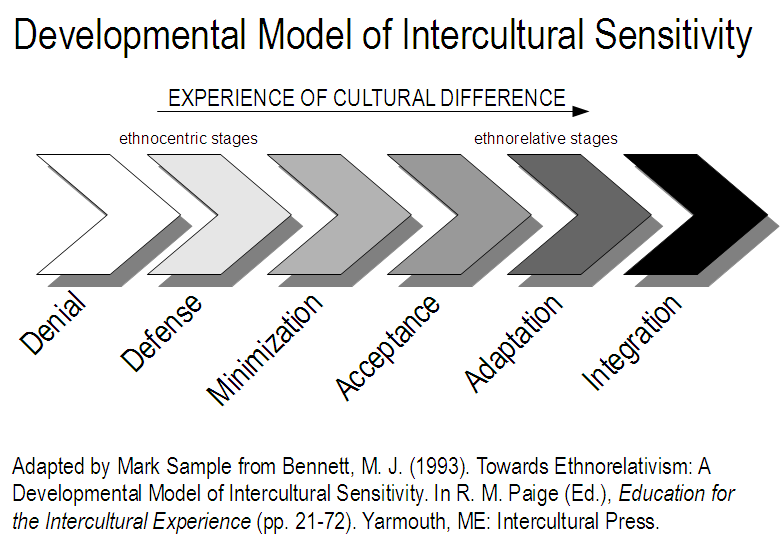

At the stage of Integration, a person has come to be culturally marginal, existing on the periphery of two or more cultures. One is no longer straightforwardly at home in his or her original culture, neither has s/he assimilated to a different culture. The “integrated person” is not particularly affiliated with any one culture, but “can function in relationship to cultures while staying outside the constraints of any particular one” (all subsequent quotes, unless noted, are from Bennett).

People at the stage of Integration are living in the realm of what Bennett calls “contextual evaluation” – i.e., behavior is determined to be appropriate or not depending on the context (he asks the questions, “Is it good to take off my clothes?” and “is it good to refer directly to a mistake made by yourself or someone else?” and answers both by, “It depends on the circumstances” or context), and have the ability to choose from a range of different cultural responses, to given situations.

“These people see their identities as including many cultural options, any of which can be exercised in any context, by choice. They are not so much bound by what is right for a given culture (although they are aware of that) as they are committed to using good judgment in choosing the best treatment of a particular situation. … They are conscious of themselves as choosers of alternatives…”

Bennett points out that marginality “describes exactly the subjective experience of people who are struggling with the total integration of ethnorelativism.”

“They are outside all cultural frames of reference by virtue of their ability to consciously raise any assumptions to a metalevel (level of self-reference). In other words, there is no natural cultural identity for a marginal person. There are no unquestioned assumptions, no intrinsically absolute right behaviors, nor any necessary reference group.”

For a personal example of what Bennett means, I enjoyed listening to the interactions of my daughter (a TCK who grew up in Tunisia, Egypt and Lebanon, and has also spent significant time in Jordan, besides attending University in the U.S.) with my brothers, all of them pastors or theologians. I would hear one of them make a statement about something (anything), including a phrase like, “the Bible says…” I would listen for my daughter’s response, and inevitably I would hear something like, “that’s one way of reading the Bible; but there are Christians who interpret that statement differently…” That, in a nutshell, is the perspective of a person who is living in the ethnorelative, marginal realm of Integration – they are always able to see things from different perspectives, and from outside of any one framework or cultural setting.

There are two possible phases of marginality, within Integration. At first, one might experience what he calls “encapsulated marginality,” “where the separation from culture is experienced as alienation,” and “constructive marginality,” “in which movements in and out of cultures are a necessary and positive part of one’s identity.” I have seen these two kinds of marginality with TCKs (third culture kids, i.e., people who grow up in a cultural setting that is different than their passport culture). For TCKs at the point of encapsulated marginality, the question, “where are you from?” may trigger an identity crisis – “I don’t know where I’m from; I don’t know who I am; I don’t know where I belong…” But for those who have developed to the point of constructive marginality, they may have come to have a positive sense of identity as a TCK – “I can go anywhere; I can adapt; I can fit in – I’m a TCK!”

Can we integrate difference?
Bennett concludes that “constructive marginality can be the most powerful position from which to exercise intercultural sensitivity,” and points out that “Cultural mediation could be accomplished best by someone who was not enmeshed in any reference group, yet who could construct each appropriate worldview as needed.”

Given the ever-“shrinking” world, with peoples traveling and migrating from and to just about everywhere, and given the levels of hostility and conflict (ethnic, national, religious, etc.) between different groups in the world today, there is a desperate need for people who have learned not only to adapt to cultural difference, but to internalize different cultural frames of reference and to live on the cultural margins. Such people can function as “bridge” people between different groups who are different, not just for mediating conflict (for which there is ample need), but also for mediating understanding and interaction.

The world needs more ethnorelative, interculturally sensitive peacemakers.


For more detail, see
Bennett, Milton J., “Towards Ethnorelativism: A Developmental Model of Intercultural Sensitivity.” In Paige, R.M. (Ed). (1993) Education for the Intercultural Experience (2nd ed., p. 21-71). YarmouthME: Intercultural Press.

Bennett, Milton J., “Becoming Interculturally Competent.”  In Wurzel, Jaime S., ed., Toward multiculturalism: A reader in multicultural education (2nd ed., pp. 62-77). NewtonMA: Intercultural Resource Corporation, 2004.

Sunday, May 22, 2011

Beyond Ethnocentrism (2) – Pursuing Peace Through Growth in Intercultural Sensitivity: Adaptation

“One of the ways people inevitably increase their awareness when learning about other cultures is to move from thinking ‘My way is the only way’ toward thinking ‘There are many valid ways’ of interpreting and participating in life. And the process involves more than changing your thinking; it also involves adjusting your behaviors.”
Brooks Peterson, Cultural Intelligence (emphasis mine)

“The essence of ethnorelativism is respect for the integrity of cultures, including one’s own. In acceptance, the framework for appreciating cultural difference was established. At this stage, adaptation, skills for relating to and communicating with people of other cultures are enhanced.”
Milton Bennett, Towards Ethnorelativism (emphasis mine)

As we spend more time living and interacting with people in another cultural context, we may experience growth from Acceptance into Bennett’s next phase of intercultural sensitivity, Adaptation.


Acceptance (the previous phase) may have to do mainly with a change in perspective and attitude toward cultural difference (seeing it more positively, realizing it is there, being curious about and respectful toward difference), with an initial behavioral dimension of taking action to discover, understand, and learn about difference. It is possible to grow in accepting cultural difference, without living deeply or constantly in the midst of difference.

To grow into the phase of Adaptation, though, we need to be living in the context of cultural difference, and developing the skills for effective adjustment. This adjustment is comprehensive, involving cognitive, affective, and behavioral change over time. Cognitively, one begins to understand and see the world from the perspective of the people in the other culture. Behaviorally, one learns to adapt to do things in a way that is appropriate in the other setting. Affectively, one’s emotions are impacted over time, as feelings associated with the new worldview and cultural practices, and the value judgments associated with them, are internalized.

For example, through our years in Tunisia, we learned how Tunisians do hospitality. When someone you know shows up at your door, you don’t stand and talk with them at the door (unless you are male and the visitor is female, or vice versa, and no one of the other gender is at home with you), but welcome the visitor in (to stand and talk in the doorway implies you don’t want the visitor in your home). You must serve something, at least something to drink, and probably at least some kind of snack, if not a meal. You do not ask, “would you like…?” because such a request will be politely refused. Rather, you simply bring out the drink(s) and food, and serve them up. If you are eating a meal, you insist your visitor join you. If it is near a meal time, you plan on the visitor staying and eating with you (and insist that they do). In the Tunisian setting, rather than “a man’s home is his castle,” the guiding motto is, “my home is your home.” Rather than the honored one being the guest being received, in Tunisia, it is the host who is honored by the visit (hosts will say to visitors, “we have been visited by blessing”). A different way of viewing the world, people, social interactions, hospitality…

After living for years in Tunisia, and adapting to the Tunisian way of doing hospitality, we were often (emotionally) uncomfortable in hospitality situations in the U.S. For example, we were at my family’s eating one evening, and a couple of visitors dropped by unexpectedly. They were invited in (they were a sister-in-law and her friend; if they had been less close, perhaps they would not have been invited in), but we sat and continued eating, while talking with them. No one even offered for them to join us. (The expectation, in the U.S. setting, was that they had “interrupted” us in our plan or schedule, and would not have expected plans to be adjusted for them.) The fact that we felt uncomfortable shows that we experience adaptation even at the affective level, over time.

Note that adaptation, in Bennett’s model, is not assimilation. You don’t give up your culture, but experience an extension of your cultural repertoire.

“In adaptation, new skills appropriate to a different worldview are acquired in an additive process. Maintenance of one’s original worldview is encouraged, so the adaptations necessary for effective communication in other cultures extend, rather than replace, one’s native skills. The key to this additive principle is the assumption that culture is a process, not a thing. One does not have culture; one engages in it.”

One of the key skills in Adaptation is the ability to “look through the others’ eyes,” to construct reality that is nearer to their reality. Bennett contrasts this “empathy,” with the “sympathy” of ethnocentrism.

Can we adapt to the different other?

“…I have contrasted empathy to ‘sympathy,’ where one attempts to understand another by imagining how one would feel in another’s position. Sympathy is ethnocentric in that its practice demands only a shift in assumed circumstance (position), not a shift in the frame of reference one brings to that circumstance; it is based on an assumption of similarity, implying other people will feel similar to one in similar circumstances. Empathy, by contrast, describes an attempt to understand by imagining or comprehending the other’s perspective. Empathy is ethnorelative in that it demands a shift in frame of reference; it is based on an assumption of difference, and implies respect for that difference and a readiness to give up temporarily one’s own worldview in order to imaginatively participate in the other’s.”

Adaptation takes time. And it changes us. As we live in another cultural setting, and adapt to the behavior, worldview, and even the value judgments and emotions accompanying sociocultural experience, we change. Even though this is not a process of assimilation, of exchanging our culture for the other, we become different people through the process. One author has called such people, “150% people.” And Bennett talks of becoming “marginal,” in the sense of becoming a person who is not straightforwardly “at home” in any cultural setting. When I returned to Minnesota after years in Tunisia (which used to be “home” but now no longer seems to be – for us know, “home” is wherever we are living), I could recognize my native culture, but I felt as if I was seeing it through different eyes. And indeed, I was. I had not become Tunisian, but I was no longer Minnesotan in the way I had been.

Would the cause of peace in the world be furthered, if more people entered into the world of different others, learning to deeply empathize, learning to see as they see, learning to understand how their behavior makes sense in its context, experiencing the fullness and richness of their life in all its dimensions? It seems that it would at least be a step in the right direction…  


For more detail, see
Bennett, Milton J., “Towards Ethnorelativism: A Developmental Model of Intercultural Sensitivity.” In Paige, R.M. (Ed). (1993) Education for the Intercultural Experience (2nd ed., p. 21-71). YarmouthME: Intercultural Press.

Bennett, Milton J., “Becoming Interculturally Competent.”  In Wurzel, Jaime S., ed., Toward multiculturalism: A reader in multicultural education (2nd ed., pp. 62-77). NewtonMA: Intercultural Resource Corporation, 2004.


Wednesday, May 4, 2011

Beyond Ethnocentrism – Pursuing Peace Through Growth in Intercultural Sensitivity (1): Acceptance

“One of the ways people inevitably increase their awareness when learning about other cultures is to move from thinking ‘My way is the only way’ toward thinking ‘There are many valid ways’ of interpreting and participating in life.”
Brooks Peterson, Cultural Intelligence

In Bennett’s DMIS (Developmental Model of Intercultural Sensitivity), growth toward a richer, fuller, more positive experience of cultural difference, i.e., growth in intercultural sensitivity, is marked by a transition from ethnocentrism (with stages of Denial – Defense – Minimization) to what he calls ethnorelativism (with stages of Acceptance – Adaptation – Integration).


This growth is characterized by a shift from the experience of one’s own beliefs and behaviors (culture, worldview) as “just the way things are,” to the experience of one’s own beliefs and behaviors as one organization of reality among many viable possibilities (i.e., one’s own culture is experienced in the context of other cultures) – as in the Brooks Peterson quote above. From being unknown, alien, absurd, threatening, insignificant, etc., the cultural difference of others becomes (or begins to become) known, real, comprehensible, respected, etc. This change involves a worldview shift – the world is seen and experienced differently, by a person who is becoming interculturally sensitive.

How do we respond to the "different other"?
The movement from ethnocentrism to ethnorelativism is characterized by the development of cultural self-awareness, accompanied by a growing awareness of different others (i.e., of what makes others different, how they are different). (Note that in a different context, Stephen Covey points out that self-awareness is the key human gift, unlocking all other unique human potential, and that without self-awareness we cannot know others, because we treat them as if they were the same as us.)

Part of the growing awareness of others, and of cultural difference, involves beginning to see both the behavior and the values of people from other cultures, within a cultural context (i.e., as understandable within their cultural context).


“people begin to see alien behavior as indicative of profound cultural differences, not just as permutations of universal (and probably ethnocentric) laws”

“Alternative beliefs about both what exists in reality and the value which may be attached to those phenomena are respected as viable, at least as they are expressed in a cultural context.”
Milton Bennett, Towards Ethnorelativism (emphasis mine)

Movement out of ethnocentrism also involves questioning the universality of our experience, our models, our ways of doing things (be it in education, economics, politics, development, leadership, the way we do church life, or whatever realm). One way in which I experienced movement from the “minimization” stage of ethnocentrism, into a more ethnorelative approach, was in realizing that the apparent fact that Egyptians I knew did not seem to live according to Covey’s 7 Habits might not mean that Egyptians are not effective, but that the “7 Habits of Highly Effective Egyptians” are different than Covey’s 7 Habits (i.e., that Covey’s 7 Habits might not be universal). This seems obvious in hindsight, but the idea that a model which works for us is universally applicable, has a powerful force which is hard to escape.  Once we become more aware of the reality of cultural difference, anyone’s claim to have a “universal” model, approach, or solution, should cause us to see red flags and hear alarm bells.

Moving into Ethnorelativism: Acceptance

The first stage in the ethnorelative experience of cultural difference, in Bennett’s model, is Acceptance. Acceptance is characterized by curiosity about cultural difference, and a growing respect for difference. As one moves into Acceptance, s/he does not necessarily have a deep understanding of the difference which exists, but there is at least a realization that there is difference to be discovered, accompanied by a positive attitude toward exploring and discovering the difference.


Acceptance (in my words) involves…
  • letting go of the idea that reality is simply the way we “know” it to be
  • relating to people as they are, rather than as we would like them to be (or according to our image of them)
  • wanting to know people (i.e., in the reality and fullness of who they are)
  • not trying to change others, to be different or to be like us (which is the tendency of an ethnocentric experience of others)
  • accepting others as being as fully human (and as fully complex) as we ourselves are
  • being open to difference, and open to change (for we cannot grow in accepting others, without ourselves changing)
  • being open to the fact that “what works for us” might not work for others, i.e., that “what works for us” might not be “universal”
If conflict in the world can be seen as being caused to some extent by the various manifestations of ethnocentrism (see my previous posts, on how ethnocentrism hinders peace), would growth into what Bennett calls ethnorelativism, have a positive impact for peace? Or to put it another way, would people who are accepting of others who are different, more likely to live in peace with those different others, than those who are denying, defensive toward, or minimizing difference (Bennett's three ethnocentric stages)? If we are serious about pursuing peace, should we be motivated to grow beyond ethnocentrism, into Bennett's stage of Acceptance, and beyond?


I’ll let you answer that one yourself…


Coming soon… Beyond Ethnocentrism (2): Adaptation


*For full treatment of Bennett’s model, see
Bennett, Milton J., “Towards Ethnorelativism: A Developmental Model of Intercultural Sensitivity.” In Paige, R.M. (Ed). (1993) Education for the Intercultural Experience (2nd ed., p. 21-71). YarmouthME: Intercultural Press.

Bennett, Milton J., “Becoming Interculturally Competent.”  In Wurzel, Jaime S., ed., Toward multiculturalism: A reader in multicultural education (2nd ed., pp. 62-77). NewtonMA: Intercultural Resource Corporation, 2004.

Thursday, March 24, 2011

What’s Wrong with Ethnocentrism?

To return once more to the topic of ethnocentrism (i.e., seeing and experiencing and interacting with the world from the perspective of your own culture / your own frame of reference, without an understanding of the different cultures of others, or the ability to enter into their frame of reference and experience), I would like to ask whether ethnocentrism is compatible with seeking peace, and if not, what’s wrong with it?

Here are some of the characteristics of ethnocentrism, with reference to the stages of Bennett’s “Developmental Model of Intercultural Sensitivity”*:

(Denial)
  • lack of awareness of cultural difference
  • lack of interest in cultural difference
  • inability to distinguish cultural difference (e.g., thinking of “Africans” or “Asians” or even “foreigners” as a broad category without internal differentiation)
  • isolation or intentional separation from different others
(Defense)
  • lack of understanding of cultural difference or others who are different
  • a negative experience of difference, and reaction against it – feeling threatened by difference
  • one’s own culture experienced as the only viable one
  • polarization (“us” / “them”)
  • generalizing and positively stereotyping one’s own people and culture
  • generalizing and negatively stereotyping other peoples and cultures
  • prejudice, denigration, possibly animosity, toward those who are different
  • in the extreme, dehumanizing and/or demonizing others 
(Minimization)
  • trivializing difference, acting as if people are basically the same (i.e., as if others are basically the same as ourselves)
  • thus, not relating to others as they truly are, in their uniqueness or fullness
  • lack of cultural self-awareness
  • generalizing from one’s own experience, principles, practices, to others – assuming that what “works for us” is universal, relevant and applicable anywhere and everywhere and to everyone
  • those in a dominant or majority group not being aware of how racial minorities experience race relations, men not being aware of how women experience gender issues, etc.
  • assuming we have “the answers” for everyone, not being aware that the questions that others are asking, may be different than our questions
In sum, ethnocentrism is a form of self-centeredness, on a group and cultural level. It ranges from ignorance through defensiveness to a somewhat benign assumption of similarity, but in all cases, one cannot know and relate to others as they are, from any point on the spectrum of ethnocentrism.

There are many reasons why someone might decide that it would be best not to stay in an ethnocentric state.  From the perspective of seeking peace, I would argue that ethnocentrism, while “natural” to people, is not compatible with living in a way that will lead to building peace between peoples.
                                                                                                               
I recently wrote up some “peace lessons” from the women and men I have met in Israel and the Occupied West Bank, who are actively engaged in trying to resolve the Palestinian-Israeli conflict (http://salemshalom.blogspot.com/2011/03/peace-lessons-from-my-travels-in.html). Among the lessons:

* We must learn to see all people – including our “enemies” – as human beings created in the image of God, due respect and honor and treatment as such (regardless of their race, religion, ethnicity, etc., and regardless of how they are treating us). The way Sheikh Ghassan put it, to see that “the person in front of me is me with a different language, religion, ethnicity, etc.,” and to “make my enemy into my friend.” The way the Quakers put it is to find “that of God” in all people. The way Jesus put it is that we must learn to love our neighbor and love even our enemy, and “do to others as we would have them do to us.”

* We need to develop an understanding of God, of religion, and of people that rises above the ethnocentric “tribalism” of believing that God is for us and our people and against others (and that uses religion/the name of God to justify fighting and killing others).

* We need to build relationship with those on the other side of a conflict. We need to share our stories, get to know each other, find what we have in common, embrace our shared humanity, and find ways to work together to end the conflict.

* Conversely, walls and checkpoints and occupation and humiliating others; enshrining our own ethnicity and religion and nationality; playing the role of the victim; and justifying actions which serve ourselves and our interests while mistreating others, do not lead to peace.

Living in a state of ethnocentrism will prevent us from the above positive steps, and will lead us to the negative ways of interacting with others. If we are living in ethnocentrism, we will not see other people who are different than us (racially, ethnically, religiously, in their nationality, etc.) as fully human. We will not be inclined to understand people, to relate to them, to seek to build bridges and friendship. If we are living in ethnocentrism, our god will be a tribal god, belonging and loyal to our people, and against others who are against us. If we are living in ethnocentrism, we will build walls to keep out the alien other, and we will do to others what we would never think of doing to ourselves or our own people (in fact, we will justify doing to others what we would never tolerate others doing to us).

Even at the most positive, least destructive stage of ethnocentrism, minimization, we will fall short of the full potential of building peace between ourselves and others. Peace, as many people have pointed out, is more than the absence of conflict. True, deep, lasting peace, the kind of peace that creates a context within which people can live their lives most fully, requires relationship, understanding, empathy with those who are different than us.

If there is ever to be true peace between Israelis and Palestinians, they will need to move beyond dismantling the separation Wall and the Occupation, agreeing upon borders, and addressing the various legal issues that have accrued over the past 60+ years. For true peace, salaam, shalom – a blessed life, characterized by harmony and well being – Palestinians and Israelis will need to build relationships and come to know each other, listen to and care about each other’s stories, understand each others’ suffering and perspectives (please note: the peace activists in the situation are working on this, and are seeing some success – this is not only possible, it is necessary, and it is not “pie in the sky” idealism). And ethnocentrism will hinder these efforts.

Ethnocentrism, in one way or another, in one form or another, is at the heart of many of the problems which exist between groups of people in the world today (and throughout history). It seems clear that if we want to work for peace in the world, we need to reject, and seek to identify and grow beyond, ethnocentrism in all of its manifestations.

Coming soon: Beyond Ethnocentrism…


* For more on each of Bennett’s stages of Ethnocentrism, see:

For full treatment of Bennett’s model, see
Bennett, Milton J., “Towards Ethnorelativism: A Developmental Model of Intercultural Sensitivity.” In Paige, R.M. (Ed). (1993) Education for the Intercultural Experience (2nd ed., p. 21-71). Yarmouth, ME: Intercultural Press.

Bennett, Milton J., “Becoming Interculturally Competent.”  In Wurzel, Jaime S., ed., Toward multiculturalism: A reader in multicultural education (2nd ed., pp. 62-77). Newton, MA: Intercultural Resource Corporation, 2004.

Wednesday, March 2, 2011

Does Bennett understand the Golden Rule?

In my previous post on the third stage of ethnocentrism, minimization, in Bennett's "Developmental Model of Intercultural Sensitivity," I briefly mentioned that Bennett sees the "Golden Rule" as somehow characterizing this phase (see http://salemshalom.blogspot.com/2011/03/how-ethnocentrism-hinders-peace-part-3.html). (He goes on to say that what he calls the "Platinum Rule" is characteristic of moving into the ethnorelative stages of acceptance and adaptation, learning to "do unto others as they would have you do unto them" - but that's a discussion for a future post.)

The way Bennett discusses the "Golden Rule" may be problematic for people who are used to thinking of Jesus' words as a pinnacle of ethical teaching; and I suppose that some might on that basis reject Bennett as not knowing what he is talking about, if he would suppose that living by Jesus' "Golden Rule" is only a stepping stone toward a deeper and more positive way of relating to others.

Thus I raise the question, does Bennett understand the "Golden Rule"?

To quote Jesus' words,

"Therefore, whatever you want people to do for you, do the same for them, because this summarizes the Law and the Prophets." (Matthew 7:12)

I would argue that Bennett does not rightly characterize the essence of Jesus' teaching here. He does rightly point out that often (and in the stage of minimization in dealing with culturally different others), we ere by doing to others as if they were us, and thus falling short of treating them in the most fully loving way.

But Jesus' intent, I believe, is that our "doing to others as we want them to do for us" would imply, that we understand them and thus do to them as they want us to do to them - for this is what we would all want, is it not? I want people to understand me, to know me, to show me respect in the way that is meaningful to me, etc. And thus, to follow Jesus' teaching, I should seek to relate to others in the depth of knowing them as they are (and not projecting myself onto them, assuming that they are like me).

Thus, although I think Bennett misrepresents the heart of the Golden Rule, I believe his model (the DMIS) and teaching stands, and in fact resonates with, I would even say is built upon, the teaching of Jesus (though I don't think Bennett ever actually refers to Jesus).

My point here is that one can hold to Jesus' teaching as the pinnacle of ethical teaching, and embrace Bennett's model. For me, at least, they are compatible. And to "do unto others as I would have them do unto me" is to be led in the direction of ethnorelativism, growing in understanding and accepting others as they are. Which, I will argue in coming posts, is a significant movement in the direction of seeking to build peace.