Showing posts with label seeking peace. Show all posts

Saturday, June 18, 2011

Peace Quote of the Day - From "Enemy" to...?


“When we look deeply into our anger, we see that the person we call our enemy is also suffering. As soon as we see that, we have the capacity of accepting and having compassion for him. Jesus called this ‘loving your enemy.’ When we are able to love our enemy, he or she is no longer our enemy. The idea of ‘enemy’ vanishes and is replaced by the notion of someone suffering a great deal who needs our compassion. Loving others is sometimes easier than we might think, but we need to practice it.”
Thich Nhat Hanh, quoted in Johann Arnold, Seeking Peace

Thursday, June 16, 2011

Love of Neighbor, Yes - But Who is Our Neighbor?

An interesting question came up yesterday, as we were talking about peacemaking and tolerance in our (Christian, Jewish and Muslim) traditions.

First of all, we all agreed that "tolerance" is a weak and insufficient goal. We want something more, and we need something more, if we are to be seeking and building peace with different others.

But then a question arose, as we considered what our sacred texts teach about our relationship with The Other.

A Jewish presenter shared the text,
The reason Adam was created alone in the world is to teach you that whoever destroys a single soul, Scripture imputes it to him as though he had destroyed the entire world; and whoever keeps alive a single soul, Scripture imputes it to him as though he had preserved the entire world.

But someone pointed out that there is another version,

FOR THIS REASON WAS MAN CREATED ALONE, TO TEACH THEE THAT WHOSOEVER DESTROYS A SINGLE SOUL OF ISRAEL,39 SCRIPTURE IMPUTES [GUILT] TO HIM AS THOUGH HE HAD DESTROYED A COMPLETE WORLD; AND WHOSOEVER PRESERVES A SINGLE SOUL OF ISRAEL, SCRIPTURE ASCRIBES [MERIT] TO HIM AS THOUGH HE HAD PRESERVED A COMPLETE WORLD.40

This raises the question, are Jews encouraged not to destroy / to save, Jewish life, or all life?

Similarly, a Muslim presenter shared the Hadith,

"None of you truly believes (in Allaah and in His religion) until he loves for his neighbor what he loves for himself,"

but another pointed out that this is "weak," that the "strong" version is

"None of you truly believes (in Allah and in His religion) until he loves for his brother what he loves for himself,"

with the understanding that "brother" means fellow Muslims.

And for Christians, does Jesus' teaching to "love your neighbor as yourself" mean fellow Christian, or all others? (Note, for example, that in Matthew 5:23-24 it says, "Therefore, if you are offering your gift at the altar and there remember that your brother or sister has something against you, leave your gift there in front of the altar. First go and be reconciled to that person; then come and offer your gift." - does "brother or sister" mean fellow Christian, or everyone?)

I do not approach this from the position of arguing what Islam or Judaism teaches (e.g., some Christians argue that Islam teaches only love of Muslims). One question is what the texts say; another is, how do we interpret and apply them, what do we emphasize?

My perspective is that in any of our traditions we are faced with the question, how do we relate to people (The Other) outside our tradition, outside our community? What are our commitments? Are we committed to doing good to all people, loving all people, saving the life of all people? The potential is there, in each of our traditions, for inclusivity or exclusivity, for narrowness or breadth. And depending on the interpretation and the path we take, the end result can be conflict, oppression, even the extremes of ethnic cleansing and genocide.

As a Christian, I believe that our mandate, from Jesus, is to love all people. After all, when he taught that the second great commandment is to “love your neighbor as yourself,” the example he used to illustrate this (to his Jewish listeners) was the dispised, “half-breed,” “false religion” Samaritan. Every person is our neighbor. We are to treat every person as we ourselves want to be treated. There is no room, in the teachings of Jesus, for the kind of exclusive views that might lead us to devalue and ultimately dehumanize other people, whatever their gender or race or ethnicity or religion.

Sunday, June 12, 2011

Peace Quote of the Day - Seeing the Light (a Rabbinic Perspective)

A rabbi asked his students: when, at dawn, can one tell the light from the darkness? One student replied: when I can tell a goat from a donkey. No, answered the rabbi. Another said: when I can tell a palm tree from a fig. No, answered the rabbi again. Well then, what is the answer? his students pressed him. Not until you look into the face of every man and every woman and see your brother and your sister, said the rabbi. Only then have you seen the light. All else is still darkness. (Hasidic tale)
Human nature being what it is, the ability to see a brother or sister in every person we meet is a grace. Even our relationships with those who are closest to us are clouded now and then, if only by petty grievances. True peace with others requires effort. Sometimes it demands the readiness to yield; at others, the willingness to be frank. Today we may need humility to remain silent; tomorrow, courage to confront or speak out. One thing remains constant, however: if we seek peace in our relationships, we must be willing to forgive over and over.
Johann Arnold, Seeking Peace 

Sunday, May 29, 2011

Peace Quote of the Day - overcoming evil with evil is not making peace

"When we try to overcome evil with evil, we are not working for peace. If you say, ‘Saddam Hussein is evil. We have to prevent him from continuing to be evil,’ and if you then use the same means he has been using, you are exactly like him. Trying to overcome evil with evil is not the way to make peace."
Johann Arnold, Seeking Peace

Thursday, May 26, 2011

Peace Quote of the Day - turning enemies into friends

“As long as we do not pray for our enemies, we continue to see only our own point of view – our own righteousness – and to ignore their perspective. Prayer breaks down the distinctions between us and them. To do violence to others, you must make them enemies. Prayer, on the other hand, makes enemies into friends. When we have brought our enemies into our hearts in prayer, it becomes difficult to maintain the hostility necessary for violence.”
Jim Wallis, quoted in Johann Arnold, Seeking Peace

Saturday, May 21, 2011

Peace Quote of the Day - the dividing line between good and evil

"One of the greatest risks in taking up arms against evil is to mistake the battle for something that must be fought on a human level, between opposing camps of ‘good’ people and ‘evil’ ones. We may speak of God and the church in contrast to Satan and the world, but the reality is that the dividing line between good and evil runs through every human heart. And who are we to judge anyone but ourselves?"
Johann Christoph Arnold, Seeking Peace

Peace Quote of the Day - Gandhi's advice

"Gandhi once advised, 'If you hate injustice, tyranny, lust, and greed, hate these things in yourself first'."
Johann Christoph Arnold, Seeking Peace

Friday, May 20, 2011

Peace Quote of the Day

“We cannot sit and wait for heaven, for God’s reign of peace, to fall into our laps. We must go after it zealously.”
Johann Christoph Arnold, Seeking Peace: Notes and Conversations Along the Way

Tuesday, May 17, 2011

Peace Quote of the Day - "my people are those who seek peace"

“Tel Aviv, Israel, 2001. Nurit Peled-Elhanan is the mother of Smadar Elhanan, who was thirteen years old when she was killed by a Palestinian suicide bomber in September 1997. After Smadar's death, Nurit and her husband, Rami, Jewish Israelis, opened their house of mourning to Palestinian supporters and to other bereaved parents. Years later, Nurit said this in a speech in Tel Aviv:

‘When my little girl was killed, a reported asked me how I was willing to accept condolences from the other side. I replied without hesitation that I had refused to meet with the other side: when Ehud Olmert, then the mayor of Jerusalem, came to offer his condolences I took my leave and would not sit with him. For me, the other side, the enemy, is not the Palestinian people. For me the struggle is not between Palestinians and Israelis, nor between Jews and Arabs. The fight is between those who seek peace and those who seek war. My people are those who seek peace. My sisters are the bereaved mothers, Israeli and Palestinian, who live in Israel and in Gaza and in the refugee camps. My brothers are the fathers who try to defend their children from the cruel occupation, and are, as I was, unsuccessful in doing so. Although we were born into a different history and speak different tongues, there is more that unites us than that which divides us.’”
Quoted in Mark Braverman, Fatal Embrace:
Christians, Jews, and the Search for Peace in the Holy Land
(emphasis mine)

Saturday, February 19, 2011

"Iron Jawed Angels" and seeking shalom

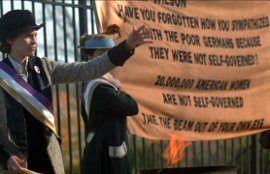
I watched "Iron Jawed Angels" last night, the film about Alice Paul and the Women's Suffrage movement.

It is a poignant film, oddly relevant to the world I normally live in, the world of the Palestinian struggle for freedom from Israeli occupation, and the ambivalence of Arab and Muslim countries to the U.S. wars in Iraq and Afghanistan, and talk about exporting freedom and democracy to the rest of the world.


To me, there were several powerful themes in this story:


How those in power resist change to the status quo, even if such change seems obviously in line with their values.


 How bringing about change takes massive and sustained effort and sacrifice on the part of those seeking it. It would have been much more “comfortable” for the suffragettes to simply accept and work within the status quo. To be willing to push the confrontation to the point of arrest and being sent to the work house, and pursuing a hunger strike, took incredible courage and commitment.


That those seeking to change injustice must act now and not wait. President Wilson kept telling the women to “be patient…”  We see the hypocrisy of those in power knowing that something is right, but maintaining somehow that “this is not yet the time” (made me think of the slave owner founders, who could see that one day slavery would be done away with, but “not yet”). There comes a time when you can’t “be patient,” if you believe in human dignity and rights.

White House protestThat significant change requires a disruption of the social order. It takes making people uncomfortable.

How easy it is for those in power to be duplicitous – the women were quoting President Wilson’s own words, which he was trumpeting to Americans and to the world, but refusing to apply to half of his own population.

How easy it is for the majority (in this case men, and many women), who have their rights or at least basic comforts, to sit back and do nothing on behalf of those who do not have those same rights.

How a government can participate in the hypocrisy of proclaiming values abroad (democracy, freedom, etc.) while denying them to people at home.

Hilary Swank as Alice PaulHow easy it is to abuse power – arresting the women for no good reason, finding them guilty under sham pretenses, sending them to the work house for 60 days (for “blocking traffic”!), mistreating them in the workhouse, psychiatric exam for undertaking a hunger strike (and the President’s men wanting to have Alice proclaimed crazy because of that), forced feeding, etc. And this was against law abiding, upstanding citizens, whose fault was that those in power hated what they were doing to try to bring about change.

So what does working for social change, for freedom and equality and basic rights, have to do with “peace”? I can imagine some (at least those in support of the status quo) arguing that this kind of movement disturbs the peace, works away from peace. The Hebrew word for peace, shalom, is a comprehensive word meaning completeness, wholeness, health, peace, welfare, safety, soundness, tranquility, prosperity, perfectness, fullness, rest, harmony, the absence of agitation or discord. I would argue, then, that although it might temporarily disturb the “peace” to work for rights and justice, the work (especially if done nonviolently, which the women’s suffrage movement was) is toward a greater peace; because as long as members of society, members of humanity, are deprived of basic rights and dignity, there is no true shalom, not for them, and not for the rest of us.